
Committee advances funding package for Broadway Polyclinic purchase amid neighborhood concern; proviso added requiring city-county implementation timeline
Get AI-powered insights, summaries, and transcripts
Subscribe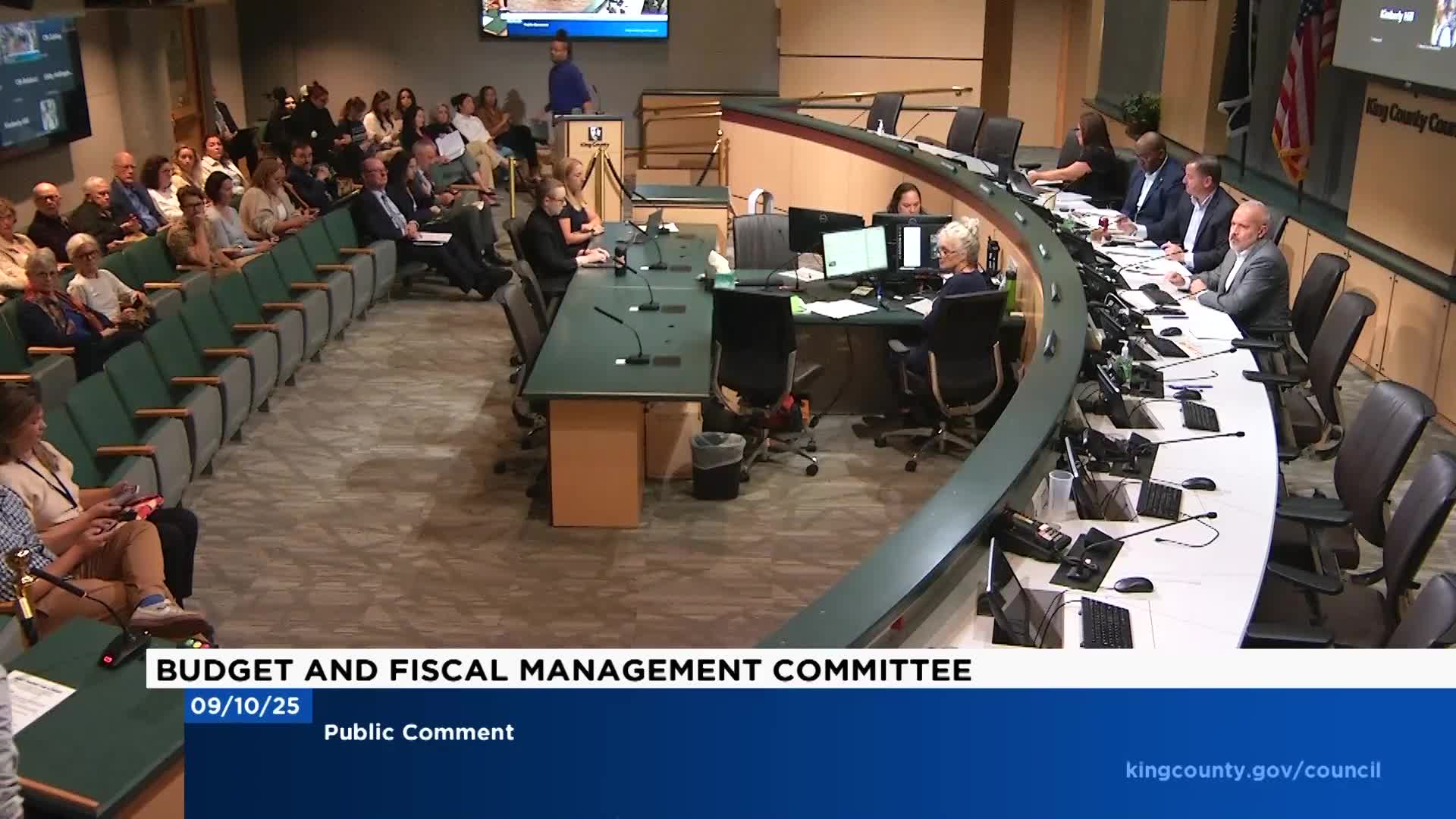
Summary
The King County Budget and Fiscal Management Committee on Sept. 10 advanced a package of ordinances to fund acquisition of 1145 Broadway — the former Polyclinic building — for a county crisis care center and a co-located residential treatment facility, and added a proviso requiring the executive to transmit a city-county implementation timeline and budget.
King County’s Budget and Fiscal Management Committee on Sept. 10 advanced three related ordinances to the full council, without recommendation, to finance a proposed county purchase of the former Polyclinic building at 1145 Broadway in Seattle for a crisis care center and a co-located residential treatment facility. Committee members voted unanimously on each piece of legislation after a multi-hour public comment period in which dozens of Capitol Hill residents, business owners and service providers alternately urged a pause for more outreach or urged the county to move forward quickly to provide crisis services.
What the committee advanced
- Ordinance 20250251: Establish a Broadway Facility Fund to collect revenues and allocate costs for the building (advanced without recommendation, vote 7-0). - Ordinance 20250250: A supplemental appropriation of $41,568,000 to acquire the building (advanced without recommendation, vote 7-0) — the package as transmitted includes a purchase price of $38,750,000 plus estimated closing costs and fees. The appropriation would be funded with $24,000,000 of crisis-care-levy proceeds for levy-eligible space and $17,500,000 in LTGO bonds backed by expected lease and parking revenues. - Ordinance 20250249: An amendment to the county’s LTGO bond ordinance to add $17,500,000 in bond authority for the acquisition (advanced without recommendation, vote 7-0).
A proviso added by amendment
Committee member Lisa Mosqueda offered an amendment, which the committee adopted after a brief floor discussion and two friendly edits. The amendment inserts a proviso requiring the executive to transmit, by Dec. 31, a plan for how King County will work with the City of Seattle and the selected operator to implement four mitigation steps requested by Mayor Bruce Harrell in his August 13 letter: (1) a crime-prevention assessment in partnership with the Seattle Police Department; (2) an operations plan to keep exterior and publicly accessible spaces safe and maintained; (3) a “good neighbor” agreement that provides reliable contacts and mechanisms for neighborhood response; and (4) a community outreach and education plan and a community advisory group. Committee members increased the amount withheld under the proviso from $1,000 to $100,000 during the meeting; the amendment as adopted requires the letter to include a timeline and a budget for the listed activities.
What county staff told the committee
Sam Porter, council policy staff, briefed members on the three ordinances and summarized the executive’s notification letter. Porter said the executive intends to use the 1145 Broadway property primarily for a crisis care center serving the central crisis response zone, to open a 16-bed residential treatment facility on the second floor, and to lease remaining space to other tenants, including Optum and a planned Harborview Bond Program presence. The building totals just over 114,000 rentable square feet, is zoned NC-3 (Neighborhood Commercial 3) and includes an approximately 321-stall parking garage.
Porter said the property was appraised at $41.3 million in February 2025. The appropriation request is $41,568,000 and includes the $38,750,000 purchase price plus closing costs. He described projected revenue assumptions for leases and parking, including approximately $8.3 million in estimated revenue in the 2026–27 biennium from anticipated private and county tenants and about $3 million in Harborview-bond revenue for 2026–27 as projected by the executive.
Operational and licensing points
County staff and agency directors said the crisis care center model includes 24/7 behavioral-urgent care, a 23-hour observation unit and a crisis-stabilization unit. Susan McLaughlin, director of the Behavioral Health and Recovery Division, said the operator for the central crisis response zone had not yet been selected and that the county expects to announce an operator this month; the design and final clinical layout will be informed by the operator. McLaughlin also said the levy-funded model emphasizes discharge planning and post-crisis follow-up teams to link clients to the next level of care and to provide transportation as needed. “We don’t anticipate that people will intentionally be discharged in the middle of the night,” McLaughlin said, describing typical discharge planning and the intention to align releases with daylight hours and available receiving services.
Zoning and permits
Staff noted there is no specific Seattle municipal-code use category called “crisis care center.” The executive’s transmittal letter said the closest category likely would be a hospital use, which is permitted outright in NC-3; the county would likely seek a Type I master-use permit to vest entitlements. Staff suggested the council could request a formal zoning interpretation from Seattle Department of Construction and Inspections before final permitting and said a formal zoning determination would follow the county’s permit application.
Public comment: concerns and support
More than 40 members of the public spoke in chambers or online. Supporters said Capitol Hill is near hospitals and transit and is appropriate for a high-access crisis center; several behavioral-health providers, labor representatives and advocacy organizations urged approval to expand capacity and reduce emergency-department strain. Representative Nicole Macri (40th Legislative District) said she supports moving forward now and added, “we do not have time to waste,” citing federal disinvestment and urgent local need.
Opponents and neighbors urged more outreach and asked for a 90-day pause. Speakers from Seattle Academy, nearby businesses, property owners and parents described proximity to multiple schools, day cares and a high density of restaurants and bars and said the site’s surrounding environment has high levels of street disorder. Several speakers said they had not been included in substantive outreach before the purchase and asked the county to pause and conduct additional engagement. Others said the proposed site lacked a calm, therapeutic setting and raised concerns about retail vacancies and neighborhood safety.
Timing and deadlines discussed in the meeting
Staff said the implementation plan required that the county notify the council and the city and that, per the transmitted notification letter, the council had until Sept. 13 to reject the purchase by motion; other staff statements during the briefing about contingency dates produced some confusion about calendar deadlines and bond-sale timing. Sam Porter told members the executive requested council action on the LTGO bond ordinance no later than Oct. 3 and that, to avoid a special meeting, council would need to take final action by Sept. 23. Executive staff and the committee agreed there remained follow-up work on financial timing and contingencies.
Votes and next steps
Each of the three ordinances was advanced to the full council without recommendation by unanimous committee votes (7-0). The supplemental appropriation (20250250) was advanced as amended with the Mosqueda proviso requiring a city-county-operational plan, timeline and budget and the $100,000 withholding. Committee members said the measure will appear on the council calendar; members also signaled intent to honor a one-week courtesy delay so that final council action would likely be considered on Oct. 7 rather than Sept. 23.
Why this matters
The Polyclinic purchase would be one of multiple crisis care centers planned under a county voter-approved levy to create regionally distributed crisis-care capacity and restore residential-treatment beds. The site is centrally located near hospitals and transit, which county staff say would improve access for patients and first responders; opponents say the location concentrates services in an already high-intensity neighborhood and that further engagement is needed to secure neighborhood buy-in and mitigation commitments.
Clarifying details
- Purchase price (PSA): $38,750,000; appropriation request: $41,568,000 (includes estimated closing costs). (Sam Porter) - Appraisal: $41,300,000 (Feb. 2025 appraisal). (Sam Porter) - Funding sources: $24,000,000 in crisis-care-levy proceeds (levy-eligible spaces); $17,500,000 in LTGO bonds expected to be repaid with lease and parking revenue. (staff) - Building: ~114,000 rentable sq. ft.; approximately 321 parking stalls. (staff) - Optum lease: approximately 28,404 sq. ft. of short- and long-term premises retained under amendment. (staff) - Harborview bond program: projected lease/parking revenue estimate of about $3,000,000 in the 2026–27 biennium if Harborview leases space. (staff) - Residential treatment facility: planned 16-bed mental health RTF on second floor; length of stay estimated generally from one month to up to a year. (staff)
Ending
Committee members emphasized the need to both move urgently to expand crisis-care capacity and to secure strong community mitigation and engagement commitments. The proviso adopted in committee requires a joint city-county timeline and budget for mitigation steps; members said they will monitor implementation funding and coordination as the purchase and the subsequent permitting and operator selection move forward.