
Regional Policy Committee backs sending 2-year MID renewal to full council amid audit concerns
Get AI-powered insights, summaries, and transcripts
Subscribe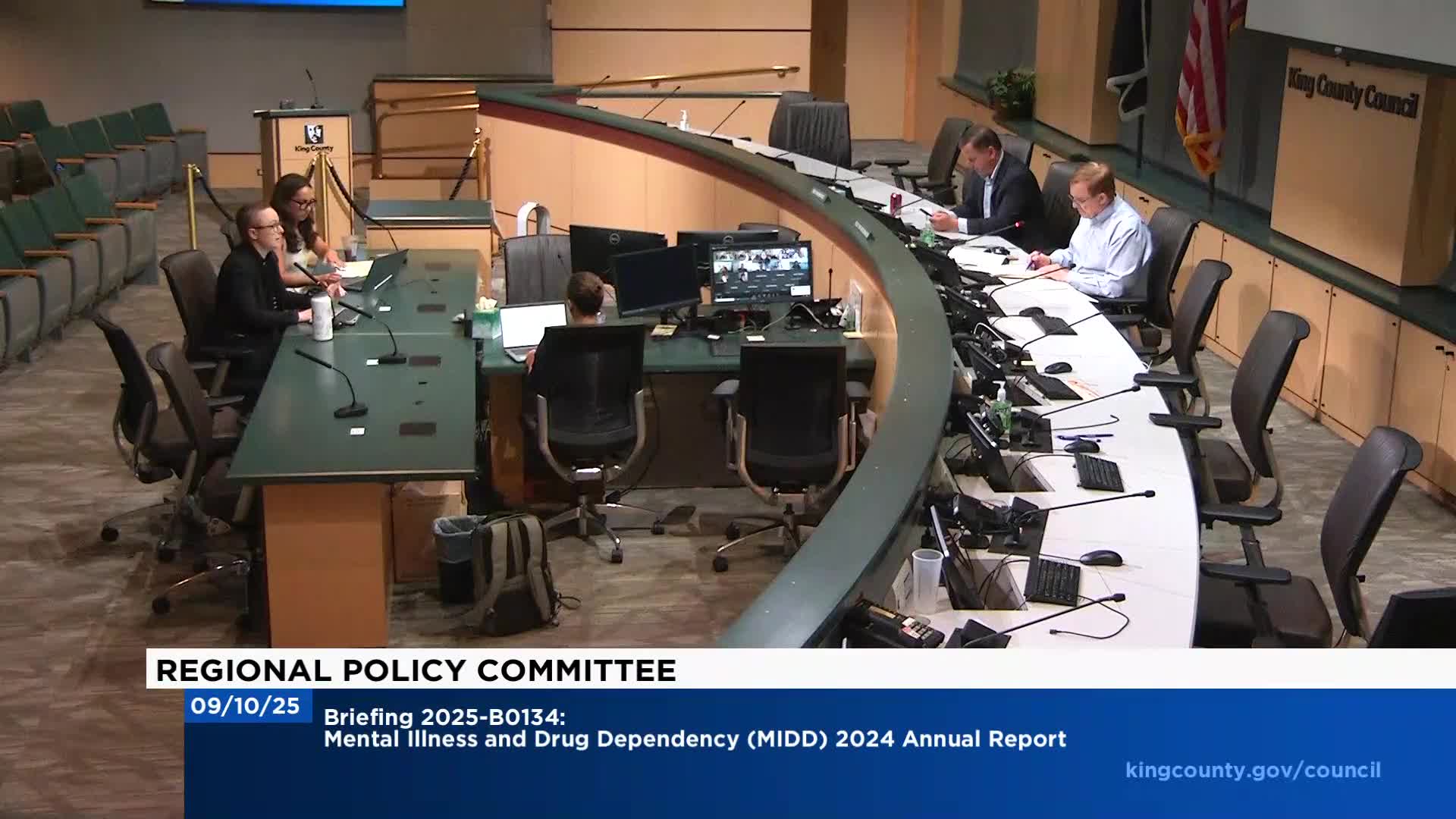
Summary
The Regional Policy Committee voted to send a proposed ordinance that would renew the Mental Illness and Drug Dependency (MID) sales tax for two years to the full King County Council, after committee members and several city mayors said short-term renewal would allow the implementation plan and additional accountability work to proceed in tandem.
The Regional Policy Committee voted to send a proposed ordinance that would renew the Mental Illness and Drug Dependency (MID) sales tax for two years to the full King County Council, after committee members and several city mayors said short-term renewal would allow the implementation plan and additional accountability work to proceed in tandem. Chair Von Reichbauer opened the item after staff briefed the committee on the 2024 MID annual report.
The MID briefing, presented by Sam Porter, Council Policy Staff, and by Department of Community and Human Services (DCHS) staff, summarized the 2024 annual report and linked it to Proposed Motion 20 20 five-two 37, which would accept that report. Robin Fomen, MID coordinator, told the committee the MID is a 0.1% sales tax that in 2024 supported 54 initiatives, served just over 28,000 people through 181 providers and community partners, and recorded total expenditures of approximately $113,600,000. “This is really a high level, summary presentation,” Fomen said, noting a data dashboard with initiative-level detail is available online.
The report highlights program-level outcome measures DCHS tracks: for MID initiatives with assessed outcomes across jail bookings, emergency department admissions, and inpatient psychiatric hospital admissions, long-term trends among participants showed reductions in use of those systems — psychiatric hospital admissions were down about 35% three years after initiating MID services, emergency department admissions were down about 25%, and jail bookings were down about 38%. Robin Fomen and Kelly Ryder, Director of the Department of Community and Human Services, also described investments in opioid response (including low-barrier buprenorphine access and naloxone distribution), children’s crisis outreach, and culturally centered community listening and grants. Ryder said the department produces a public data dashboard and that staff evaluate services using provider-submitted data.
Mayor Berney moved that the committee approve a proposed ordinance to renew the MID tax for two years and send that proposed ordinance directly to the full council for introduction. Mayor Berney said the two-year proposal would “sync up the funding” with a MID implementation plan currently under revision and would “line those things up” so that a revised implementation plan and the funding authority arrive before the council together. Mayor Bacchus and Deputy Mayor Arnold, among others, voiced support for the two-year option as a lever to increase accountability in response to recent audit findings.
Several councilmembers voiced reservations about a two-year renewal. Councilmember Dombowski, chair of the King County Budget Committee, said he shared concerns about accountability raised by the Sound Cities Association and the legislative auditor but opposed limiting funding to two years because it would reduce long-term stability for behavioral health services. Councilmember Solomon also urged that long-term certainty is important given federal funding uncertainty. Dombowski said he would work with colleagues on amendatory language to the nine-year ordinance that could add accountability provisions.
Kelly Ryder told the committee the executive branch plans to submit an updated implementation plan and that the executive intends to send an ordinance on September 23 to extend use of the current implementation plan until an update is adopted. “We will continue to have an implementation plan guiding this work,” Ryder said, if the council acts on the executive’s ordinance.
After discussion, the clerk called the roll. The committee vote was recorded during the meeting as five ayes and four noes; the committee chair directed staff to transmit the RPC-developed proposed two-year MID ordinance to the full County Council for introduction. The committee’s action does not itself adopt the tax; it moves a RPC-developed proposed ordinance to the council for introduction and further consideration under regular council procedures.
Why this matters: MID generates a significant local funding stream for behavioral health services; the 2024 report shows substantial county investment and measurable reductions in crisis system use among participants but also raises governance questions that the audit and several local leaders said require clearer, documented accountability and transparency around how MID funds are implemented. The two-year proposal is a procedural choice intended to align the implementation plan update with the funding renewal so the council and community can review both simultaneously.
Discussion versus decision: the committee’s action was procedural — it voted to send the RPC-developed two-year ordinance to the full council for introduction. Several members stated that they prefer a longer renewal for program stability and that accountability provisions could be added to a nine-year ordinance; others and some city mayors said a shorter renewal better aligns policy and implementation work now underway. DCHS said it will continue to operate under an implementation plan and will submit an updated plan next year.
Next steps: the proposed two-year ordinance will be introduced at the full County Council; the council will hold its own hearings and votes. DCHS and council staff pointed committee members to the MID data dashboard and the 2024 annual report for initiative-level performance details.
(Ending) The committee’s transmission of the two-year ordinance creates a council-level decision point; council members and the executive signaled they intend to continue collaborative work on accountability language and implementation planning before final council action.