
Edmonds planning board hears public concerns on critical areas ordinance update
Get AI-powered insights, summaries, and transcripts
Subscribe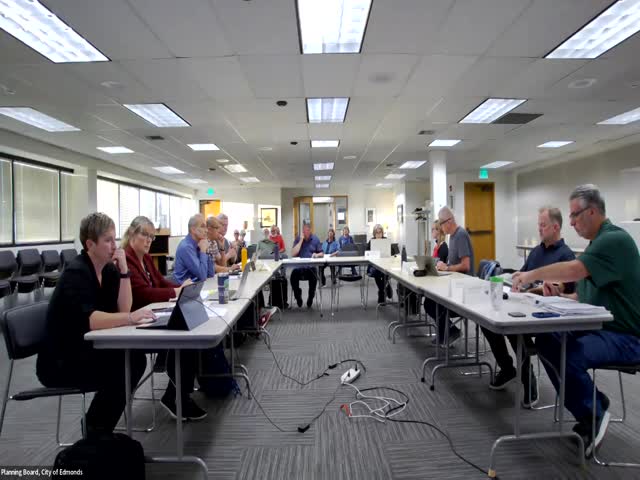
Summary
City staff presented an early draft of a major rewrite of Edmonds’ Critical Areas Ordinance; residents, environmental groups and the Olympic View Water and Sewer District urged clearer review procedures, stronger tree and slope protections, and explicit wellhead protections against stormwater infiltration and PFAS.
Edmonds planning staff opened a public hearing on revisions to the city’s Critical Areas Ordinance (CAO) and heard more than a dozen public commenters who urged clearer procedures, stronger tree and slope protections and explicit safeguards for drinking-water sources.
The proposed rewrite, presented by senior planner Brad Shipley, condenses and reorganizes existing code language and removes redundancies; Shipley told the board the draft in the meeting packet is a work-in-progress meant to show the city’s intended direction. "I think we're making a lot of progress," Shipley said, and he asked the public to focus comments on substantive concerns that should shape later drafts.
Why it matters: the CAO update guides how the city defines and protects wetlands, streams, geologic hazard areas, wellhead protection areas and riparian buffers. Changes to buffer definitions, allowed activities and review timing affect where and how development can proceed and who must pay for—and carry out—mitigation.
Public commenters representing environmental groups, experts and utility providers pressed staff on multiple topics. Arlene, a resident and commenter, praised reinstating a prohibition on tree removal from steep slopes, saying, "Reinstating a provision that the removal of trees from 25% or greater slopes is not allowed is extremely important for slope stability and public safety." She also said the draft’s hazard-tree language and the separate allowance for property-damage prevention did not cleanly match and recommended consulting certified arborists to align definitions and the level-2 ISA tree risk assessment referenced in the draft.
Laura Petsoff, speaking for Olympic View Water and Sewer District, told the board the district supports language in the draft that prohibits infiltration of untreated stormwater within wellhead protection areas. "This is a vital safeguard against PFAS and other pollutants, and we encourage the board to retain it," Petsoff said, noting the draft’s references to wellhead protection delineations and to periodic renewal of those delineations.
Several speakers with scientific or field experience pressed for explicit use of best available science (BAS) and for inclusion of local and Indigenous knowledge as part of BAS. Joe Scordino, a retired fishery biologist and long-time Edmonds resident, said local on‑the‑ground observations should inform protections for anadromous fish habitat: "Local knowledge, indigenous knowledge, is part of best available science," he said, urging stronger protections for salmon-bearing creeks.
Georgina Armstrong and Pam Power, representing citizen environmental groups, urged that the code explicitly incorporate climate-change‑resilient design and that the CAO adopt "no net loss of ecological value and function" language that reads over time; Armstrong specifically cited recommendations from the Washington Department of Fish and Wildlife (WDFW) and asked that WDFW suggestions from its letter of 08/26/2025 be incorporated. Several speakers also asked the city to clarify public-notice and critical-area determination steps so applicants and neighbors know what gets resolved before projects advance to design.
Several commenters asked that critical-area analyses and determinations be completed and publicly noticed before a development application moves into design review. Ron Eber, a retired land-use planner, said the draft contains the elements of an "upfront review" but that the provisions are scattered and should be consolidated so critical-area findings and opportunities for neighbor input happen before costly design work proceeds.
What staff said next: Shipley acknowledged the draft is iterative, said staff is collaborating with local environmental volunteers and said the city will restructure the code so repeated provisions are moved to common sections. He told the board a Department of Fish and Wildlife presentation on riparian management zones is scheduled for the planning‑board meeting on Sept. 24 and said the next draft will be more structured.
Discussion vs. decision: this meeting was a public hearing and listening session; no ordinance changes were adopted. Staff stated they will continue revising the draft and return to the board with additional edits and technical input.
Context and constraints: the draft includes multiple internally cited sections using the city code numbering (for example, the packet referenced sections shown as "23 42 0 3 0 a," "23.4 0.055," and "23.9.040"). Commenters asked staff to clarify how those citations map to review steps and to ensure definitions (for example, of "hazard tree" and the role of an ISA level‑2 assessment) are consistently applied across the code.
Next steps: staff will continue edits and public engagement; the planning board will receive a WDFW presentation on riparian management zones on Sept. 24 and may review a revised CAO draft in a later meeting.
Ending: testimony from utility, scientific and environmental residents emphasized clear process timelines, consistent technical definitions for hazard trees and buffers, and explicit protections for wellhead areas and salmon habitat. Board members asked staff to return with a reorganized draft that consolidates the upfront review steps and clarifies public‑notice points so applicants and neighbors can better understand development constraints before design work begins.