
Bellevue Planning Commission reviews HOMA land‑use rewrite as residents debate Newport Hills redevelopment and downtown incentives
Get AI-powered insights, summaries, and transcripts
Subscribe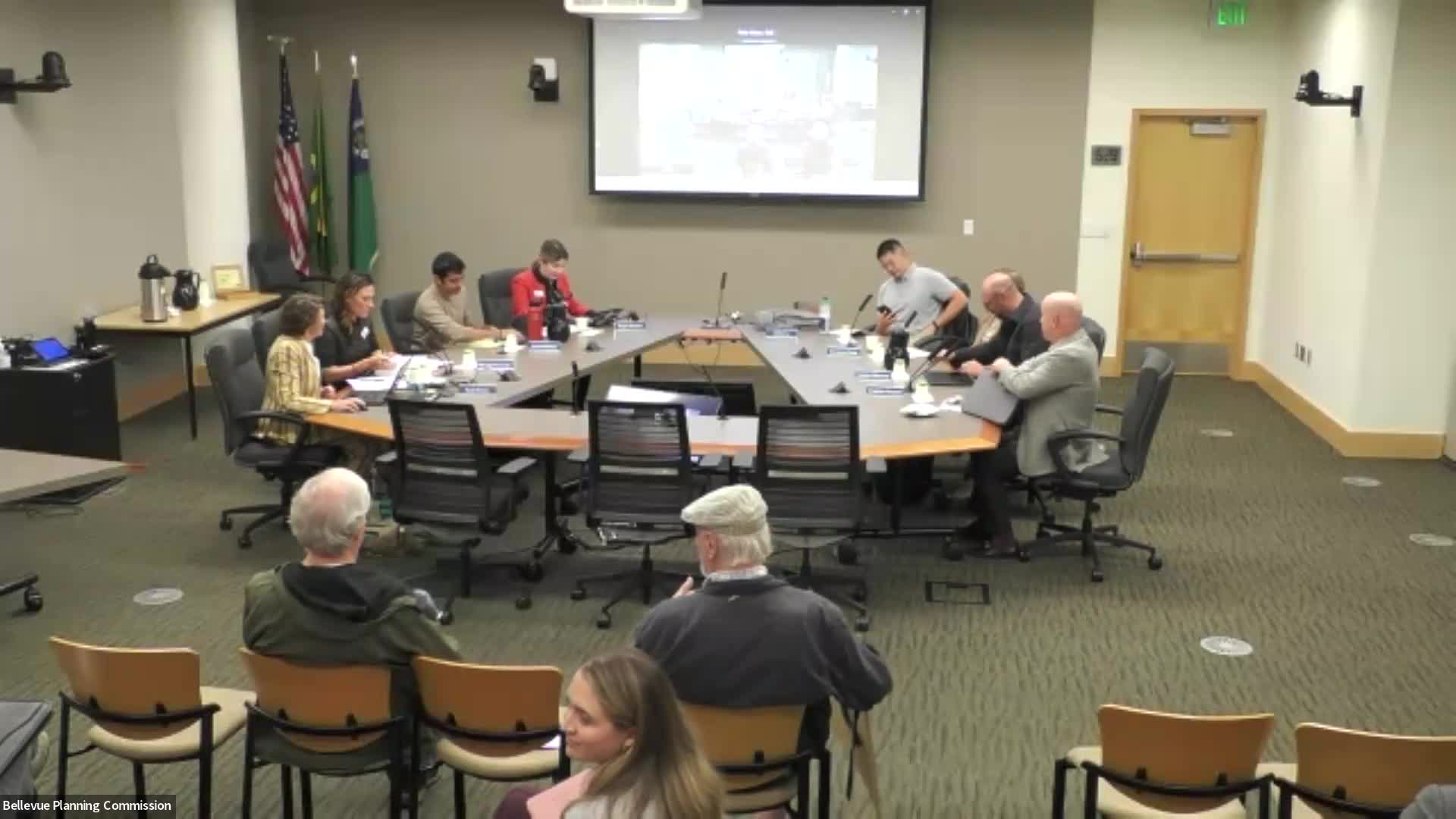
Summary
The Bellevue Planning Commission held a study session Sept. 10 to review the Housing Opportunities in Mixed Use Areas (HOMA) land‑use code amendment, aiming to align zoning with the new comprehensive plan and to add housing — including an affordable‑housing program — in neighborhood shopping centers and mixed‑use districts.
The Bellevue Planning Commission held a study session on Sept. 10 to review the Housing Opportunities in Mixed Use Areas land‑use code amendment, commonly called HOMA, and take public comment on proposed zoning changes that would allow more housing in neighborhood shopping centers and other mixed‑use areas.
The staff presentation, led by Christina Galitz, code and policy planning manager, and Matthew Menard, senior planner, framed HOMA as a citywide effort to align zoning with the new comprehensive plan and to expand both market and affordable housing in mixed‑use districts. "HOMA... is a land use code amendment that is aimed at encouraging more housing and affordable housing in our mixed use areas of the city," Menard told commissioners during the presentation.
Why it matters: HOMA would change form standards across several zoning districts — for example replacing dwelling‑units‑per‑acre limits with floor‑area‑ratio (FAR) limits, raising allowable heights in many neighborhood centers, and adding a new affordable‑housing program with two options: a mandatory requirement (Option A) and a voluntary incentive program (Option B). Staff said the mandatory option would require 10% of units in developments over 10 units to be affordable at 80% area median income (AMI) and would allow an FAR bonus where each square foot of affordable housing exempts four square feet of market housing. Staff also described a fee‑in‑lieu alternative set at $13 per buildable square foot in higher‑density districts and $10 in lower‑density districts.
Public testimony and local focus: More than a dozen residents and stakeholders spoke. Supporters of redevelopment in South Bellevue, including several members of the Newport Community Coalition and local property representatives, urged the commission to adopt standards that would allow mixed‑use redevelopment at Newport Hills Shopping Center. "My name is Deborah Deutsch and I'm a longtime resident of Newport Hills. I am here tonight to express my strong support of a redeveloped Newport Hills shopping center," Deutsch said.
Other residents and neighborhood representatives urged caution on height and retail requirements. Leslie Geller, an Eastgate resident, said she objected to reclassifying Eastgate Plaza as Neighborhood Mixed Use: "I do wanna vocalize my concern about Eastgate Plaza area being changed to neighborhood mixed use or NMU." Several commenters, including Jody Alberts of the Bellevue Chamber's Plush Committee and land‑use counsel Rachel Mazur, supported HOMA's objectives but recommended changes to affordability calibration, parking and impervious‑surface rules so the code does not make projects financially infeasible. As Alberts summarized: "We share the city's goals, but as written HOMA could inadvertently discourage the housing production it's meant to promote."
Affordable‑housing debate: Testimony divided roughly between advocates for a mandatory affordability requirement and developers and property owners who favored incentives and greater flexibility. Brady Nordstrom, associate director of government relations and policy at Housing Development Consortium, representing the Eastside Affordable Housing Coalition, urged support for a mandatory program and said staff analysis and regional precedents supported the proposed calibration: "We support HOMA as the realization of the Bellevue comp plan vision." Developers and downtown stakeholders urged that incentives, simplification of the downtown code and clearer pathways to recoup costs be prioritized; developer Kevin Wallace argued for incentive‑based approaches and code simplification so projects are viable: "What I'm asking ... is things structured as incentives and the code more simple."
Downtown amenity incentive changes: Staff proposed a targeted change to the downtown amenity incentive system. Under the draft, 25% of the amenity points required to access additional FAR/height would be met by affordable housing (or the fee‑in‑lieu) rather than being required as open space. Staff said examples of recent projects showed the fee‑in‑lieu impact would be modest for projects that currently use the amenity system (on the order of about $150,000–$300,000 in the staff examples provided), though some downtown property owners objected to rule changes for projects already in the pipeline and asked about vesting and grandfathering.
Staff follow‑up and commission direction: Commissioners asked for more economic detail, the nexus study supporting the fee‑in‑lieu numbers, greater clarity on transition‑area setbacks adjacent to residential properties, and outreach documentation for downtown property owners. Staff told the commission the nexus study would be completed and provided prior to the next meeting. At the end of the session commissioners asked staff to schedule an additional study session before any public hearing so the commission could review the requested supplemental information and permit additional stakeholder outreach. Christina Galitz framed the immediate decision for commissioners as a direction to staff: "the direction we are seeking this evening is to provide feedback on the key components of LUCA and direct staff to prepare the proposed LUCA for public hearing at future meeting." Commissioners asked for more time to review calibration details and outreach results before setting a public hearing date.
Votes at a glance (procedural actions recorded during the meeting): The commission approved routine meeting items and scheduling adjustments. Recorded formal actions during the session included approval of the meeting agenda, extensions of the oral‑comment period earlier in the meeting, rescheduling the commission retreat and moving a commissioner training session to Sept. 24, approval of minutes from prior meetings, and adjournment. None of those votes changed the substance of HOMA; the commission did not adopt or reject the HOMA draft at this session.
What’s next: Staff will complete the nexus analysis for the mandatory affordability option, provide additional economic detail requested by commissioners, and continue outreach with downtown property owners and developer groups. The commission asked staff to return for another study session with the supplemental materials before setting a public hearing date for the full HOMA LUCA.