Get Full Government Meeting Transcripts, Videos, & Alerts Forever!
Get email alerts on the Education Monitoring topic
No spam. Unsubscribe anytime.
State monitor outlines academic plan, deadlines as Mount Vernon prepares for school reconfiguration
Summary
At a July 29 public hearing, state-appointed monitor Dr. Kimberly Young Wilkins reviewed Mount Vernon’s academic performance, described the monitor’s responsibilities and deadlines for an academic improvement plan, and took residents’ questions about school closures, class sizes, teacher support and credit recovery.
Dr. Kimberly Young Wilkins, the New York State monitor for the Mount Vernon City School District, told a July 29 public hearing that she was charged with overseeing academic and fiscal policies for the district and will develop an academic improvement plan with deadlines over the coming months.
The monitor said the draft academic improvement plan is due to the state by Nov. 1, anticipated for the local board by Dec. 1 and expected to be offered to the public by Jan. 1, and warned that once the Commissioner approves the plan its recommendations become binding on the district. "The public hearing we're conducting today is required by state law that establishes the position of the monitor," Wilkins said. "Once the plan is approved by the commissioner, the recommendations in the plan become binding upon the school district."
Wilkins reviewed statewide test results for the 2023–24 school year and said Mount Vernon "underperformed the state on key academic indicators" including 3–8 ELA and math proficiency, four-year graduation rates, Regents diploma attainment with advanced designation and elementary/middle chronic absenteeism. She noted that Mount Vernon’s high school chronic absenteeism rate was better than the state average and flagged a 14 percentage-point gap in 3–8 math proficiency as especially noteworthy. "Math instruction is typically happens mostly in a school," she said, and therefore can be a clearer indicator of school-based instructional effectiveness.
Wilkins described the monitor's authorities under the law: she will attend board meetings and participate in discussions but "is not entitled to vote on matters coming before the board of education, nor is my presence considered in determining the quorum." She said one of her first tasks will be to review and strengthen the district's conflict-of-interest policy and that, if the district fails to implement elements of the approved plan, she may issue a notice of violation to the board and commissioner, who will decide next steps.
Several residents asked specific questions during the public-comment portion about the district's summer reconfiguration, which Wilkins and district staff said will begin in the 2025–26 school year. One attendee asked how the district will place students after the announced closure of three schools; an unnamed speaker characterized the number as "over a thousand children" who will have to be placed. Wilkins said she is "monitoring this reconfiguration" and that ensuring students have school assignments and safe buildings for the start of the year is a top priority. She said the district is reviewing enrollment, teacher staffing, and school leadership and that the reconfiguration will require continuous monitoring through the school year.
Parents and other residents raised concerns about classroom overcrowding and teacher retention. Wilkins said the district aims to keep general education class sizes under 25 students, with a state pre-K mandate of 18. She also said staffing and retention issues will be addressed in tandem with fiscal review, and that she will call on additional fiscal experts as needed: "I'm not superwoman, but I am gonna be calling in for reinforcements that are really around the budget and the fiscal."
Questions about academic supports prompted discussion of professional development and curriculum. Wilkins said the monitor and district are discussing whether curriculum change is necessary but emphasized prioritizing professional development and improving instructional practice before adopting a new curriculum. She said recommended actions could include issuing an RFP for a math curriculum if the plan indicates that's needed.
High-school-specific questions included the course catalog and credit recovery. Wilkins noted the board must vote annually on the high school course catalog and said it should be available before budget season because course offerings have budgetary implications; she called ensuring timely access to the catalog a "low-hanging fruit" and an early win. On credit recovery, Wilkins and district staff emphasized ensuring courses remain NCAA-eligible for student athletes and support four-, five- and six-year graduation pathways.
Dr. Demario Strickland, superintendent and moderator for the hearing, and Dr. Jamal Doggett, assistant superintendent for curriculum and instruction, joined Wilkins in answering questions. Community member Kathy Brewington urged partnership and support from residents: "We're here to help you. We're not here NAACP all the way," she said, adding that community members want forward motion and are available to push for improvement.
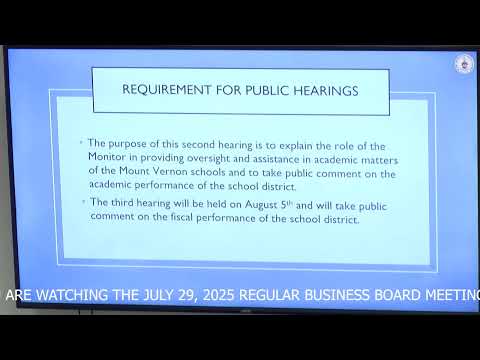
Wilkins said she was appointed by Commissioner Betty Rosa on July 1 and that the law requires the monitor to hold public hearings within 60 days of appointment; this July 29 session was the second of three required hearings. The third hearing on the district's fiscal status was announced for Aug. 5 at 5:30 p.m. at the Board of Education. Wilkins said she expects to review proposed budgets beginning with the 2026–27 school year to evaluate alignment with the academic and financial plans.
The monitor and district officials told residents they will visit schools, solicit input from PTAs and community groups, and convene a strategic planning process; Wilkins said some recommendations will be quick actions achievable in 2025–26 with deeper work scheduled for 2026–27 and beyond. She also said if disagreements arise between the board and the monitor about the plan, the Commissioner will make the final determination.
No formal votes or board actions occurred during the hearing; the session functioned as the statutorily required public comment and explanation of monitor responsibilities.