
Tomball ISD CFO outlines 2025 tax-rate plan and says November homestead-exemption vote drives calculations
Get AI-powered insights, summaries, and transcripts
Subscribe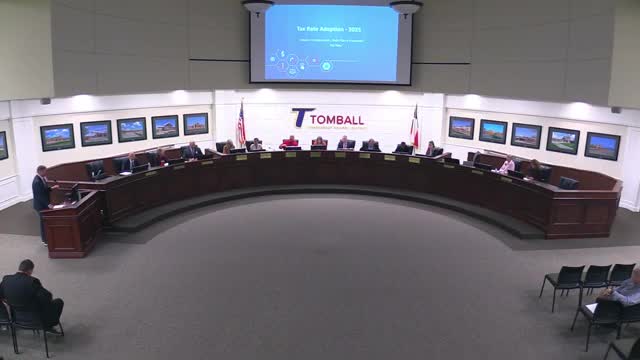
Summary
At a Sept. 8 workshop, Tomball ISD Chief Financial Officer Zach Bowles explained the district will present a proposed 2025 property tax rate of $1.0629 for adoption Sept. 9 and said the district’s calculations assume voters will approve an increase to the homestead exemption in November.
TOMBALL, Texas — At a Sept. 8 workshop, Tomball Independent School District Chief Financial Officer Zach Bowles presented the district’s proposed 2025 property tax rate of $1.0629 per $100 of appraised value and explained why the district’s calculations assume a November ballot measure will increase the homestead exemption.
Bowles told the Board of Trustees the $1.0629 rate comprises a maintenance-and-operations (M&O) rate of $0.6669 and an interest-and-sinking (I&S) rate of $0.396. He said the district will present the formal tax-rate resolution for adoption at the regular board meeting on Sept. 9.
Why it matters: Bowles said the district’s tax-rate math depends on how the Texas Education Agency calculates the maximum compressed rate (MCR) and on whether voters approve a proposed increase in the state homestead exemption. Bowles said the district is preparing tax notices for October and that, if the homestead-exemption measure fails in November, the district would have to recalculate bills and issue amended tax statements.
Bowles described the state’s role in setting the MCR. He said the Texas Education Agency this year set a statewide compressed rate of 63.22 cents and applies a 90% floor so no district’s MCR falls below 56.89 cents. Using TEA’s calculation method and the expected $140,000 homestead exemption, Bowles said Tomball ISD’s local growth measures at about 1.6 percent and the district’s MCR remains effectively unchanged from 2024.
On the I&S side, Bowles said the district needs roughly 39.6 cents to cover debt-service obligations from bonds voters approved previously. He described a “hold harmless” provision for debt issued before September 2025 that contributes to funding those obligations.
Bowles showed how the larger homestead exemption affects the district’s tax base: moving from a $100,000 to a $140,000 exemption reduces taxable values by about $1.4 billion, he said. Using the district’s average taxable-value assumptions, Bowles presented an example in which an average homeowner would see roughly a $426 reduction — about 12.7 percent — compared with a $100,000 exemption, though he cautioned that individual bills will vary with each property’s appraised value.
He also explained the “tier 2” enrichment pennies: the state allows districts to collect the first five pennies of enrichment without voter approval; accessing additional pennies requires voter approval. Bowles said that reducing the five pennies to avoid required public-notice language would cost the district locally about $1.8 million per penny (roughly $9.8 million for five pennies) and would also reduce state funding by an amount he estimated at about $4 million.
Bowles reviewed the state-required “no-new-revenue” calculation from the Comptroller’s tax-rate worksheet used during adoption and explained that because the district’s proposed levy exceeds that computed figure, state law requires the board to announce specific language when it makes its motion. Bowles suggested the board include clarifying language stating that the resolution adopts the tax rate “with no increase to the tax rate” from 2024, to avoid confusion between the required statutory wording and the district’s intent.
Board members asked about timing and wording of tax statements and about the practical effect on taxpayers. Bowles said the district plans to mail tax statements by Oct. 1 as in prior years and that most collections occur from November through January. He also said staff will prepare supplemental analyses tomorrow to refine the average-taxpayer impact using certified values.
No formal vote occurred at the workshop. The board is scheduled to consider and may adopt the tax rate at its Sept. 9 regular meeting. Bowles told trustees he and staff will include the clarifying resolution language he recommended when the board considers the rate.