Get Full Government Meeting Transcripts, Videos, & Alerts Forever!
Get email alerts on the Public Health topic
No spam. Unsubscribe anytime.
Beaufort County reports opioid-settlement-funded peer support wins and extends spending plan through 2026
Summary
County staff reported program outcomes from opioid settlement spending — peer support specialists, school-based education, syringe services and recovery court expansion — and commissioners approved extending remaining settlement spending through Sept. 30, 2026.
Beaufort County presented an update on programs paid for with opioid-settlement funds and the county extended the remaining spending allocation to Sept. 30, 2026.
Tiffany Moore, who presented the update to the Board of Commissioners, said the county’s peer support program now employs two peer specialists funded by the settlement and reported multiple participant outcomes: 88% of participants were connected to treatment or detox services through the peer program, 55% showed longer-term stability (employment, housing or continued treatment), and 70% stayed engaged in treatment or in recovery court.
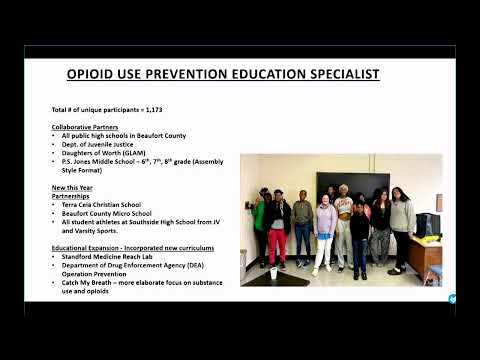
Moore highlighted prevention and outreach work: the county’s opioid prevention educator reached more than 1,100 students last year, delivered Narcan training to 70% of her participants, and expanded curricula using materials from Stanford Medicine and DEA Operation Prevention. She said youth access points included social media channels and unsecured prescriptions in home medicine cabinets, and she urged parental use of lock boxes.
The county-funded pilots described by Moore included a south-side outreach project serving Aurora and nearby communities (Mays Outreach Center), a district recovery court that increased enrollment from 12 to 19 participants with three graduations to date, the Prevention Point syringe services program (265 encounters and 32 new participants), and Daughters of Work, which served survivors with substance use disorder and trafficking backgrounds. Moore said 18 survivors were served in the past year, including referrals to detox, MAT and residential treatment.
Commissioners approved a motion to extend the remaining settlement spending of $365,963 through Sept. 30, 2026, to allow the county to finalize a strategic planning update required under the settlement and to consider shifting pathways (option A vs. B) for future distributions. Moore told the board she would convene required annual meetings and provide more community engagement before a September 2026 decision on a new multi‑year strategy.
Why this matters: The update documented measurable short-term outcomes for settlement-funded programs (treatment connections, treatment retention and education reach) and committed the county to a publicly required annual meeting and a strategic planning re-evaluation in 2026 before choosing a new option for distribution of remaining funds.
What happens next: Staff will return to the board with additional details as the county prepares the required strategic-planning meeting and the September 2026 option-B report and recommendation.