Get Full Government Meeting Transcripts, Videos, & Alerts Forever!
Get email alerts on the Recovery Court topic
No spam. Unsubscribe anytime.
Haywood County proclaims May 2025 National Treatment Court Month; recovery court leaders report program growth
Summary
The Haywood County Board of Commissioners unanimously approved a proclamation recognizing May 2025 as National Treatment Court Month. County recovery court staff said the local program, launched in 2023, is at capacity with 15 participants and two graduates, with more expected to finish soon.
Haywood County commissioners on May 5 unanimously approved a proclamation declaring May 2025 National Treatment Court Month and heard an update saying the county’s recovery court program has reached capacity.
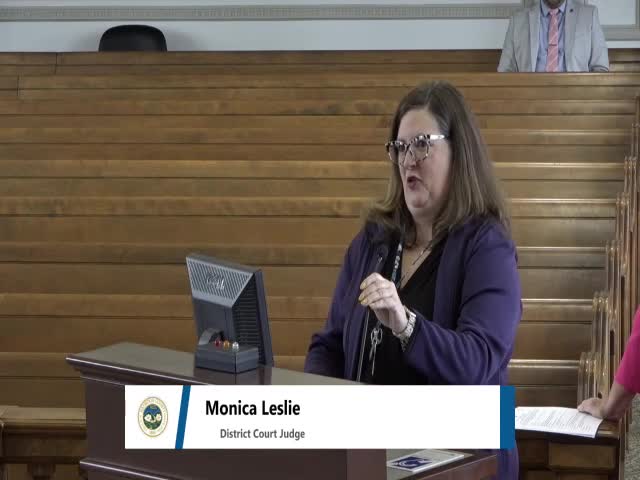
The proclamation, read to the board by a judge, says treatment courts “combine accountability with evidence based treatment” and noted that “when 1 person rises, we all rise,” language used in the reading of the proclamation.
The county’s Adult Accountability and Recovery Court began in 2023 and “we are now at our current capacity with 15 participants,” Amanda, the program coordinator, said during the meeting. She told commissioners the program has produced two graduates so far and has two more expected to graduate in June. “Currently, all of our participants are housed and in treatment,” Amanda said.
Commissioners asked where participants receive treatment; Amanda said most go to Meridian and some to Behavioral Health Group (BHG) in Clyde, and that the program also uses inpatient treatment providers in Buncombe County. She described program length as “if you did it day for day, 15 months,” noting some recent graduations took about 18 months and that probation terms are set up to two years to allow time for treatment and stabilization.
The board voted to approve the proclamation without objection. The presenters thanked commissioners for support and highlighted the program’s emphasis on housing and treatment for participants.
Formal action: a motion to approve the proclamation passed by unanimous voice vote.
Looking ahead, commissioners did not take budget or policy action on the recovery court during the meeting; staff noted the General Assembly provided temporary funding for recovery courts in prior legislation but that county funding commitments will continue per the state’s direction.