Get Full Government Meeting Transcripts, Videos, & Alerts Forever!
Get email alerts on the Collection System Pinches topic
No spam. Unsubscribe anytime.
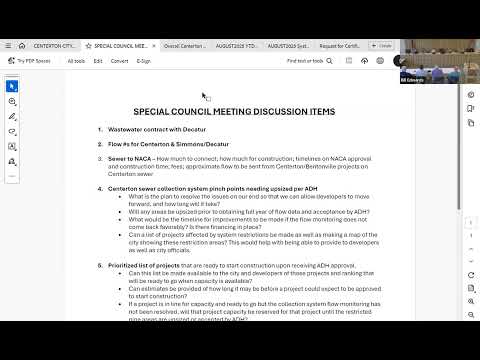
Centerton engineers map downtown 'pinch points'; developers say approvals stalled
Summary
Engineers described a proposed 36-inch downtown sewer main and other upgrades intended to remove collection-system pinch points that have kept multiple Centerton developments waiting for ADH approvals; developers and commissioners urged a consolidated list of constrained locations and timelines.
Centerton city and Water and Sewer Commission officials described a set of collection-system "pinch points" they say must be addressed before many queued developments can proceed and described a near-term downtown collection upgrade engineers estimate at $7—29 million to $9 million. In a presentation, engineering firm ESI said the proposed downtown project would run from the Allen Road lift station to the area near the former Centerton Cafe and would be largely inside existing easements. Tim Hayes of ESI said the full version of the plan with a 36-inch trunk main is roughly $9 million; a slightly smaller 24-inch alignment tied to a partial flow split to NACA had a preliminary estimate around $7 million. Why it matters: The Arkansas Department of Health (ADH) is reviewing capacity and design. Developers and engineers at the meeting said ADH will not release approvals for projects downstream of identified pinch points until the commission submits and ADH accepts plans and implementation schedules, which delays projects already in the city's queue. Developers in the meeting asked how many projects would remain blocked after Decatur completes its headworks expansion. Officials said Decatur's planned upgrade (an increase to about 5.25 million gallons per day, by Decatur's statement) will address overall treatment capacity but will not fix local collection constrictions inside Centerton. The commission said some projects that already have ADH approvals could build immediately; many others remain on hold pending both mainline upgrades and ADH acceptance of designs. Commission and private engineers described past flow-monitoring work. The utility contracted a firm (TREC) for about nine months of monitoring, but ADH did not accept that record as sufficient and later set new guidelines requiring 12 months of monitoring that include an appropriate storm event. The commission has contracted a second firm, RJN, to complete the additional monitoring and to produce a hydraulic model of the sewer system. Developers asked for a transparent list of known pinch points and their status. Multiple private engineers said they already had local mapping and flow data for particular areas; participants urged the city and commission to consolidate private-sector data to avoid duplicative expense and to create a single, public-facing priority list so developers can see where they stand in the queue. Decision vs. discussion: The commission presented draft plans and cost ranges, and no construction contract or financing was approved that night. The commission said the next steps are to finalize plans, submit to ADH and complete the RJN monitoring/modeling to support ADH acceptance. Ending: Officials said they would publish or otherwise share a prioritized list of projects and the status of pinch-point work and urged developers to submit existing data to help accelerate hydraulic modeling.