Get Full Government Meeting Transcripts, Videos, & Alerts Forever!
Get email alerts on the Alternative Response Unit topic
No spam. Unsubscribe anytime.
Farmington council accepts county contribution for alternate response unit, staff detail program operations
Summary
Council approved consent items that include a $450,000 San Juan County contribution toward the city's Alternative Response Unit (ARU) and a third amendment to the joint sobering and behavioral health intergovernmental agreement; staff described staffing, transport rules and usage statistics for the ARU.
Farmington city council approved consent-agenda items that formalize a county contribution toward the city's Alternative Response Unit and a third amendment to the intergovernmental agreement for the joint sobering and behavioral health program. City staff told the council the ARU primarily transports people to the Totah sobering center and that partners contributed $450,000 toward about $560,000 in annual operating costs.
The ARU, a two-person unit staffed by an EMT and a driver, operates under a limited-scope transport policy, city staff said. "With our current staffing model, they're operated by a full, EMT and a driver," the Deputy Chief said. The deputy chief added that ARU crews are trained to render immediate aid and to call for additional emergency medical services if a person needs hospital care.
Why it matters: the ARU is intended to reduce use of full fire or police responses for people impaired in public and to provide a dedicated transport option to the sobering center instead of the emergency department. City staff described the program as a long-running pilot that officials now treat as an essential service and said the county contribution recognizes its regional value.
Staff provided operational and data details at the meeting. The deputy chief said ARU units currently operate from about 1 p.m. to 1 a.m. under the city's current staffing; with full staffing, they could run roughly 9:30 a.m. to 2:30 a.m. The sobering center on the Totah campus is open 24 hours; an "expanded shelter" on the same campus maintains separate hours. "They're not able to [transport to a hospital]. It's only to the sobering center," the deputy chief said. He also described the blood-alcohol thresholds employees use on sobering-center transports: on-schedule transports generally require a minimum measurable BAC and ARU staff said they do not transport people they judge to need hospital care; staff said a BAC over about 0.45 would require an EMS transport.
Usage and outcomes: staff reported that since August 2019 the ARU has physically transported 20,452 individuals to sobering services. In busy winter months, Totah campus transports can run "anywhere from, you know, 350 to 400 individuals a month," the deputy chief said. Staff said about 97 percent of people picked up by the ARU are taken to the appropriate facility and that less than 3 percent are transferred to the emergency department. As of the day before the meeting, staff reported 2,432 transports in the current calendar year.
Staffing and retention: city staff said ARU positions have been difficult to fully staff in the last 18 to 20 months and described the job as demanding; some ARU employees have three to four years tenure. The county contribution is intended in part to support benefits and retention to restore fuller hours, staff said.
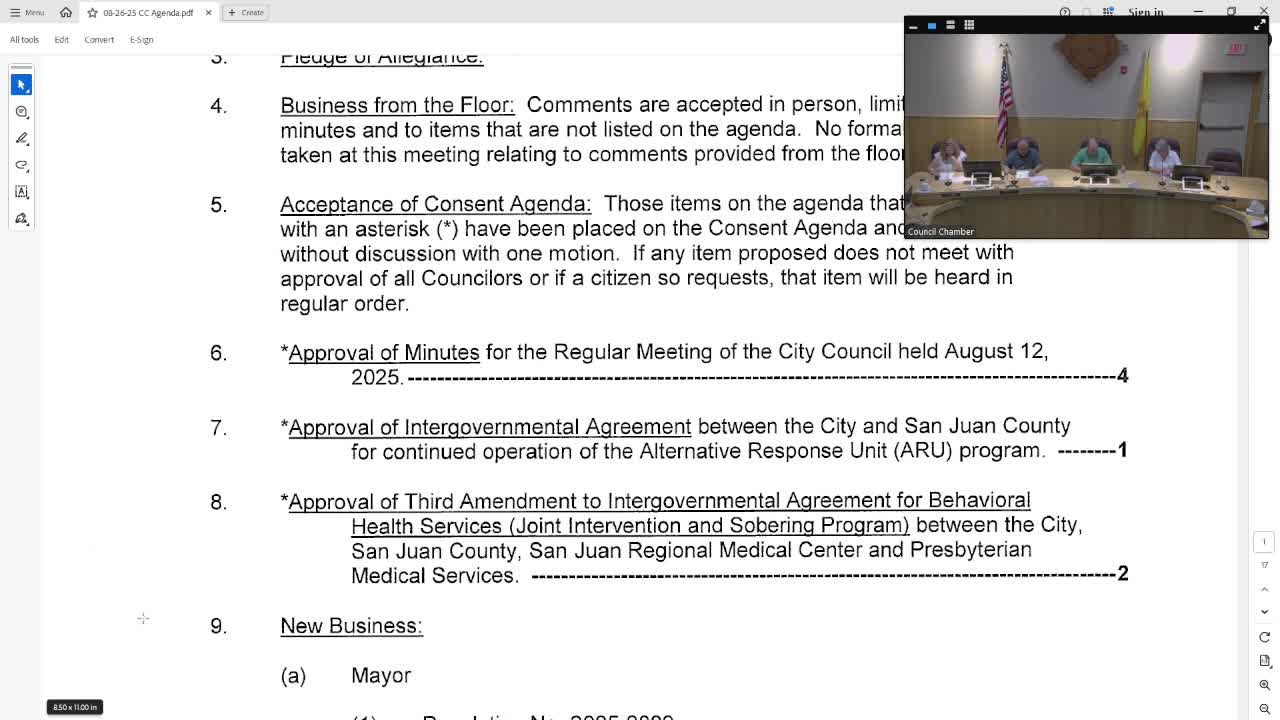
Council action and next steps: the intergovernmental agreement with San Juan County for continued operation of the ARU and the third amendment to the joint intervention and sobering program IGA with San Juan County, San Juan Regional Medical Center and Presbyterian Medical Services were placed on the consent agenda and approved with a single motion. The council did not take additional direction beyond accepting the agreements during the meeting.
Staff and councilors emphasized the partnership nature of the program and said other communities have expressed interest in the model, though implementations vary. The council did not vote on changing ARU hours or transport rules during the meeting; staff said those decisions depend on staffing and partner funding.