Get Full Government Meeting Transcripts, Videos, & Alerts Forever!
Get email alerts on the Budget Long Range Planning topic
No spam. Unsubscribe anytime.
Leander ISD confronts $16 million shortfall; board weighs tax, staffing and consolidation options
Summary
Facing a projected $16 million budget gap for 2026–27, the Leander ISD Board of Trustees and district leaders discussed a menu of responses including a temporary tax increase, staffing changes, school consolidations and revenue options at a Sept. workshop. No formal decisions were made.
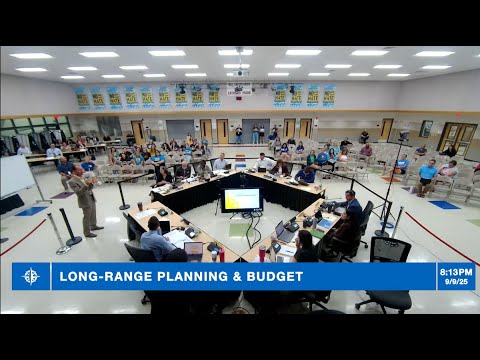
Leander Independent School District leaders told trustees Sept. 9 that the district faces a multi‑year budget shortfall and invited the board and public into a detailed workshop on options to close the gap.
The district’s estimate for 2026–27 stands at about a $16 million deficit under current assumptions; administrators and the chief financial officer emphasized the figure excludes any across‑the‑board pay increases. "Our purpose is our student experience and making sure that we maintain or improve that student experience over time," Superintendent Dr. Bruce Gearing said as he framed the tradeoffs.
Why it matters: the board must balance maintaining instructional programs and staff with shrinking enrollment in parts of the district and state funding uncertainty. District staff described three broad “paths” to address the shortfall: deeper consolidation (larger immediate savings but greater community disruption), a hybrid of modest consolidation plus staffing changes, and smaller operational adjustments that preserve community schools but yield little savings.
What the board reviewed - Tax option: Trustees heard how setting the maintenance & operations (M&O) tax rate three cents higher would generate roughly $6.8–7.5 million for 2026–27; because July flood disaster declarations cover parts of Travis and Williamson counties, the board could temporarily adopt the three “disaster pennies” without voter approval for one year while simultaneously placing a voter‑approval tax rate election (VATR) on the November ballot to make the increase permanent if voters approve. Chief Financial Officer Pete Poppe ran the revenue scenarios and noted property values and state compression change the exact yield. - Staffing and program changes: District staff said roughly 200–210 full‑time equivalents would need to be removed to realize savings on the order of magnitude of the shortfall if consolidated wholly through personnel reductions. Dr. Gearing and presenters warned that more than 86% of the operating budget is personnel‑related, and cutting FTEs will have real effects on programs and school day structure. - Consolidation: Staff described Path 1 (largest savings) as the most disruptive because it includes closing and consolidating campuses, while Path 3 (the hybrid) would mix limited consolidation and staffing guidelines. No school closures were proposed or approved at the workshop; the board called this discussion exploratory. - Other revenue levers: the district outlined open enrollment and targeted recruitment, facility rentals, possible leasing or sale of surplus land, attendance (ADA) improvement campaigns — each presented as partial mitigations rather than complete solutions.
District leaders emphasized uncertainty from state funding: a pending TEA review related to House Bill 2 carry‑forward/hold‑harmless calculations could change the district’s position but did not provide a firm timeline or amount. "We expect to have this answer in fall/winter," Poppe said of the state review, but cautioned the commissioner must work through the Legislative Budget Board and the governor.
Public input and next steps: District staff said they will return with more granular numbers and staff recommendations; trustees asked for a clearer process, timelines and community engagement plan before any formal actions. Dr. Gearing said staffing guideline work and scenario modeling will continue and that the board will be presented with refined options at upcoming meetings.
This workshop was discussion only; no motions or votes were taken. The board signaled it wants more data on likely savings, service impacts and the sequence of decisions before committing to any path.
Ending: Trustees set follow‑up meetings and asked staff to return with refined financial scenarios, staffing‑guideline proposals and an explanation of tax‑rate options for board consideration in coming weeks.