Wallingford board hears $390M–$426M estimates for single high school vs. renovate-as-new options
Loading...
Summary
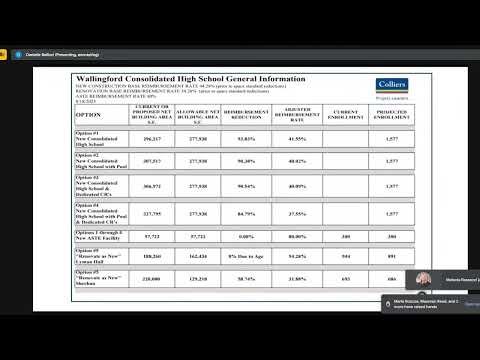
At a special meeting Aug. 18, Wallingford school officials and Colliers consultants presented estimated budgets and state reimbursement scenarios for a proposed consolidated high school and ASTE facility and for renovate-as-new options for Lyman Hall and Sheehan.
Wallingford Board of Education members received detailed budget estimates and state-reimbursement scenarios Aug. 18 as consultants outlined five options for high-school facilities, including a single consolidated high school with an ASTE (Applied Science, Technology and Engineering) facility and renovate-as-new options for Lyman Hall and Sheehan.
The presentation, led by Superintendent Belize with consultants Scott Pellman and Chuck Morrington of Colliers, laid out projected enrollment (a 10-year projection of 1,577 students), base reimbursement rates and high-level estimated probable budgets for each option. “We have assumed renovation status meaning everything that's a repair or replacement in Lyman Hall and Sheehan would be repaired and replaced,” Scott Pellman said, adding that achieving state “renovation status” is conditional on proving renovation is cheaper than building new.
Why it matters: the options produce materially different town shares and state shares, and the board must weigh design choices (pool, dedicated classrooms, ASTE facility) that affect both building size and adjusted reimbursement rates. The town’s estimated share for options presented ranges from about $209 million to $254 million depending on the scenario and eligible state reimbursement; the total probable project estimates presented range from roughly $390 million (Option 3) to $426 million (Option 5).
Most important facts first: the consultants gave five scenarios. Option 1 (new consolidated high school with ASTE, without pool or dedicated classrooms) and Option 3 (new high school with the 17 dedicated classrooms but no pool) were presented as comparisons of how programming choices change size, adjusted reimbursement rate and net town share. Option 2 and Option 4 include the pool; Option 4 includes both the pool and the 17 dedicated classrooms and had a presented estimated probable budget near $411 million with an estimated town share of about $242 million and estimated state share of about $169 million. The renovate-as-new scenario (Option 5) listed separate estimates for Lyman Hall (~$198 million) and Sheehan (~$227 million) for a combined $426 million estimated probable budget and an estimated town share of roughly $254 million with an estimated state share of about $171 million.
Consultants and board members clarified state reimbursement mechanics. Pellman said the base reimbursement rate shown for new construction for Wallingford was 44.28% (prior to space‑standard adjustments), renovation‑as‑new baseline was shown as 54.28% (prior to space changes), and ASTE facilities were modeled at an 80% reimbursement rate. Pellman also said the project team has previously succeeded, in one case, in obtaining an additional 10 percentage points for reimbursement when the state verified that consolidation produced community savings.
Board members pressed several implementation issues: acreage, site selection, and escalation in construction costs. Board members were told the state guidance for high school sites is approximately 25 acres plus 1 acre per 100 students and that a practical minimum threshold for this project would be about 42 usable, developable acres. Consultants said their estimates include a year‑over‑year construction escalation assumption of 4.5% compounded to midpoint of construction and that site costs (including artificial turf) were included in the high‑level site cost allowances.
On renovation status, Pellman explained the state may accept renovation-as-new reimbursement only if the district proves renovation is less expensive than new construction; if the state denies renovation status, many repair/replacement items could be ineligible for reimbursement. “You have to prove to the state that it's actually cheaper to renovate than to build new,” Pellman said. He added that the estimating package submitted to the state typically includes an architect-signed estimating form attesting to the cost comparison.
Board members debated scope and taxpayer burden. Several members urged fiscal caution, saying added features such as 17 dedicated classrooms and a pool materially increase town costs. Others argued the board should plan for a long‑lived facility and meet teacher and student programmatic needs; one board member noted that some program requests (dedicated classrooms) came from staff and teachers and urged the board not to “cut corners” given decades of deferred maintenance.
What was decided and next steps: the meeting was informational. No binding vote on a construction option or site was taken at this session. Superintendent Belize said the presentation materials will be posted in the board’s backup. Board members and consultants noted that final state grant applications and any claim to renovation status would occur after the district chooses a project to file and assembles the documentation the state requires.
Less-critical details/forward look: the consultants said they will begin work on ASTE ed specs with SLAM in September. The presentation excluded bonding costs and any demolition or reuse assumptions for existing buildings in Options 1–4; Option 5 (renovate-as-new) included demolition and full renovation work. Board members repeatedly emphasized that site selection (whether the district can secure ~42 usable acres) will materially affect feasibility of the consolidated option and said town council decisions about town‑owned buildings (e.g., reuse of vacated facilities) are subject to the council’s authority.