Lifetime Citizen Portal Access — AI Briefings, Alerts & Unlimited Follows
Sayreville planning board adopts fourth‑round housing plan, reduces realistic development obligation to 76 units
Loading...
Summary
The Sayreville Planning Board voted to adopt its fourth‑round housing plan and fair share plan prepared by Acuity Consulting Services, recording a realistic development potential of 76 affordable units after a vacant‑land adjustment and settling a state construction obligation at 240 units.
The Sayreville Planning Board on Wednesday voted to adopt its fourth‑round housing plan element and fair share plan, a document prepared by Acuity Consulting Services that sets the borough’s affordable housing obligations and identifies sites and ordinance changes to meet them.
The plan records a settled municipal obligation of 240 new construction units for the fourth round, but a vacant‑land adjustment and site screening produced a realistic development potential (RDP) of 76 affordable units that the borough would need to plan for site‑specifically. The board adopted the plan by roll call vote and will file the adoption with the court within 48 hours, a step required by state process before the borough council endorses the plan.
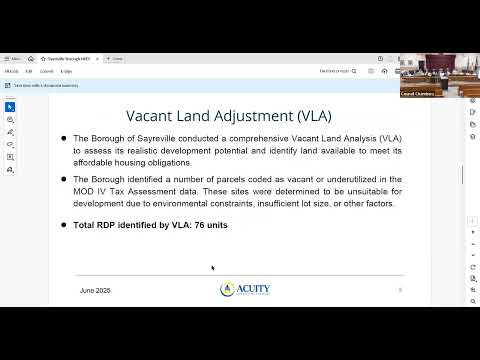
Peter, a planner with Acuity Consulting Services, told the board the firm began with the state’s assigned new‑construction obligation of 270 units, proposed a competing estimate of 210 and ultimately settled at 240 after negotiation. He said the borough’s vacant‑land screening eliminated parcels that did not meet criteria such as a minimum parcel size and environmental constraints, producing the RDP of 76 units. “We were able to demonstrate that there’s only enough property that’s vacant and that meets all these criteria for 76 affordable housing units,” he said.
Under the plan the remaining 164 units are classified as unmet need. The consultant said those units can be addressed through general ordinances and zoning tools rather than site‑specific designations — for example, a municipality‑wide set‑aside that would require a 20% affordable set‑aside on developments of five or more units, or creation of overlay zones on targeted commercial parcels.
The plan identifies a set of sites that could yield the RDP, including commercial properties near Ernston Road and the Route 9/Raritan Road Park‑and‑Ride, and a larger property referred to as the Mako site near Kennedy Park. For the RDP the consultant estimated 57 units from identified sites plus 19 bonus credits (which would be credited once projects are constructed) for a total of 76 units. The plan also includes one small special‑needs project credited by bedroom; the consultant noted special‑needs projects can generate multiple credits per dwelling because credits are applied per bedroom.
Board members also reviewed the borough’s prior‑ and third‑round compliance. The presentation notes a prior‑round obligation of 261 units with 65 age‑restricted units credited at Lakeview at Sayreville (subject to a 25% cap on age‑restricted credits) and a third‑round obligation of 785 units for which the plan documents about 792 credited units, producing a modest surplus.
Councilman Zabrowski praised the submitted plan after the vote, calling it “creative, but definitely attainable,” and noted the plan spreads obligation across mixed uses and includes special‑needs housing as a priority. The board opened the hearing for public comment and reported no members of the public spoke.
The timetable described in the presentation follows state deadlines: the municipality met an earlier January 31 deadline to acknowledge or contest the state’s assigned obligations; the planning board adopted the housing element and fair share plan by June 30; the adoption must be filed with the court within 48 hours of the board vote; the governing body is expected to endorse the plan in July; and a statewide 60‑day period for objections runs July 1 through Aug. 31. If there are no objections, the consultant said the borough would have until March 2026 to prepare and adopt implementing ordinances — updates that may include revisions to the borough’s affordable housing ordinance and creation of overlay zones.
Board members asked for and received an overview of how the vacant‑land adjustment was applied. The consultant explained the screening removes parcels under the 0.83‑acre statutory minimum, those with environmental constraints such as wetlands, riparian buffers, flood hazard areas or deed restrictions, and parcels where practical development is precluded. After screening, the consultant reported remaining vacant parcels produced the RDP of 76 units; the consultant emphasized the RDP reflects parcels judged suitable today under the regulations, while the remaining unmet need can be addressed through ordinances.
Next steps noted by the board and consultants include filing the adopted plan with the court, seeking the borough council’s endorsement, refining proposed ordinances and continuing discussions about phasing and potential developer credits. The consultant said some proposed bonus credits are not yet constructed and would be credited only after construction and recording of deed restrictions.
The plan and the board’s vote do not themselves change zoning; the consultant and board described ordinance changes and potential overlay zones as the second phase of work that would follow the plan’s adoption and court review.