Get Full Government Meeting Transcripts, Videos, & Alerts Forever!
Get email alerts on the Sewer Fees topic
No spam. Unsubscribe anytime.
Clifton council deadlocks on steep sewer hookup fee; measure fails
Summary
Council deadlocks 3-3 on an amended sewer connection fee ordinance that would have raised per-unit and square-foot charges; proponents said it holds developers accountable, opponents warned it could hurt small homeowners.
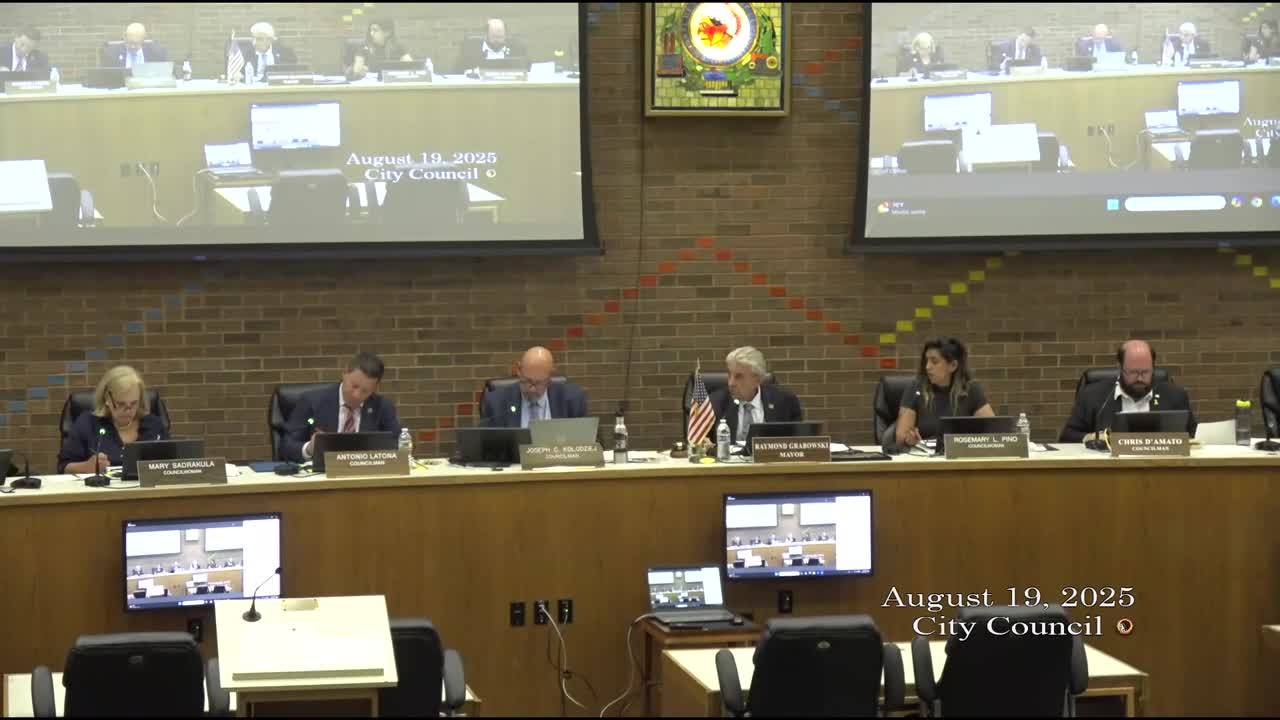
The Clifton Municipal Council failed to adopt an amended sewer connection-fee ordinance after a 3-3 tie on Aug. 19, leaving in place the city’s existing fee structure while the council considers alternatives.
Council supporters said the revised formula, which would have raised the per-unit charge for a typical three-bedroom home to about $2,500 and added a square-foot component for additions and new construction, was intended to ensure large developments and high-usage properties help pay for sewer infrastructure. Opponents argued the change could penalize modest homeowners adding a small bathroom or bedroom and would discourage reinvestment in older homes.
Councilman D’Amato urged the council to weigh the tradeoffs, calling it “the secret of politics — there’s never a perfect solution,” and voted in favor. Councilman Kolodziej, who voted no, said the measure would “hurt the little guy” and voted against it. Councilman Latona, Councilwoman Sadracula and Mayor Grabowski supported and opposed the measure in differing fashion; the roll call produced three yes votes and three no votes, resulting in the ordinance’s failure.
The ordinance introduced a new two-part formula for connection fees: a per-unit baseline (the example cited was approximately $2,500 for a three-bedroom unit) plus an incremental fee tied to additional square footage to reflect higher wastewater generation from larger homes. Supporters said the change would shift costs toward large-scale developers and multi-unit projects (a developer example cited in debate estimated a potential increase from roughly $36,000 under the old rules to about $500,000 under the new rules for a 300-unit development), reducing the burden on current taxpayers who absorbed infrastructure repairs following developer-driven system stress.
Opponents questioned the practical effect on single-family owners planning modest additions, like adding an upstairs bathroom over an existing bathroom or converting a den later into a bedroom. Several council members asked staff to clarify how the formula would be applied for additions and renovations and whether the city could assess only new incremental demand rather than gross square footage.
The council did not adopt any interim administrative changes at the meeting; the measure will return for further review. Council members asked staff to provide clearer examples of the fee application (renovation versus new construction, when a later conversion becomes chargeable) and to analyze the likely revenue impact under several development scenarios before bringing a revised ordinance back to the dais.
Outcome: the ordinance failed on a 3-3 vote; no alternative fee was adopted at the meeting.
What’s next: Council members requested additional staff work to model output under different fee formulas and to clarify application rules for additions and conversions before reconsideration at a future meeting.