
Guam Legislature rejects Perez amendment to create 4% mid-tier business privilege tax
Get AI-powered insights, summaries, and transcripts
Subscribe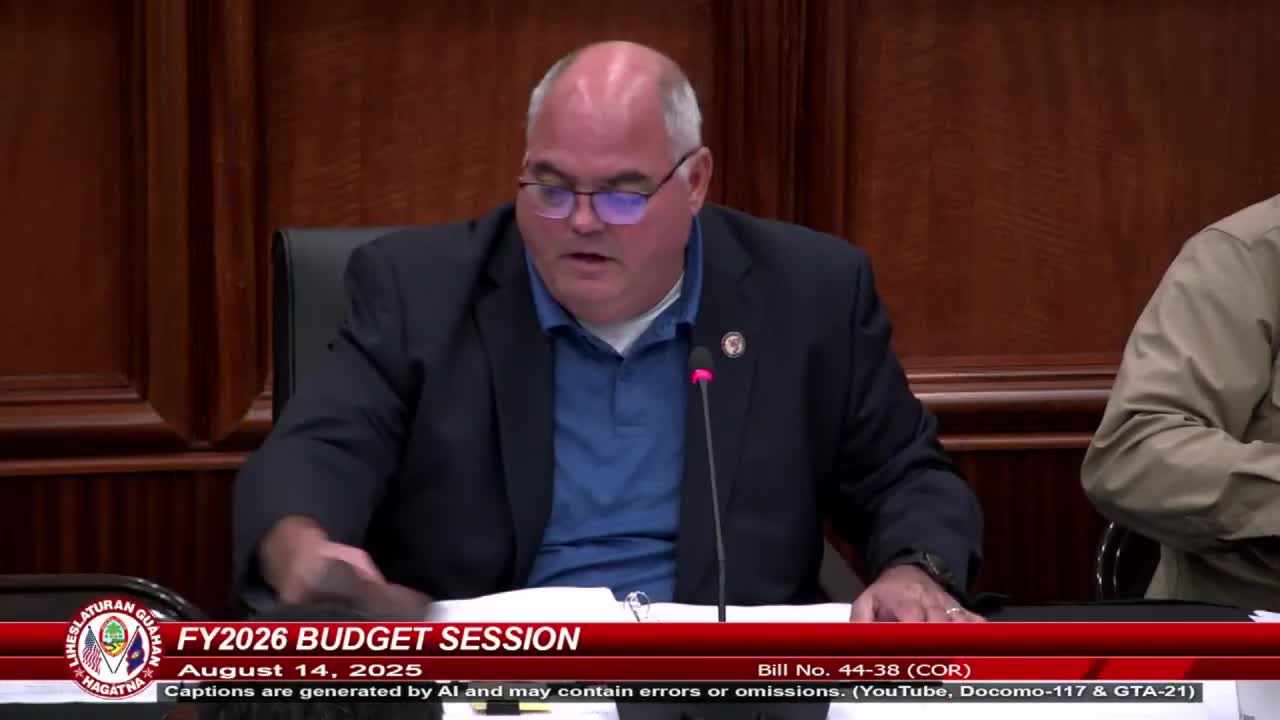
Summary
Senator Perez’s proposal to create a 4% business privilege tax (BPT) tier for businesses with gross receipts between $500,000 and under $2,000,000 failed after extended debate in the Guam Legislature.
Senator Perez’s proposal to create a 4% business privilege tax (BPT) tier for businesses with gross receipts between $500,000 and under $2,000,000 failed after extended debate in the Guam Legislature.
The amendment, offered during consideration of chapter 1 of the fiscal bill, would have left businesses under $500,000 at the existing 3% BPT rate and kept businesses above $2,000,000 at 5%, with exceptions for banks (taxed on net income) and certain foreign-currency dealers. Senator Perez described the change as “a compromise” intended to give relief to smaller businesses while preserving funds for government priorities.
Why it matters: supporters said the narrower rollback would reduce revenue loss compared with a broader cut and free money for underfunded programs; opponents said inserting the change into the budget without prior public hearings risks tax-refund payments and essential services.
Supporters argued the amendment offered a middle ground. Senator Perez said the amendment would “provide a compromise” and outlined the fiscal math presented to the body, noting the narrower rollback would cost roughly $8.7 million compared with some estimates of $37.6 million for a larger rate change. Senator Tina Muñoz Barnes (ranking member) summarized the intended distribution of relief, saying the proposal would create a new tier and estimated that about 65% of Guam’s roughly 5,100 businesses currently pay 3% BPT, 20% would fit the new 4% tier and 15% would remain at 5%.
Opponents pushed back on process and priorities. Senator Barnett said the measure had been “slipped into the budget bill” after public hearings and called that action “disingenuous,” saying it would shortchange refunds and public services. Senator Gubitalto objected to taking up alternatives that had not gone through earlier public hearings and urged authors to present their proposals in the public hearing process. Speaker Blas opposed the amendment on policy grounds and framed the debate as a question of whether to return revenue to residents or retain it for government programs.
Members cited specific funding concerns and offsets discussed during the debate: proponents noted an estimated $3.3 million federal match that could yield about $14 million for Medicaid; others flagged funding gaps the Clearing House had identified, including an item tied to the Guam Energy Office’s Solar for All program. Senator Perez and others referenced a Clearing House estimate that reduced some of the earlier $89 million exposure to approximately $62,450,000 when the Solar for All grant is factored in. Speakers also raised agency shortfalls: Guam EPA ($12 million), Department of Public Health (roughly $10 million in lost funding cited), and the need to set aside money for income tax refunds (the transcript noted a $25 million set-aside with a Committee of the Whole request to add at least $12 million).
Process and outcome: the amendment was proffered by Senator Perez and debated for more than an hour across multiple senators and floor leaders. No formal second or roll-call tally was recorded in the transcript; the presiding officer asked members to indicate support by raising hands and later announced, “Amendment fails.” The Legislature then closed chapter 1 and recessed, scheduling chapter 2 (education) to begin at 9:30 a.m. the following day.
Discussion vs. decision: the record shows extensive discussion and competing fiscal estimates, but the only formal action recorded on the amendment was its defeat with no detailed roll-call vote provided in the transcript. Several senators urged that proposals affecting tax rates be taken through public hearings before being added to appropriations bills.
The Legislature left open multiple fiscal questions: how to cover tax-refund set-asides, how much of the Clearing House reductions will be accepted by federal partners, and whether future standalone legislation or public hearings will reintroduce BPT changes.
Next steps: the chamber recessed and announced it will resume with chapter 2 (education) at 9:30 a.m., giving individual educational entities notice ahead of their appearances.