Get Full Government Meeting Transcripts, Videos, & Alerts Forever!
Get email alerts on the Civics Lab topic
No spam. Unsubscribe anytime.
Subcommittee reviews final design for Capitol civics lab, student path and interactives
Summary
Design team for the Wyoming Capitol civics lab presented refined graphics, furniture and interactive prototypes for the student path and three-wall civics lab; subcommittee cleared several design details and directed staff to post materials for formal review in Filestage.
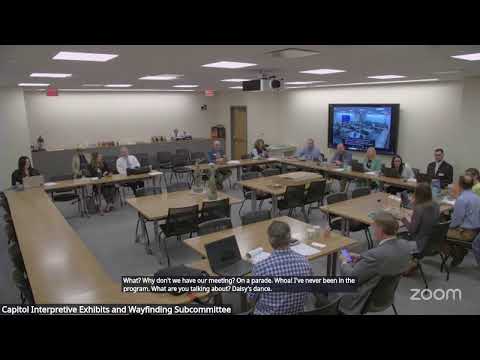
Members of the Capitol Interpretive Exhibits and Wayfinding Subcommittee on June 4 reviewed a near-final design for the Capitol’s civics lab and adjacent student path, including static graphics, micro-interactives, a central “gavel” station and role‑playing kiosks intended for school groups.
Design lead Nigel (DI) said the student path and civics lab are in production and that staff will upload the full presentation to Filestage for formal comment and approval. “You’ll have a second chance to look at it within Filestage and provide comments there,” a project manager said. The team asked the subcommittee for a limited number of immediate “yes/no” decisions so fabrication can move forward.
The nut graf: the civics lab is the subproject in Package 3 that the committee identified as a priority for visitor education. The lab is intended for school groups visiting the Capitol and uses a mix of analog and digital interactives to teach citizenship, levels of government and separation of powers.
In the walk-through, designers described three main walls: an introductory central station, a Constitution interactive adapted from the historic Supreme Court chamber, and a third station where visitors record a civic commitment that staff will post on a protected bulletin board. The central station includes winding floating banners around columns, two 32‑inch landscape touch screens and a driving‑map interactive where users choose a vehicle and stop at map hotspots that show federal, state or local roles.
Emilio, the content developer, described the kiosks’ user journey: “There’ll be an attract loop. They’ll touch the screen to start. They’ll play a video. They’ll be doing auto playing over over a big overview of the space and what we’re looking for them to learn,” he said, explaining onboarding flows for guided and self‑guided school groups.
Designers also showed several analog interactives: a ‘‘who you’d call’’ switchboard that plays pre‑recorded responses through an earpiece, a slider that demonstrates how a bill becomes law, a portrait slider highlighting the “day job” or careers of legislators, and a gears wall that models checks and balances by adding and turning gears representing branches of government and citizen voice.
Subcommittee comments focused on legibility, placement and message. Treasurer Meyer questioned the emphasis on adults’ voting responsibilities and urged content that helps students understand the relationship between rights and government actions; the design team pointed to three places in the lab where the citizen’s role is explicitly taught (the intro, the get‑involved wall and the checks‑and‑balances wall). Representative Nicholas urged the team to prioritize portraits and stories of jobs and careers students recognize, such as teachers and local service providers.
The subcommittee debated a label that appears to read “Historic Supreme Court” near the classroom entrance. One member said the placement might read as wayfinding rather than a historic image label; designers agreed to move or lighten the label and to confirm it matches the opposite hallway so color and treatment remain consistent.
Accessibility and durability were raised repeatedly. Designers said all micro‑interactives and hand‑manipulated controls are being engineered for longevity and to meet ADA reach and height standards. “Everything in the room…we are taking into consideration the ADA requirements for appropriate access,” a DI representative said.
Education staff said the Department of Education and the superintendent’s office have reviewed core content and are satisfied that the approach aligns to classroom learning objectives. The subcommittee heard that physical samples for fabric, lighting and micro‑interactives will be circulated to the core team and committee members in the coming week.
Timing: the team expects on‑site fabrication to begin this summer; package 3 installation is planned for this summer with the civics lab and constitution interactive completed later in the fall. The design deck will be posted to Filestage for formal review and comment, and the subcommittee will receive the final content reviews before text is locked.
The meeting closed with staff reminding the group of a planned July 10 kickoff for the Capitol 250 event; the subcommittee and core team were asked to consider a formal ribbon cutting when Package 3 elements are ready.
Ending: designers said they would return with the Filestage upload and physical samples; the subcommittee will review content separately in a subsequent step before final approvals for fabrication.