Committee hears bill to remove off‑street parking minimums as housing fix; residents raise enforcement, equity concerns
Loading...
Summary
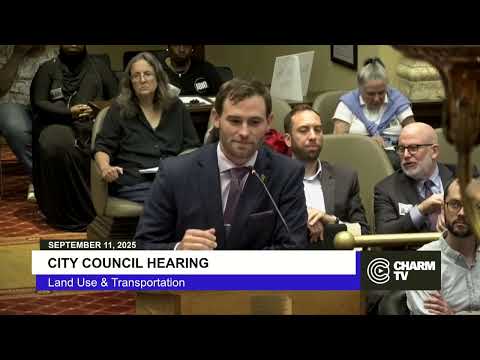
Baltimore's Land Use and Transportation Committee on Sept. 11 heard Council Bill 25‑065, the "Spaces for People" Act, which would remove many off‑street parking minimums from the city zoning code.
Baltimore's Land Use and Transportation Committee on Sept. 11 heard Council Bill 25‑065, the "Spaces for People" Act, which would remove many off‑street parking minimums from the city zoning code. Sponsor Councilman Zach Blanchard framed the change as part of a broader housing package intended to increase housing supply and lower costs without increasing city spending.
The bill would leave current exemptions in place (single‑family homes, buildings up to three units, downtown/main‑street zones and large multifamily projects already covered by the city's inclusionary housing policy) and target gaps the sponsor described as mainly affecting multifamily buildings between four and 19 units and larger C2–C4 commercial zones. "We would have done that already if that was the case. But that is exactly what the housing options and opportunities package does in this bill 25‑065," Blanchard told the committee. He said construction formulas for parking can add significant costs — "probably looking at, you know, anywhere from 25 to $35,000 for a parking space in the city of Baltimore." He and several panelists tied those costs to rents and homelessness: Blanchard said average rent rose about $250 a month between 2020 and 2025 and that homelessness has increased roughly 50% since 2021.
Why it matters: proponents said parking minimums impose an arbitrary cost on new housing that is often not used, especially near transit and amenities; opponents said Baltimore is unevenly served by transit, has many elderly and car‑dependent households, and needs better parking enforcement and neighborhood‑specific protections before removing minimums citywide.
Supporters who testified included Micah Avery of the Baltimore Regional Housing Partnership, Daniel Harriguez of the Parking Reform Network, Will Holman of OpenWorks, Kevin Lindamood of Health Care for the Homeless and Emily Ransom of Clean Water Action. Avery said the nonprofit sees removal of parking minimums as a tool to expand housing choices for low‑income families. Harriguez told the committee that more than 100 North American cities have removed parking mandates and that in many places the majority of new buildings still include some parking but the reforms enabled more housing units to be permitted. Holman, whose nonprofit makerspace saved private and public funds by avoiding extra parking, said parking rules added nearly $1,000,000 to site costs for a planned second facility.
Several city agencies filed favorable reports. Jason Wright of the Department of Housing and Community Development said DHCD stands behind its favorable report. Tom Welly of the Baltimore Development Corporation pointed to a local project where retail was removed from plans, in part due to parking costs, and urged change. Planning Commission and Parking Authority staff also recommended favorably. Luciano Diaz of the Department of Transportation told the committee the agency expects additional housing density to help support transit improvements over time.
Public testimony split along familiar lines: proponents argued the city can permit more infill and smaller, lower‑cost units and that existing parking garages and structured parking are often underused. Bike advocates and housing lawyers described daily impacts of the affordability crisis and urged the committee to act. Opponents — including longtime homeowners, neighborhood association leaders and faith institutions — said removing parking minimums citywide would intensify competition for curbspace, harm seniors and people with limited mobility, and reduce green space on small lots. Several speakers said they had not been engaged before the hearing and asked for neighborhood‑specific approaches.
Committee discussion ranged from technical details — which zones are already exempt and which would change — to enforcement questions. Vice Chair L. Middleton and other members pressed for stronger parking management and enforcement measures, including electronic license plate readers and changes that would allow more efficient ticketing and permit systems. Councilman Blanchard said the bill does not ban parking; builders will still often provide parking where demand exists and local tools (permit zones, pricing, time limits) can address spillover.
No vote was taken. The committee chair said amendments will be circulated ahead of the next hearing and that members will consider the bills again at a scheduled meeting one week later.
Ending: The committee will keep the record open for written testimony and return to the measure at a future session; sponsors and agencies said they will continue outreach to neighborhoods with high concerns about parking access, transit gaps and senior mobility.