Get Full Government Meeting Transcripts, Videos, & Alerts Forever!
Get email alerts on the Parks Kennedy Park topic
No spam. Unsubscribe anytime.
Weston parks committee presses for urgency on Kennedy Park fundraising, strategic plan
Summary
Weston parks committee members escalated concerns June 6 about the pace and financing of the long-planned Kennedy Park renovation, saying they have spent 18 months on the project but raised only modest private funds while the village moves forward with initial construction contracts.
Weston parks committee members escalated concerns June 6 about the pace and financing of the long-planned Kennedy Park renovation, saying they have spent 18 months on the project but raised only modest private funds while the village moves forward with initial construction contracts.
Committee chair Jamie Wyland said the village board has approved a contract with PGA (contractor) for two fields — described in committee materials as just over $2,200,000 — and that a pre-construction meeting is scheduled. Wyland also said the village had authorized use of capital funds, including ARPA dollars and CIP borrowing, to cover portions of infrastructure that the committee had previously described as difficult to fundraise for (parking, restrooms, stormwater).
The committee’s nut graf: members said they still lack a clear, actionable strategic plan, a public-facing fundraising “ask” and steady outreach cadence; they warned that without those pieces the project risks stalling after the two fields funded to date are completed.
“Every day we don't ask for money is a day we don't get money,” said committee member Daniel (last name not stated), who described the pace as “a lack of urgency.” Daniel, a member of the parks committee, said the consultant-produced strategic-plan draft lacked concrete targets, timelines and coordinated stakeholder meetings. “This is a 300 year project at this point,” he said. “We’re 18 months in and we’ve raised $26,000.”
Marcus (consultant), who delivered a 33-page strategic-plan draft to the committee, told members the draft offers a “skeleton” with recommended staffing models and fundraising approaches but needs more “meat” — specific funding targets, timelines and a meeting cadence. Marcus proposed a six-week work period with about three stakeholder meetings to fill those gaps.
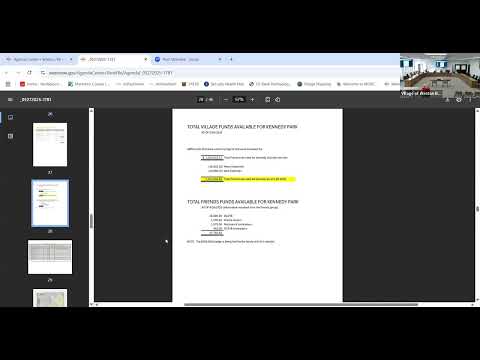
Committee members and staff provided figures and funding context during the discussion: the village has contributed “over $800,000” so far, a family gift of about $500,000 has been recorded for one diamond, youth baseball contributed $25,000, and the friends group has raised roughly $26,000 in total. Wyland and others said the village board previously approved moving forward with the contractor for two fields and that some infrastructure funding will come from ARPA (American Rescue Plan Act) dollars, CIP borrowing and room-tax proceeds. The committee discussed a publicized project cost range of roughly $14 million to $15 million, with village-funded “amenities” (parking, bathrooms, stormwater, utilities) estimated in prior materials at about $7–8 million.
Several committee members said they had been told the group would raise a larger portion of the total project in private donations but later understood the village would assume substantial infrastructure costs. “We went to the public and released the press release that said $1,415,000,000 bucks after the ARPA money,” Daniel said in frustration when recounting earlier communications (speaker used hyperbole; committee members later clarified the public figure communicated was roughly $14–15 million as the total project cost). Members pressed staff to clarify which figures had been communicated to the public and to prospective donors.
Marcus recommended temporarily quiet fundraising to build capital behind the scenes and then relaunch public fundraising with demonstrated progress and a clear, single donation channel. He also recommended creating a separate nonprofit (a 501(c)(3)) or a single community-foundation landing page so donors would see “one straight line” for where donations go rather than multiple organizations.
Committee members discussed fundraising tactics: breaking the overall goal into named elements (naming rights for fields, buying lights, etc.), preparing an ask-letter template for volunteers and businesses, and scheduling regular small-group meetings to manage outreach and grant-writing. Staff said grant-writing has yielded limited success — “typically only 1 out of 30 grants get approved,” staff said — so the group needs a designated lead for grant applications.
Speakers repeatedly flagged the need for a small-group meeting schedule and clearer communications between the village, volunteers and the consultant. Marcus said he would outline a proposed six-week stakeholder schedule and three meetings and circulate a draft agenda. Jamie Wyland and staff agreed to post dates and to create an ask-letter template for committee review.
What was not decided: the committee did not change any previously approved contracts or funding commitments at the June 6 meeting. No motion to alter the village board’s previously approved contract or budget allocations was presented to this committee.
Why this matters: Kennedy Park is presented as a multi-year, multi-million-dollar recreation investment for youth sports, hockey and other user groups; committee members worry momentum will be lost if private fundraising and public communications remain inconsistent. The committee asked staff and Marcus to return with a firm small-group schedule, an ask-letter template, clarified funding numbers and a plan to coordinate grant-writing and community outreach.
The committee set a follow-up plan: Marcus will circulate a stakeholder timeline and agenda; staff will locate and redistribute the existing ask-letter draft; and the parks committee agreed to schedule small-group meetings and to consider shifting meeting times to better include partners and volunteers.
Ending note: committee members said they want the park project to proceed but want clearer, regular communication, measurable targets and stronger volunteer-based outreach before the next public fundraising push.