
Chula Vista board reviews multi‑year budget shortfall and potential program and staff reductions
Get AI-powered insights, summaries, and transcripts
Subscribe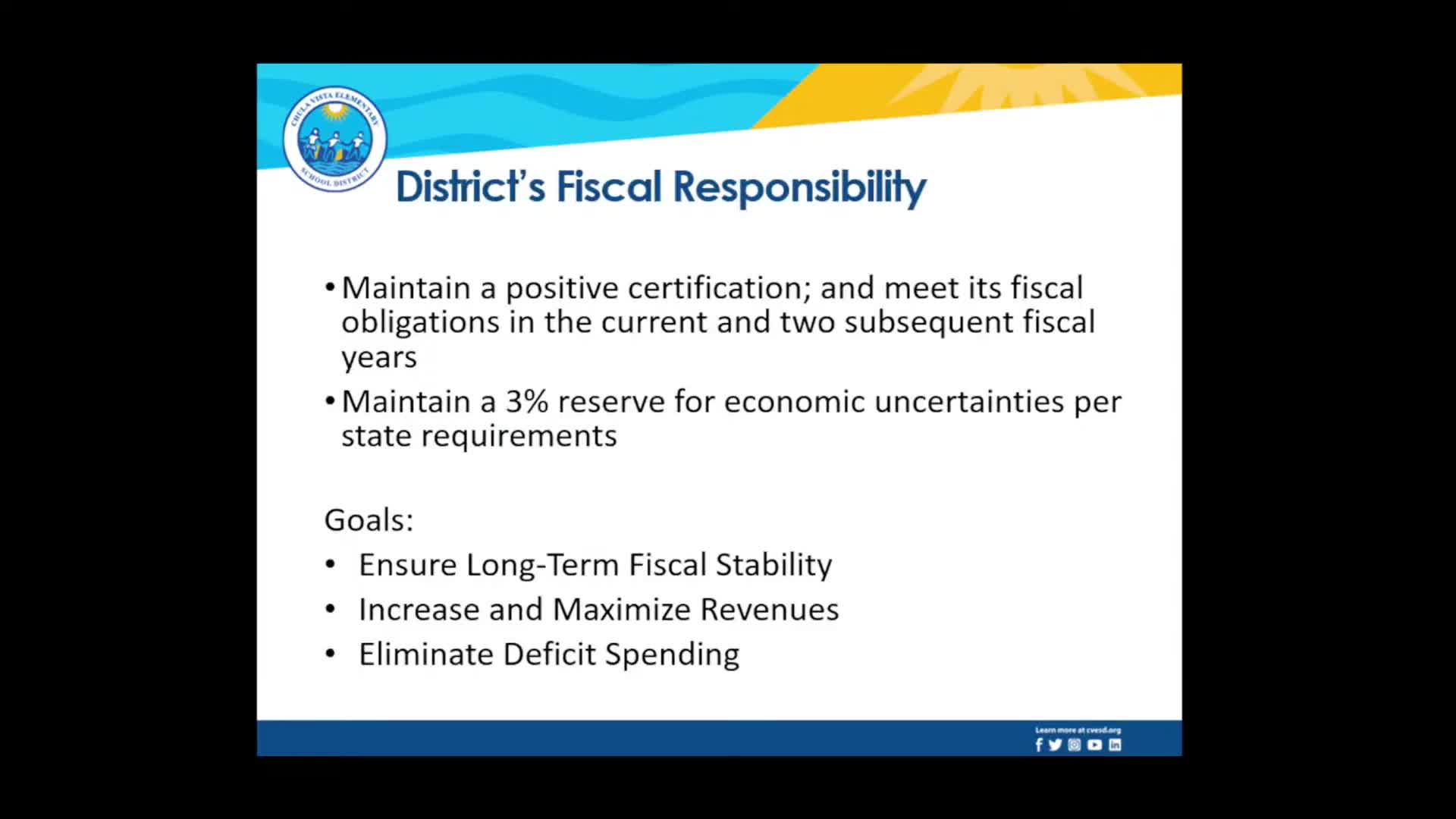
Summary
Board President Ugarte opened a public budget discussion in which district finance staff walked board members through multi‑year revenue and expenditure projections and options to address a projected shortfall.
Board President Ugarte opened a public budget discussion in which district finance staff walked board members through multi‑year revenue and expenditure projections and options to address a projected shortfall.
The presentation said the district’s adopted budget for the year was about $400,000,000 and noted an unanticipated increase in restricted revenues of roughly $23,000,000. Staff described some of that money as one‑time funds (about $6,000,000 was cited as one‑time) and other amounts tied to specific programs such as expanded learning opportunities. The staff presentation also listed the district’s revenue mix as roughly 69 percent local, about 4 percent federal and about 14 percent state for certain years; staff later gave a consolidated figure for a recent year of 53 percent local, 12 percent federal and 35 percent state.
The district flagged growing costs as drivers of the projected deficit: an increase in special education enrollment (staff said special education spending has nearly reached $80,000,000), rising pension contributions (presented as about 12.6 percent of payroll) and higher insurance and workers’ compensation costs. Staff said the district projects a decline in its unrestricted reserve from about 5 percent toward the board’s minimum target of 3 percent unless actions are taken.
Staff described several categories of possible reductions to narrow the gap: elimination or consolidation of some district office positions (estimated savings around $750,000 at the central level), reductions in school‑level/staffing positions where vacancies exist, trimming or restructuring after‑school and curriculum software contracts (one cited annual contract cost was $420,000), changes to independent study staffing, and transportation efficiencies. The presentation said a modest reduction in campus security would reduce 43 officers to 42 if enacted and listed a possible $190,000 savings tied to that change.
Programmatic areas discussed for potential cuts or restructuring included visual and performing arts (VAPA), supplemental physical education, and some site‑level nonrestricted expenditures. Staff also said some one‑time funding has supported additional counselors, social workers and behavioral supports this year and cautioned those positions may not be sustainable once one‑time funds are spent.
Board members asked specific operational questions: Board member Pong asked for clarification about restricted versus unrestricted funds and about how the new expanded learning funding would be applied; Board member Pérez asked whether special education funding covers the full district cost (staff said it does not and the district must supplement), and several members pressed for data on how many transitional kindergarten students and the size of waitlists (staff said about 1,200 transitional kindergarten students and roughly 300 on a waitlist, and that current sites have capacity for about 1,600 seats while there were about 1,900 requests in one exchange).
Staff emphasized that many revenue increases are restricted and therefore do not reduce the district’s structural deficit in unrestricted general fund balances. They also described timing in the state budget calendar and local budget deadlines: projections, interim reports and a final budget adoption cycle concluding in June for the statutory year, with interim reports due mid‑March and mid‑December.
At the end of the public discussion the board handled routine procedure. Early in the meeting the board approved the meeting agenda; the motion passed with four in favor and one absence (Vice President Tamayo was recorded as absent). Later the board voted to approve the presented revision related to the noted restricted program revenues (the staff presentation framed those as approximately $23,000,000 in restricted program funds); the motion passed on the final vote call.
The board directed staff to return with final recommendations and a set of proposed reductions in December, and to issue required layoff or reduction notices in March if necessary. Staff said they will present finalized solutions and preliminary reductions in December and provide formal notices in March under the established timeline.
The presentation and discussion reflected multiple cost pressures — rising pension and benefit costs, insurance claims tied to historical litigation, and increases in special education caseloads — and emphasized the district’s need to prioritize sustaining core instructional services while using one‑time funds for temporary supports. The board did not adopt a detailed reduction plan at this meeting but set a schedule for follow‑up analysis and suggested site visits and additional engagement with school staff and parent groups before final decisions.
Votes at a glance
• Motion to approve meeting agenda — outcome: approved; vote recorded as 4 yes, 0 no, 1 absent (Vice President Tamayo absent).
• Motion to approve the fiscal revision tied to approximately $23,000,000 in restricted program revenues and to proceed with the budget review process — outcome: approved (final roll call recorded; individual yes vote from Board member Camacho was recorded).