
Chula Vista school board hears budget workshop as district projects multiyear deficit; approves 45‑day state-driven revision
Get AI-powered insights, summaries, and transcripts
Sign Up Free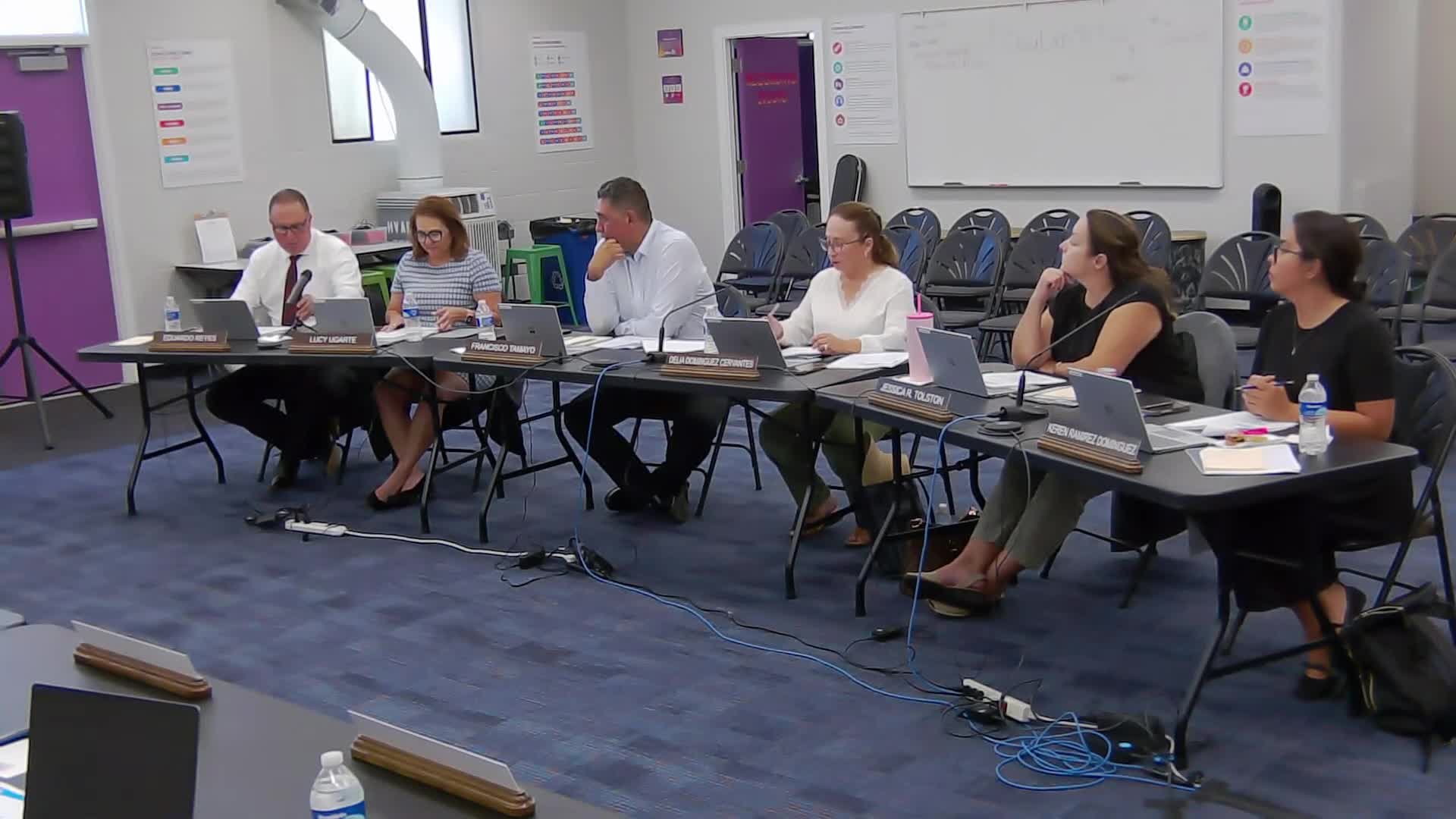
Summary
At a combined special and regular meeting, district staff outlined a multiyear budget gap driven by rising pension and insurance costs, growing special‑education spending and the end of COVID-era one‑time funds. The board approved a 45‑day revision to align the district’s 2025‑26 budget with changes in the final state budget.
The Chula Vista Elementary School District Board of Education on Monday heard a detailed budget workshop in which district finance staff warned of a multiyear structural deficit and outlined possible reductions and new revenue strategies, then voted to approve a 45‑day revision to the district’s 2025‑26 budget to reflect recent state changes.
The presentation, led by district finance staff and administrators, said the district began 2024–25 with roughly $400,000,000 in total revenue and $451,000,000 in projected expenditures; the district’s adopted multiyear projection showed an unrestricted fund balance decline of about $24,000,000 and an overall projected draw on fund balance approaching $51,000,000 across the planning window.
“This workshop is to provide the board and the public with an overview and detailed information on our budget, where we stand fiscally, and steps we need to take to remain fiscally solvent,” said Dr. Reyes. The presentation outlined revenue shifts in the final state budget, rising pension and health‑insurance costs and increasing costs tied to special education.
Why it matters: district leaders said much of the recent increase in state and federal funding was restricted to specific programs and therefore does not eliminate the district’s underlying shortfall on the unrestricted general fund. That mismatch, staff said, drives the administration’s push for a combination of cost reductions, revenue maximization and structural changes.
Key numbers and changes
- District staff reported total revenue near $400 million at budget adoption and total expenditures of about $451 million. - State actions added roughly $23 million in restricted revenue since the June adoption, including a $1.3 million increase to the learning‑recovery block grant, a one‑time discretionary block grant of about $6.6 million and a projected $15 million boost tied to the Expanded Learning Opportunities Program (ELOP). Staff noted ELOP changes require programs be offered to all students in schools that qualify under the new threshold. - Revenue mix reported by staff: about 69% LCFF (state/local), ~4% federal, ~14% state categorical and ~13% local revenue. - Staff projected a 2025–26 full‑year deficit equal to roughly 10% more in expenditures than revenues for that fiscal year under current assumptions.
Restricted versus unrestricted
“Again, these are all restricted programs,” said Mr. Pong, describing the recent state allocations and emphasizing that those funds cannot be used on the district’s unrestricted obligations. Presenters repeatedly contrasted restricted program funding (federal/state categorical grants, ELOP, learning recovery) with the unrestricted general fund, which covers salaries, benefits and many ongoing district costs.
Drivers of the shortfall
Staff pointed to several structural pressures: - Increasing pension rates for certificated (STRS) and classified (PERS) staff that have risen substantially since 2016–17. - Rising insurance premiums, including large increases for sexual‑abuse and molestation coverages driven by changes in state law that expanded claim windows. Staff noted a spike in premiums and several large assessment invoices tied to prior incidents. - Growing special‑education costs and a maintenance‑of‑effort requirement that forces the district to sustain or exceed prior‑year special‑education spending. Staff said special‑education placements and outside service rates have risen sharply.
Potential solutions and next steps
District staff presented a set of potential budget solutions and revenue initiatives intended to minimize impacts in classrooms. Proposed cost actions included: a shared assistant‑principal model, targeted reductions at the district office through attrition, reviewing the full‑time independent‑study staffing, examining transportation routes and usage, potential consolidation or repurposing of sites, reductions in site discretionary allocations, and a careful review of software and contracted services.
On revenue and offset opportunities, staff said they will pursue new reimbursable claims under the Children and Youth Behavioral Health Initiative, expand short‑term independent study/attendance recovery to boost average daily attendance, and pursue markets for renewable energy certificates and low‑carbon credits tied to the district’s solar and fleet conversions.
Staff asked the board to consider priorities it wants protected while staff finalize recommended reduction scenarios. The presentation reiterated the district’s timeline: first interim reporting in December, preliminary reduction/layoff notices in February and final reduction notices in March.
Board discussion and community questions
Board members asked for more detail on how restricted funds flow to schools, how school‑level Title I allocations are distributed, the ratio and placement of transitional kindergarten seats, and how site‑based decisions would be impacted. Administrators said school site councils already have preliminary site budgets for 2025–26 and that final carryover numbers will be available when the books close in August.
A number of trustees emphasized the district should seek input from site staff and the “boots on the ground” before finalizing reductions. The administration said it already engages site principals, teachers and union leadership while evaluating positions and programs.
Votes at a glance
- Motion to approve the 45‑day budget revision to the 2025–26 adopted district budget (to reflect final state budget changes, restricted revenues only): approved (yes: 5; no: 0; abstain: 0; absent: 0). The motion updated restricted revenue lines and left any associated expenditure updates for a future date. - Motion to approve the regular‑meeting agenda (recorded earlier in the session): approved (yes: 5; no: 0; abstain: 0; absent: 0). - Motion to adjourn: approved (recorded unanimous or by voice vote at meeting end).
What remains uncertain
Staff repeatedly cautioned that many figures are projections and that the state’s cost‑of‑living adjustment (COLA) and other assumptions can change; the board will have to approve final reductions or replacements once staff return with specific proposals. Administrators also said that most recent state increases are ongoing (ELOP) or one‑time (learning recovery, discretionary block) and that only the ongoing items affect long‑term planning.
Speakers
- Dr. Reyes, presenter (district finance) - Mr. Pong, presenter (district finance/operations) - Bernadette Faustino, budget team lead (district finance) - Miss Perez, district staff - Miss Brown, district staff - Miss Casey, enrollment/placement staff - President Negrete, Board President (presiding during regular meeting vote) - Delia Dominguez Cervantes, Board member - Jessica Tolston, Board member - Ramirez Dominguez, Board member - Paulson, Board member - Sebastian, Board member - Francisco Tamayo, Trustee (arrived late/absent during some votes)
Topics and tagging
- topic_primary: budget - topics: [{"name":"district_budget","justification":"Comprehensive workshop on revenues, expenditures, multiyear projection and proposed reductions","scoring":{"topic_relevance":1.00,"depth_score":0.90,"opinionatedness":0.05,"controversy":0.50,"civic_salience":0.95,"impactfulness":0.90,"geo_relevance":1.00}}]
Clarifying details
- Current reported total revenue (at budget adoption): about $400,000,000. - Reported total expenditures (at adoption): about $451,000,000. - State revenue change since adoption: approx. $23,000,000 (learning recovery +$1.3M; one‑time discretionary ~$6.6M; ELOP +~$15M projected). - LCFF represents approximately 69% of district revenue; federal ~4%; state categorical ~14%; local ~13%. - Projected ongoing budget gap (2025–26 full year on current assumptions): spending about 10% more than revenues.
Community relevance
- Geographies: Chula Vista; impacts to all district schools (TK–6). - Impact groups: students in special education, TK families facing wait lists, schools with high unduplicated pupil counts, staff (potential reductions/attrition), school site councils.
Searchable_tags:["budget","LCFF","ELOP","special_education","pensions","insurance","Chula_Vista","VAPA","revenue_revision"],
salience:{"overall":0.90,"overall_justification":"Large district budget gap, potential staff and program impacts, and a formal budget revision vote; affects operations across the district.","impact_scope":"local","impact_scope_justification":"Impacts Chula Vista Elementary School District operations and services.","attention_level":"high","attention_level_justification":"Multi‑year deficit plus pending personnel and program decisions; layoff timelines forthcoming.","novelty":0.40,"novelty_justification":"Budget pressures mirror statewide trends but include local specifics (insurance spikes, enrollment patterns).","timeliness_urgency":0.85,"timeliness_urgency_justification":"Board must act before interim and layoff notice deadlines; preliminary notices due in February.","legal_significance":0.40,"legal_significance_justification":"References to maintenance‑of‑effort and state budget rules; some issues require statutory compliance.","budgetary_significance":0.95,"budgetary_significance_justification":"Projected multi‑million‑dollar deficits and large items (pensions, insurance, special ed) directly affect the general fund.","public_safety_risk":0.10,"public_safety_risk_justification":"Discussion touched on SROs and security staffing but no immediate public safety crisis reported.","environmental_impact":0.02,"environmental_impact_justification":"Minimal; mentions sale of renewable energy certificates as a revenue source.","affected_population_estimate":18000,"affected_population_estimate_justification":"District‑wide student population and school operations likely affected (district enrollment scale; estimate not specified in transcript).","affected_population_confidence":0.40,"affected_population_confidence_justification":"Approximation based on typical district size; transcript did not state a precise student count.","budget_total_usd":51000000.0,"budget_total_usd_justification":"Aggregate projected draw on fund balance and multiyear deficit as discussed in presentation (approximate).","decision_deadline":"2026-02","decision_deadline_justification":"Staff cited preliminary reduction/layoff notice in February and final notices in March.","policy_stage":"proposal","policy_stage_justification":"District presented proposals and asked board guidance; no final reductions approved."},
engagement_forecast:{"newsworthiness":{"national":0.05,"regional":0.20,"local":0.95,"justification":"High local impact (district operations, staffing, programs); limited regional/national appeal."},"notify_recommendation":{"audience":"city","reason":"Local parents, staff and community stakeholders will be most affected by potential program and staffing changes.","audience_regions":["US-CA-SD-CHV"],"justification":"Immediate local significance with school‑level impacts."},"notify_thresholds":{"local_min":0.5,"regional_min":0.7,"national_min":0.9},"predicted_interest":{"national":0.05,"regional":0.20,"local":0.90,"justification":"Predominantly local interest."},"predicted_click_through":0.40,"predicted_click_through_justification":"High interest for local audience; moderate for broader audiences."},
graph_signals:{"jurisdictions":["US-CA-SD-CHV"],"jurisdictions_justification":"Chula Vista Elementary School District; San Diego County; California state budget context.","ontology_topics":["education_budget","school_finance","special_education","labor_contracts"],"ontology_topics_justification":"Matches topics discussed in the workshop.","entities":[{"id":"bernadette_faustino","name":"Bernadette Faustino","type":"person"},{"id":"chula_vista_esd","name":"Chula Vista Elementary School District","type":"agency"}],"entities_justification":"Named district staff and organization referenced in discussion."}},{