Get Full Government Meeting Transcripts, Videos, & Alerts Forever!
Get email alerts on the Ai Policy And Use topic
No spam. Unsubscribe anytime.
Staff members urge strict human review and policies when using generative AI for reports
Summary
During an internal meeting, participants discussed using generative AI to draft reports, emphasizing human oversight, an AI policy, privacy impact assessments and security protections; staff also warned against using biased sources or uploading personal data to third‑party tools.
Staff members at an internal meeting discussed using generative artificial intelligence tools to draft and organize office reports, with presenters urging clear policies, human oversight and data protections.
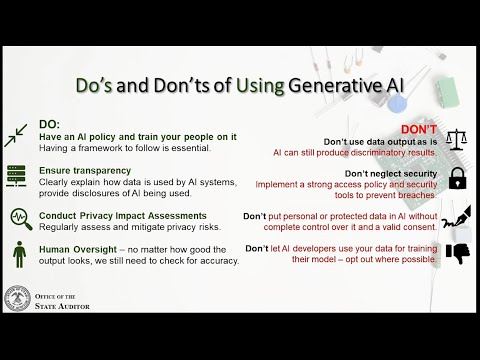
The discussion centered on practical steps to use generative AI safely and legally. “You really have to review it for accuracy and make sure that nothing in there is inappropriate for public release,” said Staff member 2, a meeting participant. Staff member 6, who led the guidance, listed a set of recommended practices including creating an AI policy, appointing an AI coordinator, requiring transparency when AI is used and conducting privacy impact assessments for high‑risk uses.
Why it matters: Several speakers framed generative AI as a productivity tool that can help meet tight deadlines, but they warned that unchecked use risks inaccurate or inappropriate public materials and possible privacy or security breaches. The meeting included practical cautions—do not use biased datasets, do not put personal data into third‑party AI without consent, and protect AI systems with strong security tools.
Participants described working examples and limitations. One attendee said they would have a chatbot “help me finish mine” to meet a Friday report deadline, while others cautioned that AI outputs can “hallucinate” or pull unreliable sources. Staff member 6 advised against using forums like Reddit as authoritative sources and said teams should verify facts generated by AI before public release.
The presenter summarized recommended governance steps: adopt a written AI policy and staff training, appoint an internal AI coordinator, disclose when AI contributed to output, provide clear explanations of how data are used by AI systems, conduct privacy impact assessments for activities that could affect civil liberties, and maintain human oversight at all stages. On security, the presenter warned: “Don’t put personal data in AI without complete control or expressed and valid consent to do so” and recommended strong technical protections to prevent data breaches.
Speakers also discussed operational controls: limit use of AI for draft organization and brainstorming unless outputs are verified; avoid datasets that could introduce discriminatory outcomes; and, where possible, opt out of allowing vendors to use local data to train their models.
The meeting included informal exchanges about speed and accuracy—some participants joked about the tools’ quirks—but the substantive, recurring message was procedural: adopt policies, train staff, document AI use and verify outputs before anything is released publicly.
The session closed with staff returning to immediate work deadlines while acknowledging that the office needs explicit, written rules and oversight to use generative AI responsibly.