
Leesburg planning panel denies Lake Margareta Estates comp‑plan amendment and PUD rezoning
Get AI-powered insights, summaries, and transcripts
Subscribe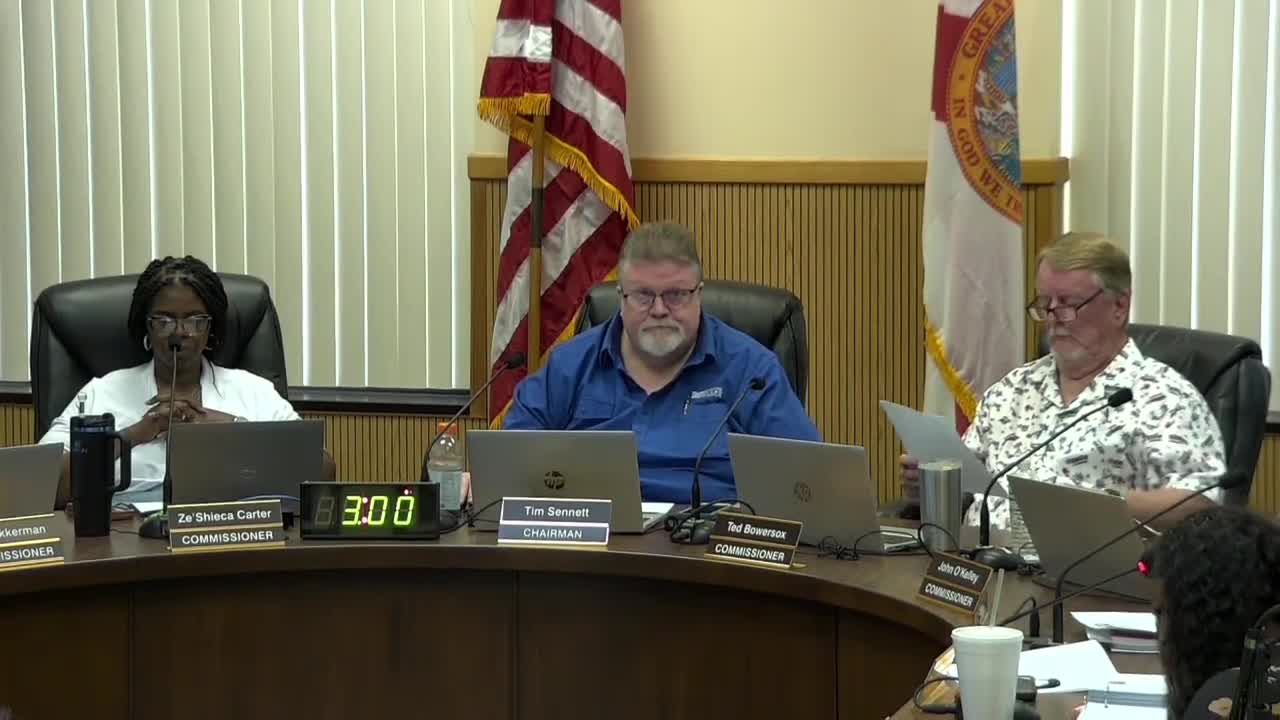
Summary
The Planning and Zoning Commission voted to disapprove a large‑scale comprehensive plan amendment and rezoning request for the 196‑acre Lake Margareta Estates development after commissioners and residents raised traffic and density concerns.
The City of Leesburg Planning and Zoning Commission voted to disapprove a large‑scale comprehensive plan amendment and a planned unit development (PUD) rezoning request for the proposed Lake Margareta Estates on May 22, 2025.
The proposal covered about 196 acres south of County Road 48 and east of Number 2 Road, and would have annexed roughly 90 acres still in Lake County into the city and rezoned the entire site to PUD to allow up to 586 detached single‑family homes under the applicant’s concept plan. Tom Daley, the project consultant, said the developer had agreed to cap buildout at 3 units per acre—even though the Leesburg comprehensive plan allows up to 4 units per acre—bringing the proposal to 586 homes. “We’ve agreed to cap that at 3 units per acre,” Daley said.
The project drew concerns from commissioners and a nearby resident about traffic and compatibility with existing rural uses. One resident who spoke during public comment said the added traffic would be substantial and urged denial. “Forty‑eight is a busy road already…500 to 600 more vehicles on there, minimal, is quite a boot,” the resident said, urging the commission to deny the request. Planning staff had flagged multiple infrastructure and permitting issues in the departmental review: Lake County Public Works noted required turn lanes and potential traffic‑signal warrants at County Road 48, the need for additional rights of way, required sidewalks, and other off‑site improvements; the Lake County school board said the project would be subject to school concurrency review and potential mitigation agreements if student stations were not available.
Staff recommended approval of both the large‑scale comprehensive plan amendment (citing Chapter 163.3184, Florida Statutes) and the PUD rezoning, and outlined standard PUD conditions such as a 25‑foot landscape buffer around the perimeter, 35% open space, a two‑story height cap, recreational amenities, and a four‑year substantial‑commencement phasing clause that would revert the property to RE‑1 zoning if not acted upon. The applicant’s conceptual plan showed three village areas, a central amenity center, dry retention basins intended for occasional recreational use when dry, and lot widths of 50, 60 and 70 feet with minimum home sizes from 1,700 to 1,900 square feet.
After public comment and commissioner discussion focused on traffic impacts, rural character and compatibility, a motion to disapprove the comprehensive plan amendment was made and seconded. The commission voted to deny the comprehensive plan amendment; the commission then considered the PUD rezoning separately and denied that request as well. The transcript records a roll call with mixed votes; the motion to deny was carried by the commission in the public hearing.
Because portions of the site remain in Lake County and because multiple off‑site roadway improvements would require county approval, Lake County engineering and state agencies retain approval authority over some of the project’s required improvements. The school concurrency requirement means the developer must either demonstrate adequate student capacity in Lake County schools or negotiate mitigation with the school board and obtain City Commission approval of any mitigation agreement before platting.
With the Planning and Zoning Commission’s recommendation of denial, the developer may revise the proposal and potentially seek future hearings before the city bodies, but no approvals were granted at this meeting.