Get Full Government Meeting Transcripts, Videos, & Alerts Forever!
Get email alerts on the Housing Duplexes topic
No spam. Unsubscribe anytime.
Board approves conditional use to convert 1432 S. Winfield Road into duplex with conditions
Summary
The Bloomington Board of Zoning Appeals on April 24 approved a conditional-use petition to convert 1432 South Winfield Road from a single-family house into two rental units, imposing a rental-inspection requirement and a property‑line barrier after neighbors raised noise and parking concerns.
The Bloomington Board of Zoning Appeals on April 24 approved a conditional-use petition from owner Kumar Zaidi to convert 1432 South Winfield Road from a single-family house into a two-unit dwelling, with conditions requiring a rental inspection, rental permits and a barrier to separate driveways.
The approval followed a staff presentation that said the property is in an R-2 (residential medium-lot) district and that the proposed interior conversion would not change the building’s exterior, roof pitch, setbacks or driveway configuration. David Brantez, zoning planner, told the board staff found the petition met use-specific standards for a duplex and recommended approval with two conditions: limit the approval to the design shown in the packet and require the owner to pass a rental inspection from HAND and procure rental permits for rented units.
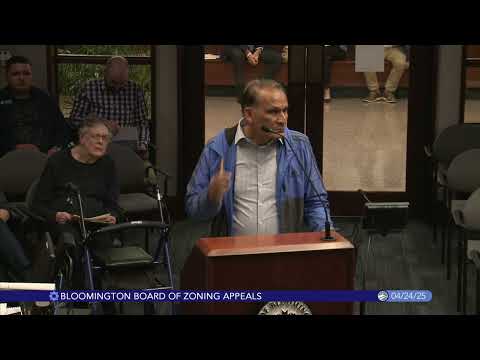
In public comment, nearby residents described repeated late-night noise and parking impacts they attributed to student tenants. Carol Barlow, an adjacent property owner, described multiple late‑night partying incidents in August 2024 that she said “woke [her] at 1:30 a.m.” Judith Lee and Dan Lee, neighbors who share a driveway with 1432, said overflow parking has blocked driveways and created sight‑line hazards at a nearby roundabout.
Kumar Zaidi, who identified himself as the property owner, told the board he has owned the 3,400-square-foot house since February 2013, said he rents to students under strict leases that allow termination for illegal activity, and said he is willing to work with neighbors. When the board discussed mitigation, staff noted noise complaints would be enforced by the Bloomington Police Department, and that the conditional‑use criteria allow the board to require measures to address impacts on adjacent properties. Staff suggested a fence or landscaping could be a condition.
The board added a third condition requiring the petitioner to erect a property-delineating fence or landscape barrier between the subject property and the neighbor to the north, phrased to meet applicable city code (for example, a 4-foot fence within the public-facing yard or taller screening where allowed behind the house). The motion approved the staff findings and the conditional use with the three conditions.
Roll call on the motion recorded the approval as unanimous (Kosinko: yes; Throckmorton: yes; Ballard: yes; Burrell: yes). The board concluded by advising neighbors concerned about noise to contact the police and to coordinate with the landlord under the lease and local enforcement mechanisms.
The conditional use approval applies only to the design shown in the packet; the board required a passed HAND rental inspection and rental permits before occupancy as rental units, and the fence/landscape barrier to be installed as described in the motion.