
Asheville committee previews economic-recovery plan; staff cites FAST team, business-inclusion wins
Get AI-powered insights, summaries, and transcripts
Subscribe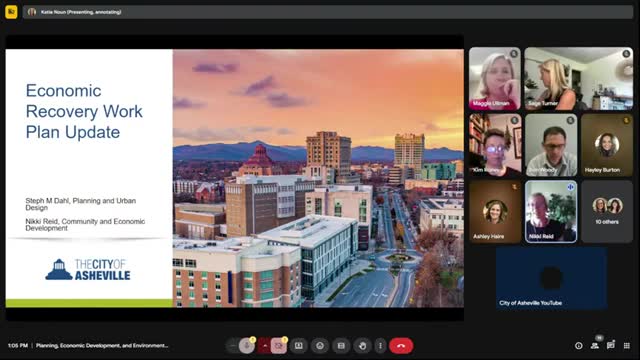
Summary
Asheville City Council’s Planning, Economic Development and Environment Committee heard an economic-recovery update July 15 that detailed near-term assistance and longer-range planning to move recovery work from emergency response toward an organized strategic program.
Asheville City Council’s Planning, Economic Development and Environment Committee heard an economic-recovery update July 15 that detailed near-term assistance and longer-range planning to move recovery work from emergency response toward an organized strategic program.
City staff presented results from the FAST team, short-term grant allocations, technical-assistance workshops, and outreach efforts intended to prepare the city to deploy Community Development Block Grant Disaster Recovery (CDBG-DR) funds. “This goal number one is really about ensuring that businesses have access to resources,” said Steph Munson Dahl, planning and urban design director for the City of Asheville, describing resources as “funding, technical assistance, and access to staff.”
The presentation framed recovery under four Council priorities: (1) ensuring businesses impacted by the disaster have access to recovery resources; (2) strengthening outreach to underrepresented businesses; (3) expanding the city’s contractor pool; and (4) enhancing Asheville’s economy through a diversified, sustainable base. Nikki Reed, director of Community and Economic Development, said the briefing also previewed an upcoming Urban Land Institute advisory panel that staff expect will refine the city’s recovery work plan and inform use of CDBG-DR funds.
Staff described the FAST (focused assistance) team as a time-limited effort that provided one-on-one technical assistance to property and business owners dealing with flood damage, including help interpreting damage assessments and understanding federal and state building guidelines. Munson Dahl said the team had conducted almost 80 special-assistance meetings and handled roughly 60 incoming inquiry emails per week while working on data for 626 individual parcels; staff said the “bulk” of the team’s intense outreach work has been completed.
To move money into the community quickly after the storm, Council asked staff to work with existing partner grant programs. Staff reported 77 Asheville businesses received awards through Mountain BizWorks; staff said those awards amounted to more than $1,000,000 in total and that preliminary data showed an average award of about $22,000 per company, but staff said Mountain BizWorks was still finalizing figures and the city would update numbers when available. City staff also said Council redirected $150,000 in general (public art) funds to ArtsADL to support arts-based businesses; staff said that program helped 81 Asheville arts-related businesses and that total program reach was approximately 180 businesses.
Reed and Munson Dahl emphasized ongoing community engagement. Staff said they are coordinating recurring business surveys with local partners and maintaining a presence at association meetings; the Chamber of Commerce planned a survey release around the storm anniversary as a check-in on business conditions.
On equity and contracting, staff highlighted the Business Inclusion Office and Marcus Kirkman’s work to connect underrepresented firms with recovery contracting opportunities tied to debris removal. The presentation named a federal debris-removal contractor referenced in the briefing and said the Business Inclusion Office helped arrange mentorship and matchmaking; staff reported 11 local firms secured debris-removal subcontracts through that channel. Kirkman’s team also has provided workshops and created weekly updates and an email listserv, which staff said grew from about 75 pre-storm subscribers to about 238 post-storm. Staff said 14 businesses became MWBE-certified through a streamlined process developed with Mountain BizWorks since October.
To broaden the city’s contractor pool, staff said they have hosted 13 workshops and technical-assistance events since the storm on topics such as insurance risk management, North Carolina Department of Transportation (NCDOT) prequalification, and debris-removal contracting.
On place-based recovery and downtown activity, staff noted several indicators of downtown return: Harris Cherokee Center attendance from January to June was up 36% year-over-year, facility usage dates increased, and sellout shows were more frequent. Staff described steady programming in public spaces and highlighted partnerships with the Asheville Downtown Association and the Chamber. Staff also announced a pilot to make city-owned space at 68 Haywood Street available for public programming, from food trucks to arts events.
Votes at a glance: the committee unanimously approved the minutes of its June 17 meeting at the start of the session. Councilwoman Kim Roney moved to approve the minutes; a second was entered on the record; roll-call votes were recorded as “aye” from Councilwoman Kim Roney, Councilwoman Sage Turner and Chair Maggie Ullman.
The presentation did not propose immediate new ordinances or binding actions; instead staff framed the briefing as an update and as preparatory work for a strategic recovery plan and the upcoming ULI advisory panel that will inform CDBG-DR deployment.
Looking ahead, staff asked the committee to expect follow-up materials with updated grant tallies from Mountain BizWorks and continued outreach summaries; they said the ULI panel’s recommendations will be used to finalize priorities for CDBG-DR fund allocation.