
Asheville staff proposes $10M to WNC loan fund to leverage private capital; outlines draft uses of $20M affordable housing bond
Get AI-powered insights, summaries, and transcripts
Subscribe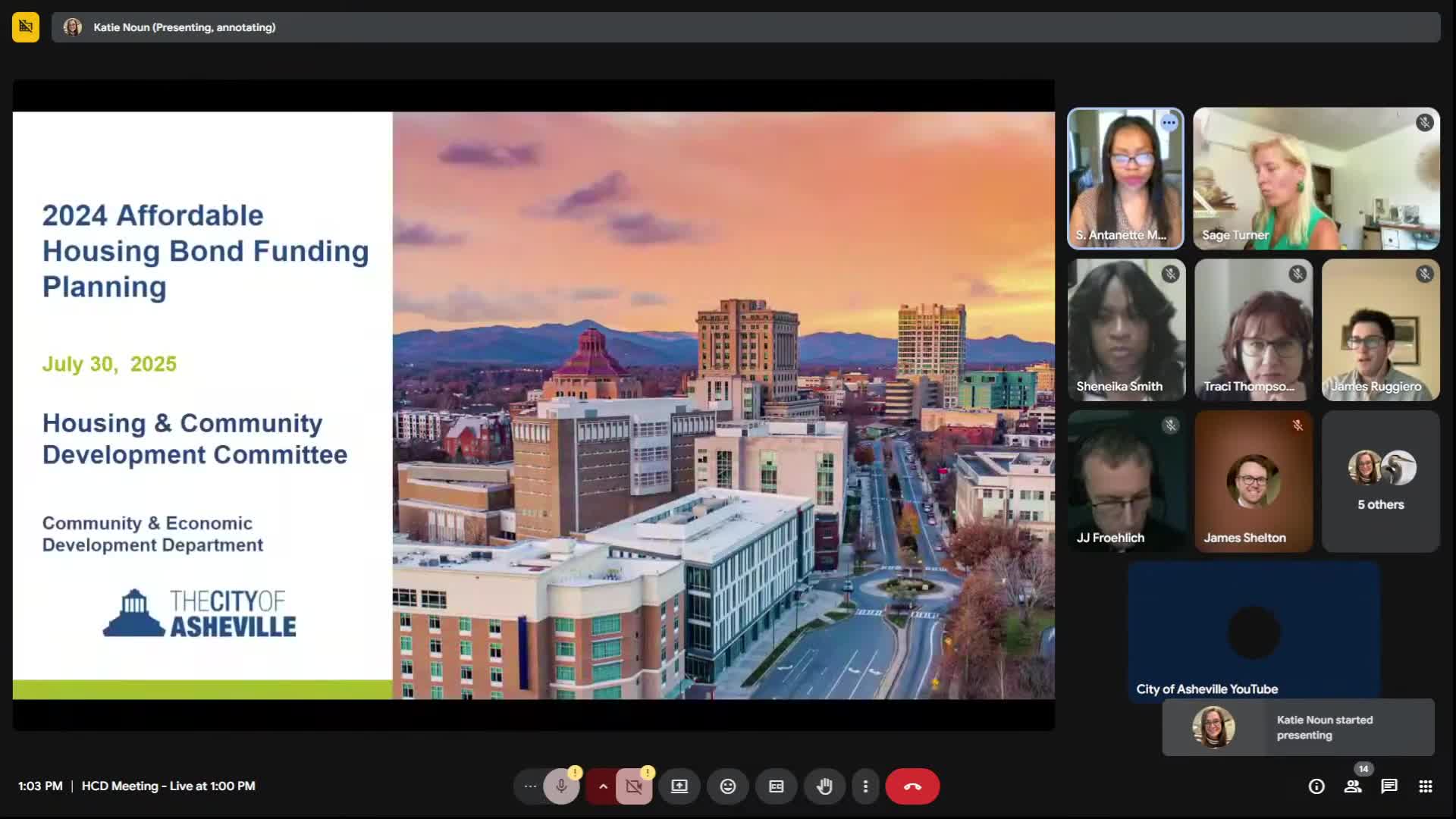
Summary
City staff on July 30 proposed lending $10 million of the $20 million affordable housing bond to the Western North Carolina Affordable Housing Loan Fund — a Self Help Credit Union–administered vehicle seeded by Dogwood Health Trust — to leverage private capital for multifamily projects, and presented a draft distribution that also would direct $6 million to the city housing trust fund and $1 million to pre‑disaster home repair.
City staff on July 30 proposed lending $10 million of the $20 million affordable housing bond to the Western North Carolina Affordable Housing Loan Fund — a Self Help Credit Union–administered vehicle seeded by Dogwood Health Trust — to leverage private capital for multifamily projects, and presented a draft distribution that also would direct $6 million to the city housing trust fund and $1 million to pre‑disaster home repair.
The proposal was presented by Sasha Versinski, Affordable Housing Officer for the Asheville City Housing and Community Development Committee. Versinski said the bond was approved by voters in November 2024 and that staff are coordinating those bond dollars with other housing sources, including federal CDBG‑DR funds the city received. “There are a lot of vulnerable folks who rent and, we’re very concerned about stabilizing those folks and making sure that they can stay in the community and that we make sure that folks don’t fall into homelessness unnecessarily,” Versinski said.
Self Help Credit Union staff described the loan fund's structure and products. JJ Freilich, representing Self Help, said the fund was launched with initial support from Dogwood Health Trust and that Self Help manages fund origination and underwriting. Freilich said the fund offers two primary products: bridge loans ($500,000–$7,000,000; five‑year term; interest‑only payments; stated example rate 2.95%) and mezzanine/permanent gap loans (same loan size; 15‑year term; interest‑only payments; stated example rate 2.45%). He said the fund will generally require that units serve households at or below 80% of area median income and that the fund's minimum underwriting expectation is that half of units meet that 80% threshold.
Staff described how joining the regional loan fund would work operationally: Asheville would lend $10 million at 0% interest to Self Help, which would blend the city dollars with private and philanthropic capital, perform underwriting and loan servicing, and originate gap and bridge loans to developers. Versinski and other staff emphasized that the fund could expand the pool of private capital available to local projects and speed underwriting because Self Help has commercial lending capacity the city does not.
Staff also reviewed related housing resources and pipeline projects. Versinski said the city has been awarded $225 million in CDBG‑DR funds, noting $20 million of that award is designated for multifamily construction, and that separate HOME funds of roughly $3 million target multifamily construction aimed at homelessness prevention. She described past bond spending (the 2016 $25 million bond) and cited investments in rental units, land acquisition, and predevelopment for projects including Haywood Street Apartments and Star Point.
Staff proposed additional draft allocations and program design notes: $28 million set aside for multifamily construction (as a broader gap‑funding pool), a $500,000 minimum project award threshold for multifamily gap funding, competitive scoring that would prioritize deeper affordability (targeting units below 60% AMI where feasible), and that CDBG‑DR projects must comply with federal requirements such as environmental review and Davis‑Bacon prevailing‑wage rules. Versinski said staff will return in August with a formal proposal, additional data from consultant Patrick Bowen to inform affordability targets, and answers to outstanding policy questions raised by advocates (including source‑of‑income nondiscrimination language and whether the city should set a 60% AMI cap for city‑funded projects).
Council members and Self Help staff discussed practical and policy tradeoffs. Councilwoman Sage Turner expressed support for the toolset and asked about the fund's track record with “missing middle” (smaller multifamily) projects; Self Help staff said other funds have supported acquisitions ranging from scattered‑site portfolios to conversions of hotels and large multifamily preservation deals. Staff and Self Help also discussed how mixed‑income projects and averaging of AMI across unit types typically factor into financing and tax‑credit applications; Self Help said their product allows some flexibility up to an 80% AMI cap but that many funders and underwriting models expect a mix that can average to deeper affordability.
No formal vote was taken on the loan agreement or bond allocations at the July 30 meeting; staff said they will return with a formal proposal and program manual in August. The committee approved the minutes for the June 17 meeting earlier in the session by roll call vote.
Ending: Staff asked committee members to submit additional questions ahead of the August meeting; no public speakers were queued during the public comment period at the end of the remote session.