
City prepares to launch $17 million CDBG‑DR small-business program; staff to use subrecipients for grants, loans and technical assistance
Get AI-powered insights, summaries, and transcripts
Subscribe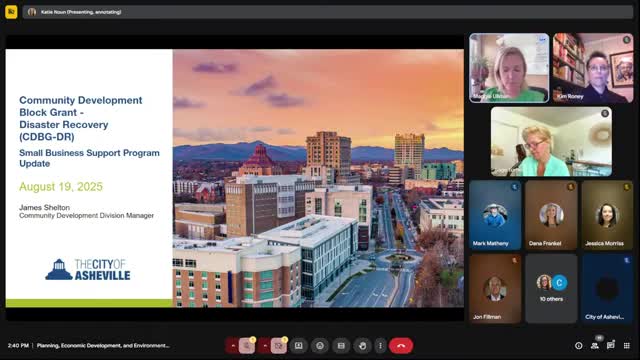
Summary
City staff told the committee they will prioritize a $17 million CDBG‑DR small‑business support program and will use competitive NOFOs to select subrecipients who will administer grants, forgivable loans and technical assistance to qualifying local businesses.
The city’s Community Development Division presented details Aug. 19 on its Community Development Block Grant–Disaster Recovery (CDBG‑DR) program rollout and the small-business support program staff plans to prioritize for early implementation.
Manager James Shelton said the city received a HUD CDBG‑DR grant this year and that the action plan submitted to HUD in April was approved in May. The city is finalizing program manuals and certification requirements; Shelton said the city recently obtained HUD certification for financial-management and grant-compliance systems and would sign the grant agreement before program implementation.
Shelton said the small-business support program within the economic‑revitalization bucket is budgeted at $17 million and will deliver grants, forgivable loans and technical assistance intended to stabilize businesses affected by Tropical Storm Helene. The economic‑revitalization bucket totals about $52 million of the city’s CDBG‑DR allocation; other buckets include infrastructure, workforce development and housing-related programs.
City staff said they will not make direct awards to private businesses from the city; instead, the city will issue competitive notices of funding opportunity (NOFOs) to select subrecipient organizations (nonprofit or public partners, including accredited local educational institutions and community development financial institutions) to administer the funds. Shelton said subrecipient awards are expected to range from a minimum of $250,000 to a maximum of $10 million. Subrecipients will then operate business-facing application processes, distribute grants or loans to eligible small businesses, and comply with federal monitoring and anti‑fraud requirements.
Shelton and staff explained several program rules and federal constraints: CDBG‑DR programs must meet HUD’s national objective of benefiting low-to-moderate-income (LMI) persons — the city’s plan allocates that at least 70% of program dollars must benefit LMI residents. For businesses located in census tracts with a poverty rate of 20% or higher, HUD allows a presumption that benefits reach LMI residents; in central business districts (including downtown Asheville) the presumption threshold is 30% poverty, and Shelton said downtown Asheville’s poverty rate (~27%) would not meet that presumption, which increases documentation needs for downtown business awards. Shelton added construction-related activities were excluded from the initial business-support design because construction triggers additional federal cross‑cutting requirements (environmental reviews, Davis‑Bacon prevailing wage rules) that lengthen delivery times.
Shelton described proposed allowable uses: forgivable working‑capital loans (for payroll, inventory, equipment), lower‑cap grants for working capital, technical assistance (business planning, accounting, e-commerce) and architectural/engineering design services (not construction) to help businesses prepare for repairs or mitigation. He said eligibility for business awards will follow SBA small-business size standards, require a principal place of business in the city, and require the business to demonstrate a disaster-related impact or loss. Subrecipient partners must pass federal debarment checks, maintain financial systems and perform duplication‑of‑benefit reviews (to ensure federal dollars are not used to pay the same loss twice).
Shelton said staff are already holding facilitated stakeholder sessions with the Chamber and GoLocal to refine program details and would begin rolling program implementation later this year after the grant agreement is executed and program manuals are finalized. Shelton said the city’s first CDBG‑DR hire (a program manager) would start the next day.
What’s next: the city will publish NOFOs for subrecipient partners, score applicants on readiness and recovery alignment, bring recommended subrecipients to committee and council for approval, and then pay subrecipients to run applications for businesses. Small businesses were urged to prepare documentation in advance: business revenue records, insurance claims, SBA application status, SAM.gov registration (if applicable), and household income information for employees where required to establish LMI benefit.