
Committee considers pilot to raise 'level 3' event cap and asks Noise Advisory Board update
Get AI-powered insights, summaries, and transcripts
Subscribe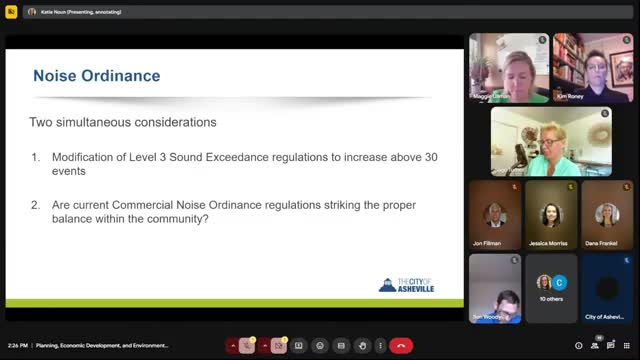
Summary
Staff presented options to alter the city’s commercial-noise rules, including temporarily increasing the 30-event cap for 'level 3' venues as a time-bound pilot and reviewing the commercial-noise ordinance versus neighborhood concerns; members asked for Noise Advisory Board input and data on noise complaints before moving to council.
City staff presented Aug. 19 on the city’s commercial-noise ordinance and a narrow proposal to pilot a temporary modification to the level-3 sound-exceedance rule (the city’s current cap for level-3 event days is 30), plus broader questions about whether the commercial-noise ordinance balance remains appropriate for downtown.
Development Services Director Mark Matheny said the proposed approach could establish a sunset date for any temporary change to the number of allowable level-3 events, require an evaluation at the pilot’s end, and rely on community reporting to summarize benefits and impacts. He noted only a small number of venues currently meet the level-3 technical requirements (which include on-site monitoring and baffling). If a particular venue repeatedly exceeded the ordinance, that history would be considered when staff reviewed future event approvals.
Council members said they wanted more community context before changing the ordinance. Several members, including a council member with a background in the music industry, asked staff to get an update from the Noise Advisory Board about lessons learned since the board’s creation and to provide historical complaint and enforcement data. Council members also asked staff for data on how many noise complaints were generated by current level-3 venues and whether past enforcement records would prevent venues from continuing planned events.
No ordinance changes were adopted at the Aug. 19 meeting. Committee members expressed support for a time-limited pilot approach, particularly as a way to test whether temporary increases in allowable events could support downtown activation, but asked staff to return with Noise Advisory Board findings and complaint/enforcement data to inform any council-level decision.