
Committee weighs event-based "social districts" pilot to let customers carry alcohol within downtown event areas
Get AI-powered insights, summaries, and transcripts
Subscribe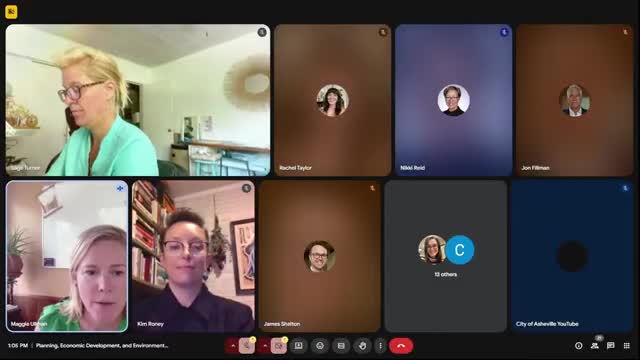
Summary
City staff recommended an event-based pilot for state-authorized social districts as one possible downtown activation tool; committee members signaled support for a limited, pilot and event-based approach but asked for more targeted outreach and mapping before moving a permanent ordinance forward.
The Planning, Economic Development and Environment Committee discussed a proposal Aug. 19 to pilot state-authorized "social districts" tied to specific outdoor events that would allow customers to carry alcoholic beverages purchased at participating on-site, ABC-permitted businesses within a defined event boundary.
City Downtown Projects Manager Dana Frankel told the committee the authority for social districts comes from state law and that the program would require a council ordinance, clear geographic boundaries, specific days and hours, signage, and a management and maintenance plan submitted to the North Carolina Alcoholic Beverage Control (ABC) Commission. Frankel said a few North Carolina cities have used event-based social districts as pilots and that the city’s legal team had consulted the state ABC office about an event-driven approach.
Frankel said the city found three North Carolina models: Pinehurst (tied to about four annual events and now being retired), Wilmington (a three-Saturday pilot that provided a model for a broader advisory and application process), and China Grove (a single-annual-event approach). She said Wilmington’s pilot showed businesses reporting three to four times their typical sales for the tested events and that nonprofits helped underwrite staff costs for the pilot. Carly Gillingham, assistant city attorney, said she had spoken to the state ABC legal department and that the state indicated an event-based framing would be acceptable.
Committee members repeatedly asked for more geographic detail. Councilwoman Turner and other members said feedback from downtown stakeholders varies by neighborhood — South Slope business interests had expressed support while some Wall Street businesses had not. Several members said they would only support social districts if the city pursued them as a time-limited pilot tied to specific events rather than a permanent, citywide change that would require extensive community engagement and long-term staff commitment.
Council Member Sage and others emphasized operational details: whether the city’s outdoor events office or another office would serve as program administrator for events the city stewards, and whether a social district tied to an event would allow patrons to leave the event boundary with alcoholic beverages (the city’s presentation said the authorized area would be boundary-limited and that carrying alcohol beyond the boundary would not be allowed). Frankel said staff had not yet done broad-based community engagement on social districts.
The committee did not take a formal vote to create a social district. Members asked staff to return with maps, clearer proposals for where pilot events might be permitted, and more outreach to affected businesses and neighborhoods before any ordinance is drafted for council consideration.
The committee also discussed coordination between social districts and open-streets events and whether social districts should be considered alongside the city’s outdoor special events permitting process. Frankel and legal staff said an event-based social-district model would generally be processed alongside the city’s event permitting framework and that costs and management could vary depending on whether existing event organizers absorbed extra responsibilities.
What’s next: staff will develop maps and targeted outreach materials, explore an event-based pilot model, and return with more specific proposals for committee and council review. No ordinance or formal council action was adopted during the meeting.