Get Full Government Meeting Transcripts, Videos, & Alerts Forever!
Get email alerts on the Professional Development Instructional Model topic
No spam. Unsubscribe anytime.
Deputy superintendent outlines 2025–26 professional development plan and new instructional model
Summary
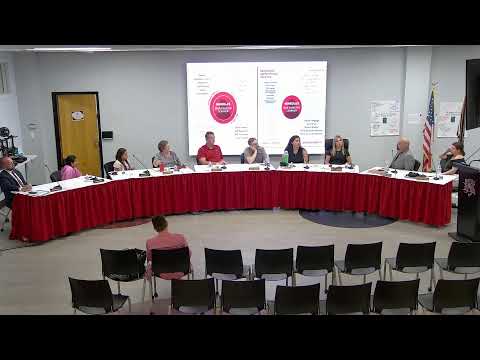
Deputy Superintendent Catherine Fishman presented the district’s Professional Development Plan and Michael Naglas outlined a proposed instructional model emphasizing skills (executive functioning, information literacies) and new scheduling ideas such as BYOG to create more self-directed learning time.
Catherine Fishman, deputy superintendent, presented the Mineola Union Free School District’s Professional Development Plan (PDP) for 2025–26, describing structured cycles of professional learning, independent study options and survey feedback used to shape next year’s training. Fishman said the PDP aligns adult learning with district goals, instructional leadership and learner data.
Fishman told the board the PDP uses three cycles with four sessions per cycle, offers asynchronous “SNACs” (short new applications of expertise) and includes independent-study options for support staff and specialists. She reported 159 respondents to last year’s district PDP survey and 94 respondents this year. The presentation highlighted program-level training (for curricula such as Amplify) and committees (social-emotional learning, executive functioning) that help sequence training across grade bands.
Superintendent Michael Naglas followed with a broader presentation on evolving the district’s instructional model to foreground “skills” — human skills (empathy, curiosity), literacies (digital, information, financial), executive functioning and student voice — and to make time in school more flexible. Naglas described pilot concepts such as BYOG (bring-your-own-grade/course model) intended to “recapture time in the class” so teachers can shift from whole-class direct instruction to rotations, conferencing and individual/small-group work.
Naglas framed the change as preparing students for contemporary workplaces and said the district will audit where skills are explicitly taught pre-K–12 and then build curriculum and schedule adjustments where gaps appear. He noted the district will draft one-pagers for each targeted skill area and continue program audits, professional learning committee work and pilot scheduling experiments.
Board members asked about credentials for professional learning (certification credits), the balance between choice and required sessions, and the logistics of asynchronous coursework; Fishman said qualifying sessions will earn re-licensing credits when they meet state guidelines. Trustees who have observed the PDP committee described it as representative and practical in shaping professional learning.
Fishman and Naglas said the PDP and model audit will inform the district’s 2025–26 work plan; the board will receive a draft of board goals at the next meeting.