
Twain Elementary growth options: boundary change, expansion, or capped enrollment with bridging considered
Get AI-powered insights, summaries, and transcripts
Subscribe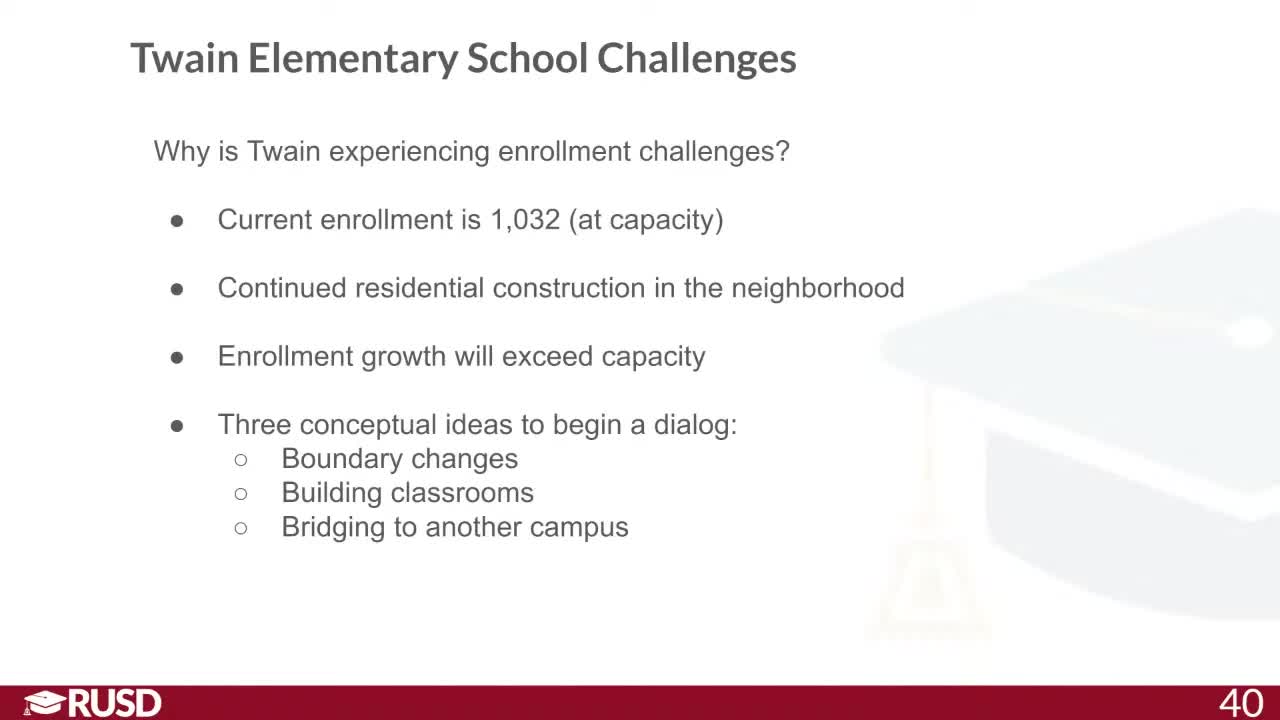
Summary
Staff identified three ways to address Twain Elementary’s growth: adjust attendance boundaries, build an addition on adjacent district land, or cap enrollment and bus new arrivals to nearby schools (bridging). Trustees asked staff to develop all three concepts for community review.
Riverside Unified staff presented three conceptual approaches to address rapid enrollment growth at Twain Elementary: boundary adjustments, a physical expansion using district-owned adjacent land, or a capped-enrollment approach that would bus new resident students to nearby schools until capacity opens (“bridging”). Staff said Twain has become one of the district’s largest elementary campuses and will soon exceed capacity. The three concepts were described as follows: - Boundary adjustments: redrawing attendance lines to shift some students to adjacent campuses. Staff noted this is a domino process—the change would affect multiple schools and require transportation adjustments—and asked trustees whether to pursue specific boundary maps. - Expansion on district-owned land: staff noted the district owns property adjacent to Twain and presented preliminary sketches showing what a wing addition could look like. Trustees asked district staff and instructional services to weigh whether a larger elementary (approaching middle-school-sized enrollments) would be educationally appropriate; Instructional Services said very large elementary enrollments create supervision and programming challenges. - Bridging: temporary caps on grade-level enrollment with targeted transportation for new families so that new students would attend other nearby schools until capacity opens at Twain. Staff said bridging is similar to approaches used in other districts (Corona-Norco example cited) and described how developers and incoming buyers could be notified to set expectations. Trustees directed staff to develop all three concepts so the board could evaluate the trade-offs, and asked staff to prioritize community communication so families know how near-term growth will be handled. Trustees also asked staff to include cost estimates, transportation implications, and program impacts in the follow-up analysis. Why it matters: Rapid growth at a neighborhood school changes family experience, staffing, and capital demands. Each option has trade-offs in family disruption, cost, and long-term program impact; trustees asked staff to model outcomes and bring refined options for board and community review. Next steps: staff will prepare refined boundary maps, cost estimates for an addition, transportation cost scenarios for bridging, and proposed messaging for the community.