
Madras planning commissioners approve code amendments to align public-improvement standards with city specifications
Get AI-powered insights, summaries, and transcripts
Subscribe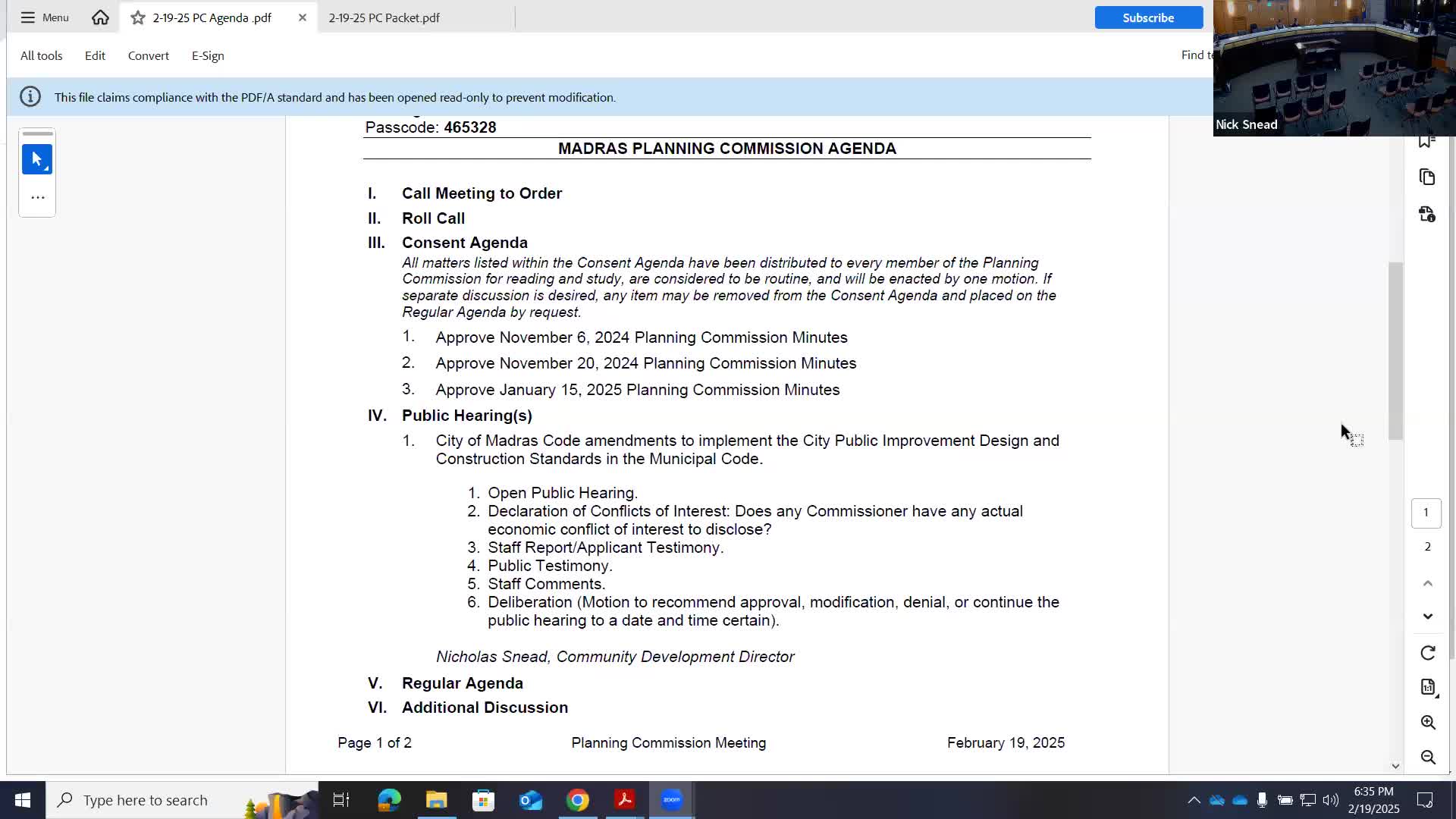
Summary
The Madras Planning Commission voted to approve changes that move public-improvement design and construction standards out of the development code and clarify authority and submittal requirements for right-of-way dedications, storm drainage and street improvements.
The Madras Planning Commission voted to approve amendments to the city's development code to implement the city's public improvement design and construction standards and specifications, the commission decided after a public hearing opened at 6:35 p.m.
Staff told the commission the changes are intended to make the development code consistent with the city's standards and specifications and with state law requiring that criteria for 'needed housing' be defined by clear and objective standards. "This statute requires that they be approved by clear and objective standards," a staff member said during the hearing, describing ORS 1 97 a 400 as the governing statute cited in the staff report.
The approved package pulls engineering and right-of-way procedures out of the development code and relies on the city's standards and specifications and the municipal code chapter that governs public rights of way (chapter 12) for implementation. The commission's action clarifies multiple topics: when streets and frontages must be improved to city standards, how private and easement streets are treated, when existing inadequate streets must be brought up to standard, and submittal requirements for storm drainage and grading plans.
Key provisions noted by staff and discussed by commissioners include a requirement that applicants submit a preliminary grading and drainage plan when a project will add or remove more than 24 inches of soil; revised frontage and access requirements to require improvement of all applicable frontages per the standards and specifications; new language authorizing acceptance of dedications and transfers of public rights of way under procedures in chapter 12; and clearer cross-references so the engineering standards in the city's standards and specifications govern street alignment, spacing and construction rather than duplicative or discretionary development-code language.
Commissioners asked clarifying questions about checks and balances on who can accept rights-of-way. Staff explained the proposed language authorizes the city administrator or designee (for example, the public works director) to accept many dedications administratively while preserving the city council's authority to consider grants, dedications or transfers and to call a public hearing at its discretion. "All grants or dedication as well as intergovernmental transfers of right of way require the approval of city council," staff said while explaining the chapter 12 wording, and added the city administrator may refer any proposed grant or dedication to the council.
The package also clarifies that an occupation, encroachment or franchise use of public right of way requires council approval but allows the council to delegate routine licensing, permits and other approvals to the city administrator or a designated public works official.
Commissioners discussed practical examples raised during the hearing: purchasing or dedicating right of way when a third party (for example, a state agency) needs additional right of way for a project; how right-of-way acquisitions are handled through title and escrow; and the implications of annexing unimproved county roads that may become city responsibilities. Staff said the proposed code language is intended to reflect current practice while avoiding conflicting standards between the development code and the standards and specifications.
Vice Chair Commissioner Eder moved to approve the amendments and Commissioner Irvin seconded the motion. The commission recorded the motion as approved; no public testimony was offered at the hearing. Commissioner Irvin thanked staff for presenting the changes in a table format and for clarifying the differences between chapter 18 (development code) and chapter 12 (rights of way).
The commission's approval sends the recommended code amendments forward in the city's process consistent with the municipal code. The changes place engineering and right-of-way details where staff said they belong'in the standards and specifications and the right-of-way chapter'while highlighting submittal requirements (for example, preliminary drainage/grading plans for more than 24 inches of fill) that applicants must provide to render applications complete.