
Committee approves Echo Northwest homelessness recommendations to send to city council
Get AI-powered insights, summaries, and transcripts
Subscribe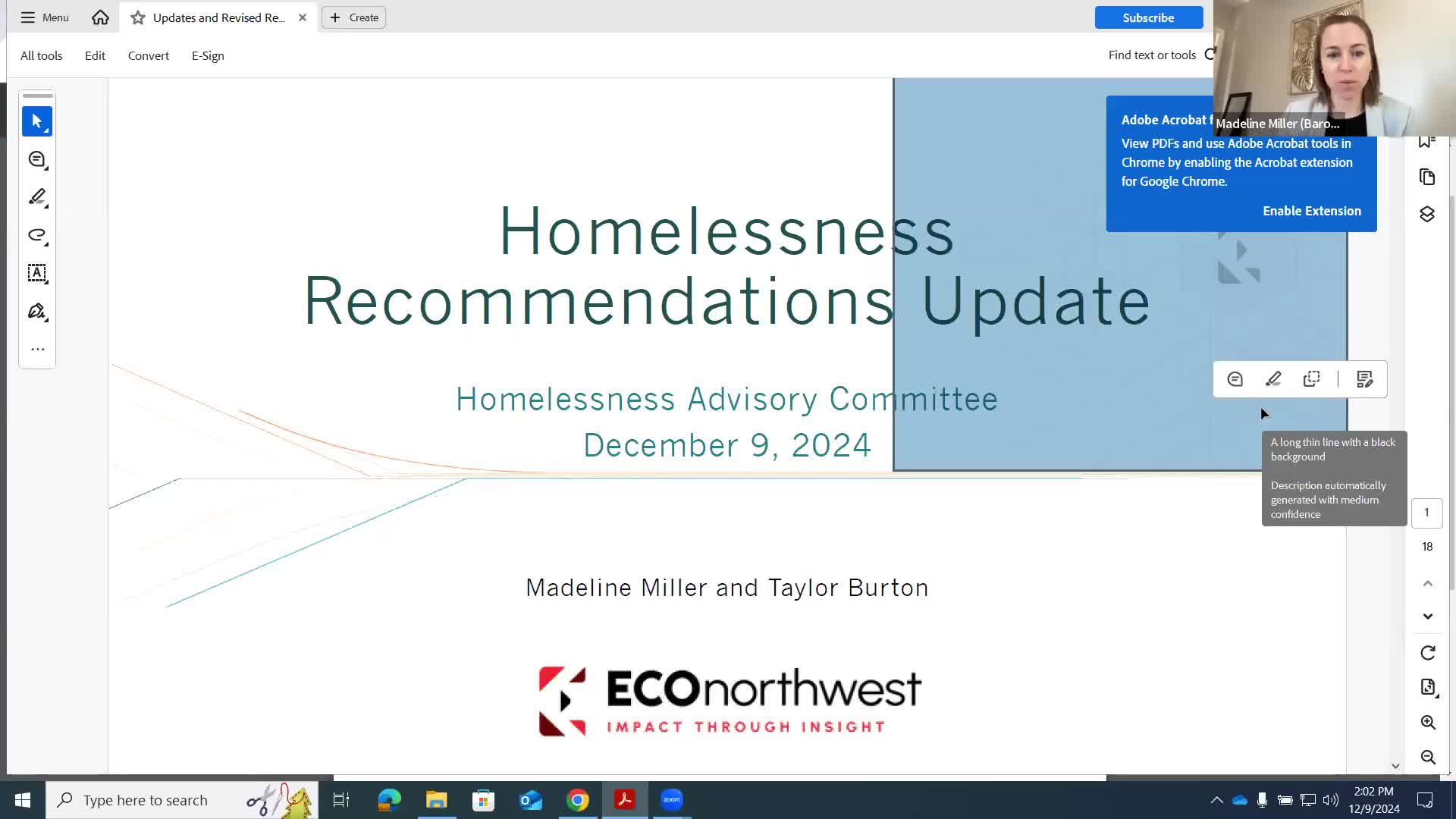
Summary
Echo Northwest presented a revised homelessness recommendations report based on 46 interviews and local provider input; the Madras committee approved forwarding the plan to city council with requested edits including a housing continuum and transitional housing options.
Madeline Miller, a senior project manager with Echo Northwest, presented a revised homelessness recommendations report to the Madras Housing and Homelessness Committee and asked the committee to recommend advancing the plan to the City Council for adoption in late January or early February.
The consultant team said the revised report reflects feedback gathered from interviews and service providers and builds the recommendations into a work plan organized around six issue areas: too few affordable housing units; barriers to reentry; evictions and housing instability; shelters and services not meeting all needs; a centralized navigation/resource function; and larger stability needs including income, identification and employment supports. "We are hoping to receive the committee's recommendation to advance the recommendations we're putting forward," Miller told the committee.
Nut graf: The committee unanimously approved forwarding the recommendations to the city council after asking staff to add language recognizing a continuum of housing options and to include transitional housing options (including safe parking and other interim models) as well as a summary of available state and regional funding sources. The report is intended to guide city staff and partners on steps the city can take as an advocate, partner or limited funder while noting the city does not directly control some levers such as federal vouchers.
The report draws primarily on 46 interviews facilitated by local partners — BestCare, Jefferson County Public Health Department and the Jefferson County Faith-Based Network — and supplementing a market analysis, literature review and prior local focus groups. Consultants said 95 percent of interview respondents reported long-term struggles with homelessness. More than half of respondents said they did not have trouble finding a shelter, though 44 percent reported difficulties getting into shelters; 65 percent reported trouble accessing services; and many respondents cited lack of affordable housing, insufficient income and missing identification as barriers to obtaining permanent housing. Twenty-three respondents specifically cited financial stability and employment as obstacles to meeting basic needs.
Echo Northwest staff acknowledged limits in the data: demographic fields were not collected consistently across partners, some interviews were completed on paper forms, and the sample is not statistically representative. They said the raw interview records are in an Excel file and that the consultants supplemented those interviews with a market analysis and a review of best practices.
Committee discussion focused on adding transitional housing and a clearer statement that housing exists along a continuum with wraparound services; improving connections to rental assistance and legal aid for tenants facing eviction; landlord risk mitigation tools (a risk-mitigation pool was discussed but committee members questioned immediate funding sources); and coordination with the jail and reentry supports. A public-health representative confirmed culturally competent training for shelter staff had occurred and committee members reported ongoing steps to expand winter warming hours and summer cooling services at the local shelter.
The consultants noted potential roles for the city including advocating for more vouchers (the city cannot directly increase federal vouchers), supporting the development of deed-restricted affordable units through zoning or funding incentives, and building or funding an expanded navigation center to centralize referrals and eligibility information.
A motion to approve the presentation and recommend the report to city council was made, seconded and approved by voice vote; individual roll-call votes were not recorded in the transcript. The committee directed staff to incorporate the recommended edits—specifically: (1) add language recognizing a continuum of housing options and the need for wraparound services; (2) add transitional housing options to the list of recommended solutions; and (3) include an appendix or section summarizing state and regional funding sources and existing referral pathways—before the report goes to council.
Echo Northwest said it is prepared to deliver a final report with the committee's edits for the council agenda in late January or early February. The committee's chair thanked the presenters and noted the revised report was stronger than prior drafts.
Ending: With that approval, the committee adjourned at roughly 3:00 p.m.; the presenters and staff will return with an updated report for the city council review and possible adoption.