
Groves council workshop focuses on major street backlog; staff and consultants push transportation-utility fee to leverage debt
Get AI-powered insights, summaries, and transcripts
Subscribe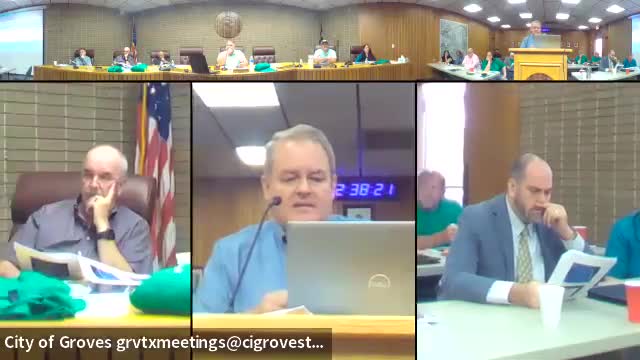
Summary
City staff told the July 12 strategic planning workshop that the city cannot make significant progress on its failing streets with pay‑as‑you‑go funding and urged use of a transportation utility fee to support borrowing for large-scale reconstruction.
At a July 12 strategic planning workshop, Groves city staff and outside advisers told council members the city’s current street-maintenance budget is far too small to address decades of deferred reconstruction and that a transportation utility fee is the most viable way to create steady revenue to service debt for large projects.
Kevin, a city finance staff member leading the presentation, said the city’s routine annual allocation—about $500,000—“is barely good” for ordinary maintenance and cannot fund the scale of reconstruction council members described. He told the council, “The only way to have enough money to do anything with significance is to use this transportation utility fee to get the income to service a debt issue.”
The staff presentation included cost estimates for typical reconstruction: a 2‑inch hot‑mix overlay was shown at roughly $400,000 per mile (March pricing referenced by staff), while deeper reconstruction with stabilized subbase was estimated at substantially higher per‑mile costs. Slides showed Groves maintains roughly 75 miles of streets; staff calculated that reconstructing 7.5 miles per year (a 10‑year cycle) would require roughly $5.7 million in funding beyond current annual allocations.
Council members discussed funding options. One council member proposed a short-term step to fund a technical study by adding a small monthly charge to utility bills (participants discussed $1 per month as a visible, temporary funding line to pay for the study and public outreach). Several council members and staff said the water bill is the most reliable monthly communication vehicle to reach every household and that a visible line item could be used for outreach and transparency while a study is produced.
Bob Anderson, managing director at RBC Capital Markets, who attended as a financial adviser, encouraged the council to prepare the public education work needed before asking voters to approve bonded debt or other revenue measures. He told the council a common outcome across Texas is that local governments must prepare voters to approve revenue increases to maintain services, saying local governments face pressure from state limits on new revenue and rising municipal costs.
Council members and staff discussed next steps and timing: staff estimated 12–24 months from adoption of a financing approach to start major reconstruction, allowing time for engineering, voter outreach if required, and contract procurement. They also discussed potential program design choices: a voter referendum for a bond package, a dedicated utility user fee used to pledge debt service, or reallocating existing sales‑tax or general‑fund dollars (the latter would be a zero‑sum reallocation). Several council members favored a time‑limited (“sunset”) fee or clearly restricted use language to reassure residents that fees will fund streets and related infrastructure only.
No formal action was taken at the workshop; council directed staff to continue work on a costed program and public education plan and to prepare a draft scope and cost estimate for a transportation‑utility fee study and a potential financing scenario for council consideration ahead of the formal budget schedule.
The workshop included extended discussion of related issues—underground utilities that require repair before paving, chip‑seal versus full reconstruction, and contractor capacity in the region—underscoring that a credible plan will need mapping of subsurface needs and a prioritized project list before a large funding request is presented to voters or lenders.