
Finance staff recommends $101,000 accounting-system investment in 2026 preliminary budget
Get AI-powered insights, summaries, and transcripts
Subscribe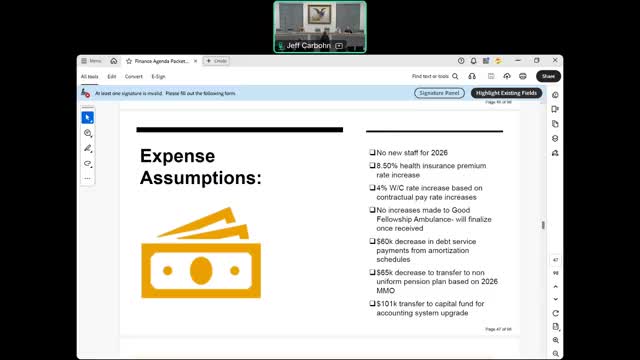
Summary
Finance staff proposed a $101,000 capital investment to replace a 22-year-old accounting system, citing poor integration and manual processes; staff said the implementation would run 6—68 months and annual subscription costs would be offset by retiring multiple existing systems.
Finance staff presented a preliminary 2026 budget that includes a $101,000 one-time implementation fee for a new accounting system to replace the borough's current 22-year-old MIP fund accounting software.
Why it matters: staff argued the upgrade would cut manual work, reduce errors and consolidate multiple payment processors and software platforms into a single system, improving reporting timeliness and transparency.
Barb, the finance director, described limitations of the current system: it requires manual exports to Excel, offers no purchase-order integration, does not attach invoice back-up and provides department heads reports that are often 30 days out of date. "The accounting system does not integrate with SmartGov, Clover, MyRec, United Public Safety, Flash, Paylocity, Heartland, or Muni Billing," she said. "So all the entries we're doing manually. We're doing manual cash receipts, the journal entries...it equates to there's no real time reporting."
Staff said an RFP generated responses from five vendors; implementation-only quotes ranged from roughly $100,000 to $287,000. The $101,000 figure in the 2026 request reflects the implementation cost the staff recommends, while annual subscription costs were estimated at about $32,000. Staff said those ongoing subscription costs could be absorbed by retiring existing subscriptions (Clover, Abila, Muni/uni-billing), yielding estimated net annual savings of roughly $30,000—6$35,000.
Committee members asked about upgrades, vendor longevity, timeline and staff workload. Barb said the existing vendor chain has changed ownership several times and upgrades required adding modules at extra cost. She recommended beginning the implementation in January with a 6—68 month timeline, noting staff and consultants would need to run both systems in parallel during the migration. "I am prepared that there is going to be work done on our end," she said, adding training and staff data preparation will be required.
Staff also outlined related 2026 budget assumptions: no headcount increases (headcount remains at eight for the department), conservative revenue assumptions, and a 8.5% increase projected for health insurance premiums.
No final appropriation or formal council vote on the system purchase occurred at this meeting; staff asked that the investment be included in the 2026 budget packet for council consideration.