
Survey: Majority of Anchorage respondents say schools underfunded; parents more concerned
Get AI-powered insights, summaries, and transcripts
Subscribe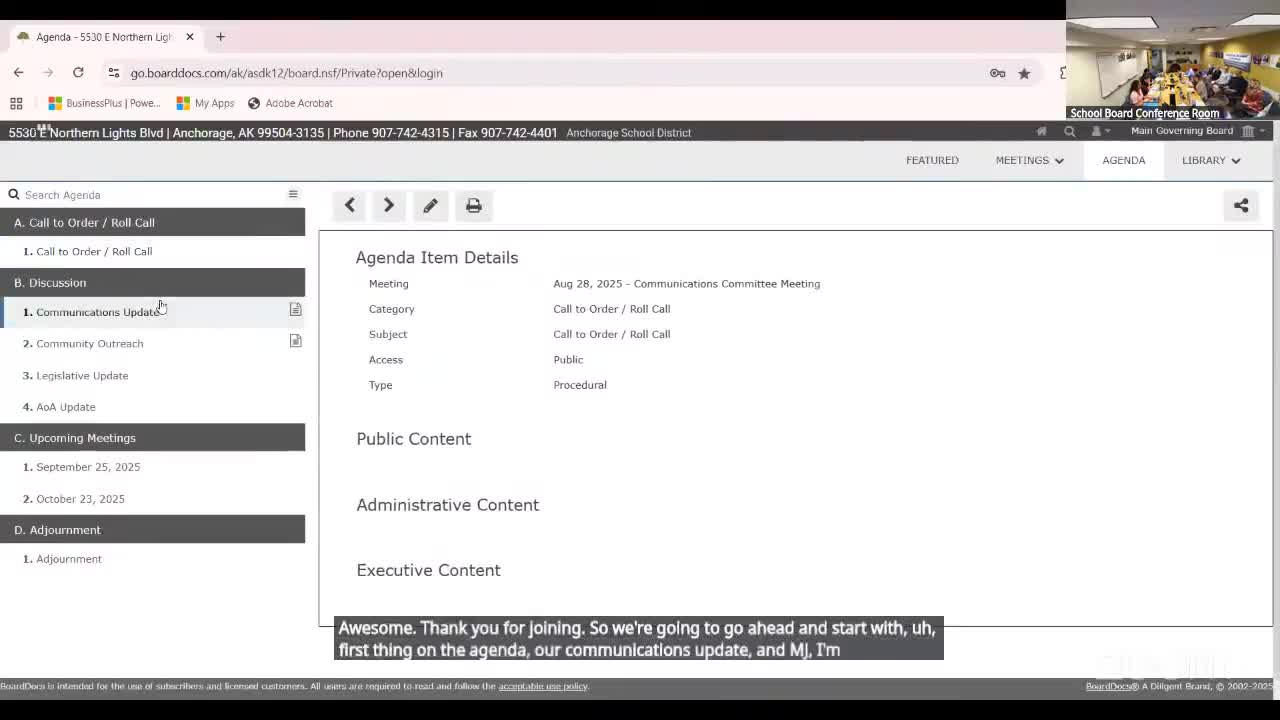
Summary
An Alaska Survey Research poll presented to the Anchorage School District communications committee found most respondents believe Alaska schools lack sufficient funding, with parents of ASD students reporting stronger concern and higher support for legal action the district has taken.
An Alaska Survey Research poll presented to the Anchorage School District Communications Committee on Aug. 28 found most respondents think Alaska schools are not receiving enough funding, and parents of ASD (Anchorage School District) students reported stronger concern and stronger support for the district's recent legal action.
The presentation, introduced by MJ of ASD communications, was delivered by Sina Stanton of Alaska Survey Research, with Ivan Moore, the firm's research director, joining on Zoom. Stanton said the firm fielded the survey from July 29 to Aug. 1 and collected 874 adult responses, producing a margin of error of plus or minus 3.5 percentage points at a 95 percent confidence level. "That sample size gives us a margin of error of plus or minus 3.5% at a confidence level of 95%," Stanton told the committee.
The poll used text-message outreach and an email panel and applied post-stratification weighting by area, age, race, gender, education level, party ID and participation patterns tied to the 2024 presidential election, Stanton said. Moore confirmed that just under 25 percent of respondents reported having children in ASD.
The survey asked respondents to "grade" the district across nine categories (teachers; school board performance; superintendent performance; fiscal responsibility; curriculum; preparing students; communications; and overall). Stanton said teachers received the strongest grades while fiscal and budgetary responsibility scored lowest.
On funding specifically, 62.3 percent of all respondents said Alaska schools are not receiving enough funding; that concern rose to 72.4 percent among respondents who reported having children in ASD. On whether the district's Base Student Allocation (BSA) should be increased, Stanton cited 66.3 percent of all respondents and 73.7 percent of ASD parents in favor of an increase.
The poll also tested awareness of recent budget actions: Stanton said only 34.9 percent of respondents reported awareness of "all parts of the federal funding freeze and state vetoes," and 19.4 percent said they learned about the cuts for the first time through the survey.
Respondents were asked how the cuts would affect education quality; 69.6 percent of the general public and 77.2 percent of ASD families said the cuts would reduce educational quality. On remedies to close budget gaps, Stanton said respondents favored laying off administrative staff most and were least supportive of laying off teachers; she reported 9.9 percent total support for laying off teachers versus 21 percent support for increasing class sizes.
The poll also asked whether state funds should support nonpublic schooling; 65.4 percent of respondents opposed using state funds for nonpublic options, while 29.6 percent supported it. Stanton said 69.3 percent of respondents overall — and 71.8 percent of ASD families — supported the district's recent legal action against the federal government.
Committee members asked methodological questions about the weighting and respondent composition. Dora Wilson, committee chair and a school board member, and Superintendent Dr. Bryant (present in the meeting) both pressed for cross-tab details and a full report; Moore said the district would receive the full cross-tabs and a more detailed report the following day. MJ said the communications office will incorporate the findings into an annual report and other messaging work for the coming school year.
The presentation and Q&A were discussion only; the committee did not take a formal vote on actions during the meeting.