Get Full Government Meeting Transcripts, Videos, & Alerts Forever!
Get email alerts on the Mandatory Reporting topic
No spam. Unsubscribe anytime.
Catalina Foothills board receives mandatory-reporting training on Arizona law
Summary
At a pre-meeting study session, attorney Lisa Ann Smith reviewed Arizona’s mandatory‑reporting law with Catalina Foothills School District governing board members, explaining who must report, when reports must be made, and where to send them.
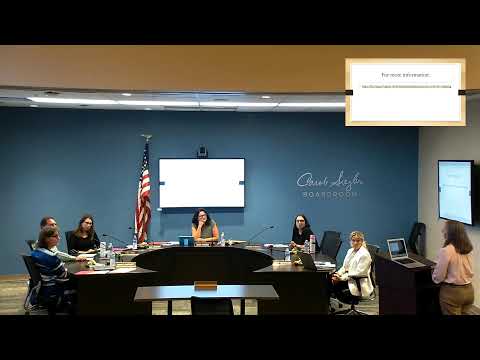
At a study session before its regular meeting, the Catalina Foothills School District Governing Board received mandatory‑reporting training from attorney Lisa Ann Smith of the district’s law firm. The presentation explained the district members’ new status as mandatory reporters under Arizona law and summarized when board members must notify law enforcement or the Department of Child Safety.
The training focused on Arizona Revised Statutes §13‑3620 and related guidance, which Smith described as criminal‑code provisions because Title 13 is the state’s Criminal Code. Smith told the board that the statute requires anyone who forms a reasonable belief that a minor (or an adult who has been declared incompetent) has been a victim of child abuse, nonaccidental physical injury, neglect, or specified sexual offenses to make a report to local law enforcement or, in some circumstances, the Department of Child Safety. "You have an obligation to make a report immediately upon forming a reasonable belief," Smith said, adding, "immediately means immediately." She warned that failing to report can be a misdemeanor in some cases and a Class 6 felony for failing to report certain listed sexual offenses.
Smith explained key practical points the board should follow. Reports must generally go to local law enforcement; reporting only to a school resource officer or school safety officer is no longer sufficient under recent state changes, she said. If the suspected perpetrator is a parent or guardian, a reporter may call DCS, though Smith recommended calling law enforcement as a safe practice. Board members were instructed that the duty to report is personal and cannot be delegated: even if multiple people know of the same allegation, each person who forms a reasonable belief has an individual obligation to ensure a report is made and to confirm in writing that they fulfilled their duty.
The presentation reviewed which conduct triggers reporting: nonaccidental physical injury (bruises, fractures, burns, rug burns), neglect that poses a substantial risk to a child's health or welfare, and a range of sexual offenses including penetration, fondling, indecent exposure, sexting and secret recording in spaces with an expectation of privacy. Smith discussed statutory exceptions and thresholds used by schools: for example, an exception narrows mandatory reporting for elementary school playground accidents when the injury is accidental, occurred at the child’s school during typical playground activity, the parent is informed, and a written record is kept. She also noted a statutory exception that generally does not require mandatory reporting for consensual sexual contact between minors both aged 14–17.
Smith stressed operational guidance for board members who learn such information in their official role (for example, at a school event): do not investigate, avoid repeated questioning of the child, do not confront alleged perpetrators, do not promise confidentiality, and inform the superintendent as soon as possible so the district can coordinate next steps. She said certificated employees who make reports about district employees may also trigger a report to the State Board of Education; while board members are not typically certificated staff, Smith advised notifying the superintendent so district leadership can meet that requirement when applicable. Smith also explained that reporters acting in good faith are immune from civil or criminal liability unless the report was made maliciously.
Board members asked clarifying questions about scenarios such as witnessing an intoxicated parent at a public event, the treatment of accidental contact in sports or playground play, and how to handle third‑hand information. Smith said that not every rumor or vague statement meets the statutory "reasonable belief" standard, but sufficiently specific third‑party accounts can. She reiterated that if a board member forms a reasonable belief based on what they learn in their role, the duty to report attaches.
Before the training ended, a board member asked that the presenter provide the PowerPoint and the state training link for distribution; Smith agreed to provide the slide deck and link for board review. The session was presented as fulfilling the board members' annual mandatory‑reporting training requirement; no formal motions or votes were taken during the study session.
This training supplements district procedures and is distinct from the regular meeting that followed the study session.