
Conroe ISD trustees hear SBOE member, staff and parents debate Bluebonnet reading curriculum and rollout options
Get AI-powered insights, summaries, and transcripts
Sign Up Free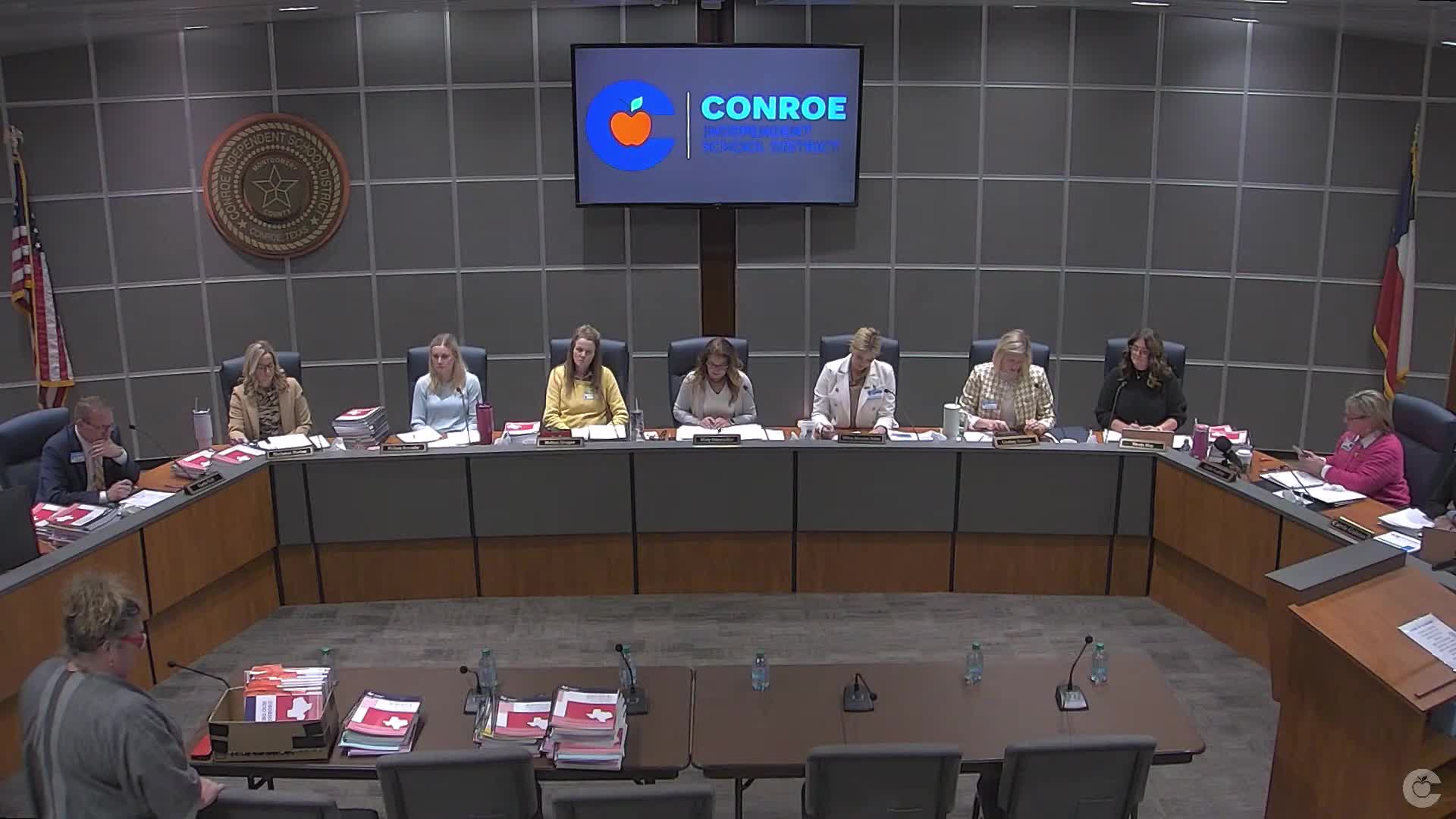
Summary
Trustees spent extended workshop time reviewing state-approved 'high-quality' reading materials, concerns about religious references in Bluebonnet, bilingual availability and costs, and district assessment options including a MAP pilot and dyslexia screening improvements.
Conroe Independent School District trustees spent more than two hours on Jan. 7 reviewing two state-approved K–5 English language arts options and the district’s path for possible adoption.
The board heard from State Board of Education member Dr. Audrey Young and Conroe ISD curriculum staff about Bluebonnet Learning (a Texified version of Amplify) and another publisher on the state High-Quality Instructional Materials (HQIM) list. Dr. Young described pilot results in other Texas districts and said, “I would not have voted yes for it if I didn't believe in this product.”
Why it matters: the state’s HQIM process and recent legislation (HB 1605) created new funding and rules for district adoptions, including a $40-per-student allotment for approved materials and an additional $20-per-student OER (open education resource) allotment for titles that qualify. Trustees, curriculum staff and parents pressed on three practical questions: whether the texts contain religious material presented as religion rather than literature; whether bilingual/Spanish editions will be available and funded; and what diagnostic assessments the district should use to match instruction to student needs.
Discussion and key details - Religious content: During public comment Lynn Greaves told trustees, “Please don't adopt the Bluebonnet curriculum. It's just injecting religion into places it doesn't need to be.” Dr. Lynn Walters, a retired teacher, told the board she believes “religion belongs in the Sunday schools, and religious stories have no place in children's readers.” Board members and Dr. Young responded by showing pages from Bluebonnet units. Dr. Young summarized that the teacher guides contextualize the material as literary background knowledge and said roughly “about 10% of it cites religious texts and the rest of it's literature.” She also pointed out that some lesson pages present the Golden Rule alongside multiple faith traditions. - Pilot results and the science of reading: Dr. Young said districts piloting the system reported “growth of more than one year in less than a year” on internal screeners. She and Conroe ISD staff emphasized that the materials claim alignment to the Texas Essential Knowledge and Skills (TEKS) and to structured-literacy approaches tied to the science of reading. Mark Smith, the district’s elementary language-arts coordinator, and Sharon Henry, the district dyslexia coordinator, described how structured literacy components (phonology, phonics, morphology and diagnostics) fit classroom practice. - Assessments, MAP pilot and dyslexia screening: Wendy Tisdale, coordinator of assessment and instructional materials, reviewed the district assessment calendar and optional pilots. Conroe ISD is piloting MAP (Measure of Academic Progress) at a small number of campuses; staff said MAP’s adaptive, diagnostic reporting could replace some current literacy screeners and provide more rapid teacher-actionable data. District staff estimated annual MAP licensing at roughly $425,000 (reading-only k–6) to $636,000 (k–6 for multiple subjects) and said the license can be budgeted from instructional materials allotments if the board chooses. - Bilingual editions and funding buckets: Staff cautioned that Bluebonnet’s Spanish materials were not yet approved as HQIM/OER at the time of the meeting; that means the $20-per-student OER allotment could not be used for Spanish copies unless the Spanish edition is added to the approved list. The district reported existing balances in instructional-material-related accounts (example figures discussed in the meeting: roughly $6.8 million in new HQIM-related funds, an IMTA balance of about $5.9 million, and an OER balance near $1.3 million) and estimated first-year print costs for a K–5 Bluebonnet rollout at roughly $2.1 million for teacher and student print materials (district staff caveated those as preliminary estimates). - Curriculum-in-house, benchmarks and implementation: Trustees and staff discussed Conroe-created curriculum units that the district has produced as a bridge while HQIM options were reviewed. Darren Carlisle, director of curriculum instruction and professional learning, described a three-year audit and curriculum-management effort (CMAT) that produced unified curriculum maps, lesson exemplars, and a focus on high-leverage TEKS. Staff said district-created units were meant as an interim resource and recommended giving teachers time, training and consistent materials before changing course again.
Quotes from presenters - “I have never seen our literacy scores anywhere close to state averages... CISD has long been a very good district,” Trustee Nicole May said as she urged a data-driven conversation about materials and the 40% of elementary students the board discussed as not reading on grade level. - “It is printable, and it's free,” Dr. Audrey Young said of online Bluebonnet materials; she added that districts may order bound copies or print locally. - “We need to give teachers time and training; picking a book and walking away is not sufficient,” Mark Smith told the board during the workshop portion.
Next steps and timeline discussed - Staff asked the board to authorize the selection process so the district can convene a representative materials-review committee (campus contacts, teachers, coaches, principals and district staff), circulate samples to campuses, host vendor showcases, collect teacher and public feedback and return a recommendation to the board. Trustees signaled support to start that process; staff proposed returning with a committee recommendation in May, recognizing the OER transition-plan rules could lengthen deployment if the board chooses an OER option. - Pilots and staged rollout were discussed as implementation options. Staff said a staged pilot could reduce risk and allow the district to preserve the present curriculum for campuses not yet transitioned.
Ending: what trustees were asked to decide Trustees were asked to authorize the formal district review and selection process for K–5 ELA/HQIM materials and to allow staff to present a final recommendation to the board later this spring. Staff will also provide price estimates for both publishers' print sets (English and Spanish), a clarified OER transition timeline after state guidance, and a cost/benefit comparison that includes MAP licensing and translation/Spanish-copy costs.