Get Full Government Meeting Transcripts, Videos, & Alerts Forever!
Get email alerts on the Housing And Blight topic
No spam. Unsubscribe anytime.
Chelsea advocate urges stronger enforcement of abandoned-properties laws, cites 100+ vacant parcels
Summary
A presenter representing Chelsea neighborhood stakeholders told the council that landlords and out-of-town owners hold many vacant or blighted properties and urged the city to use existing tools — including the Abandoned Properties Act, vacant-property fees and foreclosure processes — to return properties to productive use.
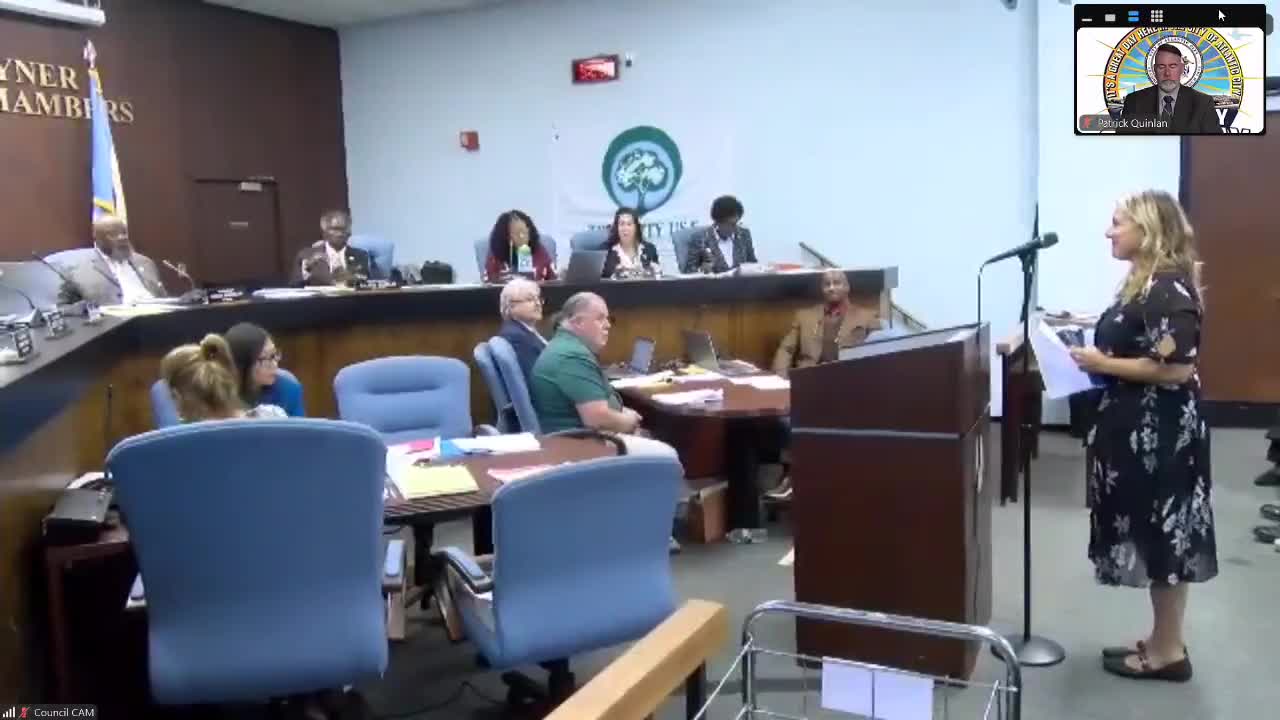
A community representative identified in the meeting transcript as Elizabeth Taranick urged Atlantic City council members on Sept. 17 to increase enforcement actions against absentee owners of vacant and blighted properties, saying the condition of those properties imposes costs on taxpayers and damages neighborhood safety and property values.
“At least a hundred in my area,” Taranick said when asked for a count; she later specified “about a 103 vacant” properties in the Chelsea district and said other neighborhoods also have large numbers of vacant parcels. She told council the owners “do not live in Atlantic City” and said some owners hold multiple properties (one limited liability company was identified in the presentation as owning 31 vacant properties in Chelsea).
Taranick reviewed tools she asked the city to use more aggressively: the Abandoned Properties Act (an ordinance the presenter described as allowing the city to take control of property, make improvements and, if costs exceed property value, place liens on other properties owned by the same owner), a vacant-property fee (she identified a $500 fee on the books but said enforcement has been limited), foreclosure for unpaid taxes and existing code-enforcement processes. She said the abandoned-properties process requires meeting several criteria, including six months of vacancy plus at least one of other statutory conditions, and she described the city’s ordinances as “very effective” if enforced.
Council members and Taranick discussed specific questions: one council member asked whether the Chelsea group shares lists with other community development corporations and Taranick said they do and that CDCs are coordinating. Council members also asked how property values used in the backup were obtained; Taranick said the assessment values came from the city tax assessor.
Taranick characterized blighted properties as drawing repeated service calls to police, code and public works, raising municipal costs, lowering surrounding property values and contributing to trash and arson risks. She also voiced support in remarks for a motel ordinance that was on the council’s agenda that evening.
Council members asked clarifying questions about the abandoned-properties criteria and the process for notifying owners and residents. City staff explained the city must meet statutory criteria — vacancy plus additional nuisance factors — before listing a property as abandoned, and that simple vacancy alone is insufficient.
Taranick offered the Chelsea CDC as a resource and said local groups have met with some owners to explain the enforcement processes. She urged the council to continue to enforce abandoned-properties laws and follow through with foreclosure or lien actions where appropriate.
The council did not take an immediate formal action during the presentation; the session recorded the exchange as a public presentation and part of the public-comment agenda.