Get Full Government Meeting Transcripts, Videos, & Alerts Forever!
Get email alerts on the Housing Blight topic
No spam. Unsubscribe anytime.
Chelsea community group urges Atlantic City to use abandoned-properties tools, supports motel ordinance
Summary
A Chelsea-area community organizer told council there are more than 100 vacant or blighted properties in her neighborhood and urged use of the Abandoned Properties Act, vacant-property fee and foreclosure to address owners who do not maintain properties.
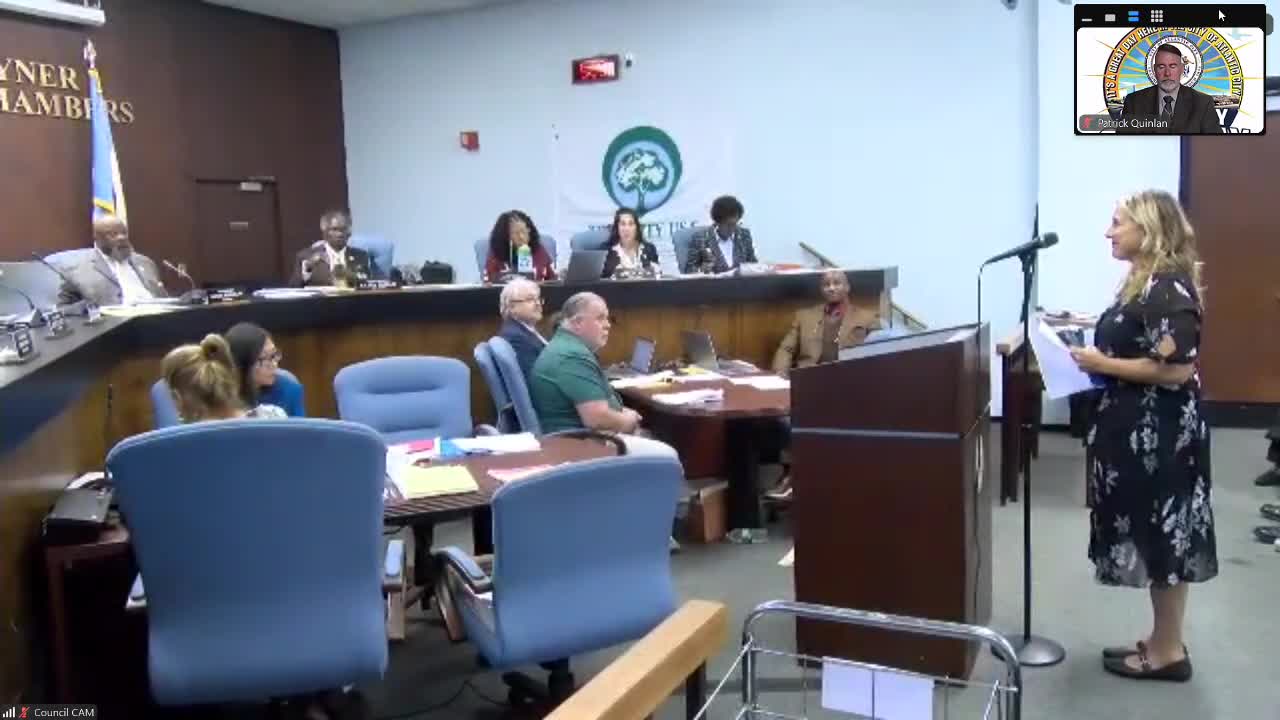
A presenter representing a Chelsea neighborhood planning effort urged the Atlantic City Council on Sept. 17 to use existing legal tools — including the Abandoned Properties Act, a vacant-property fee and foreclosure — to address an extensive inventory of vacant and blighted properties she said depress neighborhood values and impose municipal service costs.
"Taxpayers are paying the cost to maintain these properties as they demand additional services from police, code, public works, and fire," the presenter, Elizabeth Taranik, said during a presentation. She said a single LLC owned 31 vacant properties in the Chelsea area and that there are about 103 vacant lots and buildings in her neighborhood list.
Taranik told council the city already has ordinances that permit action: the Abandoned Properties Act (which can allow the city to take control and lien other properties owned by the same owner when improvement costs exceed property value), a vacant-property fee (noted in the presentation as $500), foreclosure on tax-delinquent properties and code enforcement. She said the community organizations have met with owners to explain the processes and asked the city to enforce its ordinances more fully.
She also expressed the neighborhood group's support for a motel ordinance on the council agenda.
Discussion versus decision: Taranik's presentation was a public-comment/agenda presentation urging enforcement and explaining local impacts. The council did not adopt additional enforcement measures at the meeting; attendees and council members discussed the city's processes for designating abandoned properties and the criteria involved (for example, vacancy for six months plus other conditions), and staff explained the threshold and enforcement steps.
Implementation notes: Taranik said community groups are offering to be a resource to the city and that some community development corporations have purchased and started rehabbing properties in other neighborhoods. Council members and staff discussed the need for clear processes and notification when resident petitions or requests are denied or when an enforcement decision is made.