Get Full Government Meeting Transcripts, Videos, & Alerts Forever!
Get email alerts on the District Improvement Plan topic
No spam. Unsubscribe anytime.
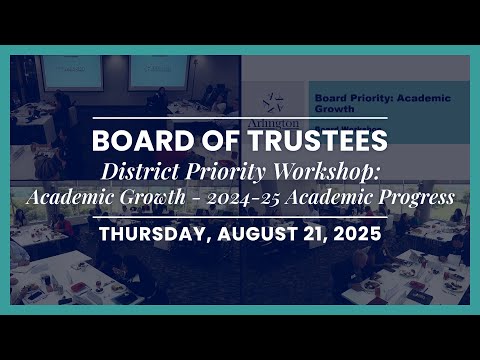
Arlington ISD trustees review draft district improvement plan, staff collect feedback on literacy and math strategies
Summary
Arlington ISD held a workshop where district staff presented a draft district improvement plan and sought trustee feedback on strategies for reading, math, science and social studies.
Arlington ISD held a workshop where district staff presented a draft district improvement plan and sought trustee feedback on strategies for reading, math, science and social studies.
The discussion focused on data trends, proposed ‘‘wildly important goals’’ (WIGs) for departments and campuses, and implementation steps including sustained professional learning, ‘‘compelling scoreboards’’ to track progress, and monthly/quarterly accountability checks. Staff collected table-level written feedback to inform a final plan.
Why it matters: Trustees and staff said the draft will guide district priorities for the coming year and that early feedback from the workshop will be incorporated before the plan is finalized. Several speakers raised concerns that, if unaddressed, current trends could affect student outcomes across the district.
District data and main concerns District participants working in mixed groups reviewed charts for social studies, science, reading and math. Multiple table reports, summarized by staff, identified a district-wide decline in math performance and widening gaps in some groups. By contrast, staff noted increases in science performance at several grade levels.
A participant summarized table findings as showing math ‘‘stagnant’’ or ‘‘decreasing in most areas’’ and described the pattern as a district-wide issue rather than isolated to particular schools. Staff repeated that the data review should inform the WIGs and lead measures that campuses will track.
Strategies and implementation steps presented Staff described a four-part implementation approach: select WIGs, identify lead measures (actions to move the needle), create simple ‘‘compelling scoreboards’’ (dashboards) for routine review, and establish a cadence of accountability with monthly/quarterly checks. The district framed the approach as iterative: table feedback will shape final measures and strategies.
Staff highlighted steps already under way: a districtwide relaunch of structured literacy and a revised K–3 literacy block begun in August, inventories of school materials to identify and fill gaps, and district math training focused on research-based instructional strategies (for example, moving students from concrete to abstract understanding and integrating a consistent problem-solving model K–12).
Trustee and table feedback Table reports amplified several implementation questions trustees asked staff to clarify: - Teacher buy-in: multiple tables asked how the district will secure sustained teacher engagement so the strategies are not seen as a one-year initiative. - Measuring professional learning: trustees asked how the district will measure the impact of professional development beyond assessment and benchmark results and how coaching will be evaluated. - Small-group instruction: leaders suggested screening early in the year to identify students needing targeted small-group instruction (for decoding, fluency or comprehension) while maintaining grade-level whole-group instruction. - Scale and transfer of grant-funded work: staff explained the district intends to scale practices from a literacy grant serving 19 campuses to all campuses via curriculum resources and professional learning.
Operational details from the workshop Staff asked table groups to record observations on supplied ‘‘thought catcher’’ forms and submit those for incorporation into the final plan. The workshop used short rotation exercises (about 90 seconds per chart) followed by about 10 minutes of table discussion; staff said collected feedback will inform final drafts of the district improvement and recruitment plans.
Distinction between discussion and decisions No formal board votes were taken at the workshop. Staff described the session as a feedback and information-gathering meeting; staff noted the board had previously adopted a professional learning plan and that the current activity is to refine measures and strategies prior to final district approval.
What’s next Staff said they will finalize the improvement plan after incorporating the workshop feedback and continue implementation of the professional learning plan through the school year. Several trustees asked for clearer measures of professional learning impact and more detail on classroom-level expectations tied to specific points in the school year.
Ending note The workshop emphasized iterative development: staff framed the draft plan as open to revision and asked trustees to identify blind spots and additional questions to address before the plan is finalized.