Get Full Government Meeting Transcripts, Videos, & Alerts Forever!
Get email alerts on the Opioid Settlement Funds topic
No spam. Unsubscribe anytime.
Supervisors weigh how Johnson County can use opioid settlement funds; county attorney stresses MOU limits
Summary
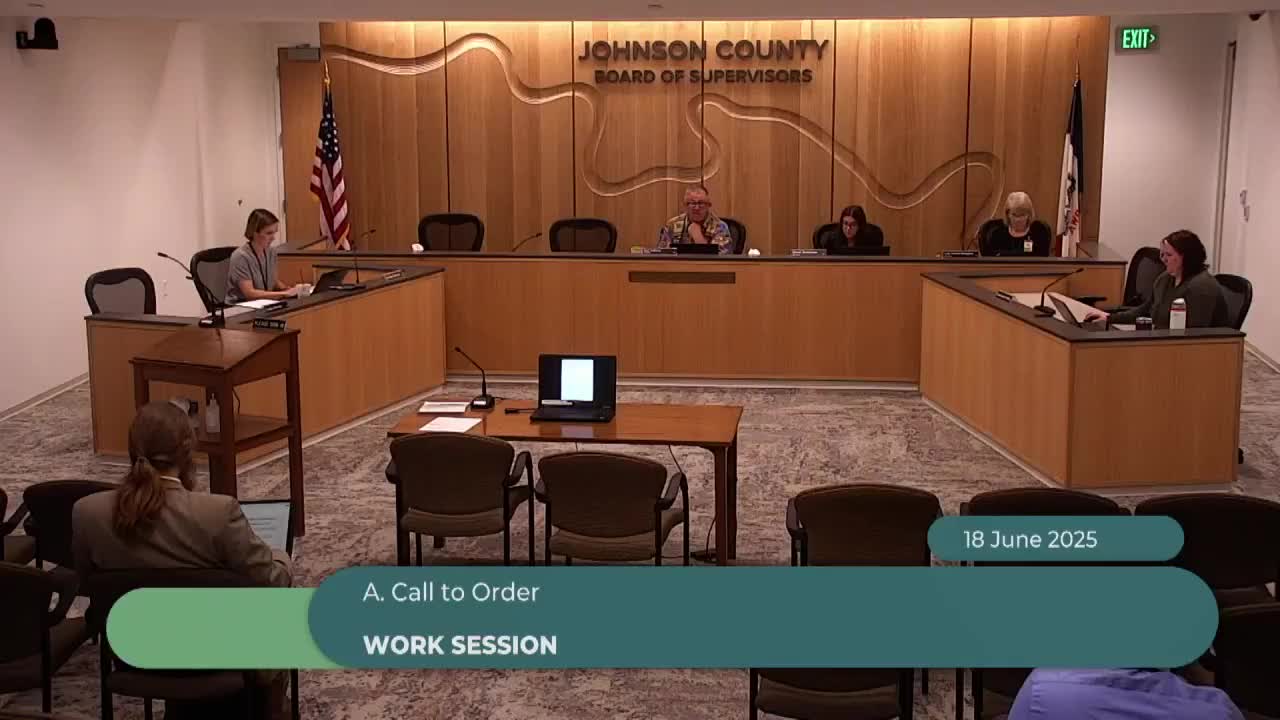
Assistant County Attorney Nathan Peters told the Johnson County Board of Supervisors at a June 18 work session that the county must target at least 75% of opioid settlement funds to Schedule A “core strategies,” and cautioned that many GuideLink activities may fall under the more limited Schedule B.
Assistant County Attorney Nathan Peters told the Johnson County Board of Supervisors at a June 18 work session that the county’s participation in the Iowa memorandum of understanding for opioid settlements requires strict accounting for how settlement money is spent.
“Schedule A of the Iowa MOU ... is called the core strategies. And in that MOU, we've agreed we will spend at least 75% of the opioid settlement funds that we receive on those core strategies,” Peters said. He added that Schedule B contains permissible but limited uses and that administrative spending is capped.
Why it matters: the county is receiving multi-year settlement payments from national opioid litigation; how officials classify local programs will determine whether funds can reimburse current county costs such as jail treatment, ambulance runs and detox services or instead must be spent on prevention and core abatement strategies.
Peters described Schedule A as the MOU section that lists primary prevention and abatement strategies and said the county should target at least 75% of funds there, with no more than 25% in Schedule B. He said the MOU also limits administrative spending to about 2.5% and obligates reportable accounting subject to financial and performance review.
Several supervisors urged using settlement dollars to cover ongoing county expenses tied to opioid treatment. “I see 4 places that Johnson County spends money right now on opioid related services that we are not that we could be funding at least some through this, and we're not,” Supervisor Remington said, citing the jail, ambulance service, the CFR detox contract and GuideLink as candidates for reimbursement. “I would like to see these these 4 groups start billing as early as possible.”
Board members and staff discussed practical reimbursement models. Peters recommended a recent-expenditure, reimbursement-based approach rather than blanket retrospective payments: reimburse for documented, recent services rather than “look back 3 or 4 or 5 years and reimburse you,” which he said would not withstand audit. He noted settlement payments to local governments are expected to continue through fiscal year 2039.
County staff and supervisors described specific accounting options discussed in the meeting: GuideLink’s quarterly report showed opioids accounted for roughly 10% of primary drug-of-choice cases in one quarter and self-pay/uninsured patients represented about 17% of GuideLink clients; GuideLink’s annual budget was discussed in the packet as about $1,500,000. Staff and the board discussed a reimbursement model where providers document opioid-related services each month and submit requests for payment tied to those documented expenditures.
The board agreed on next steps short of a formal vote: the county’s incoming grants manager will coordinate with the sheriff’s office, ambulance department, CFR (Community Family Resources) and GuideLink to build itemized billing and reimbursement procedures; staff set a tentative timeline to begin collecting FY26 cost data and to have an initial report and process steps in several weeks. The board did not adopt a formal ordinance or motion at the work session.
Quotes are drawn from staff and supervisors during the board’s June 18 work session.
Ending: County attorneys and grants staff said they will return with more detailed proposals, documentation templates and a recommended reimbursement process for formal action at a future meeting so any use of settlement funds conforms to the Iowa MOU and is audit-ready.