
Preliminary housing assessment flags aging population, slowed construction and a gap in “missing middle” units in Johnson County’s non-metro area
Get AI-powered insights, summaries, and transcripts
Subscribe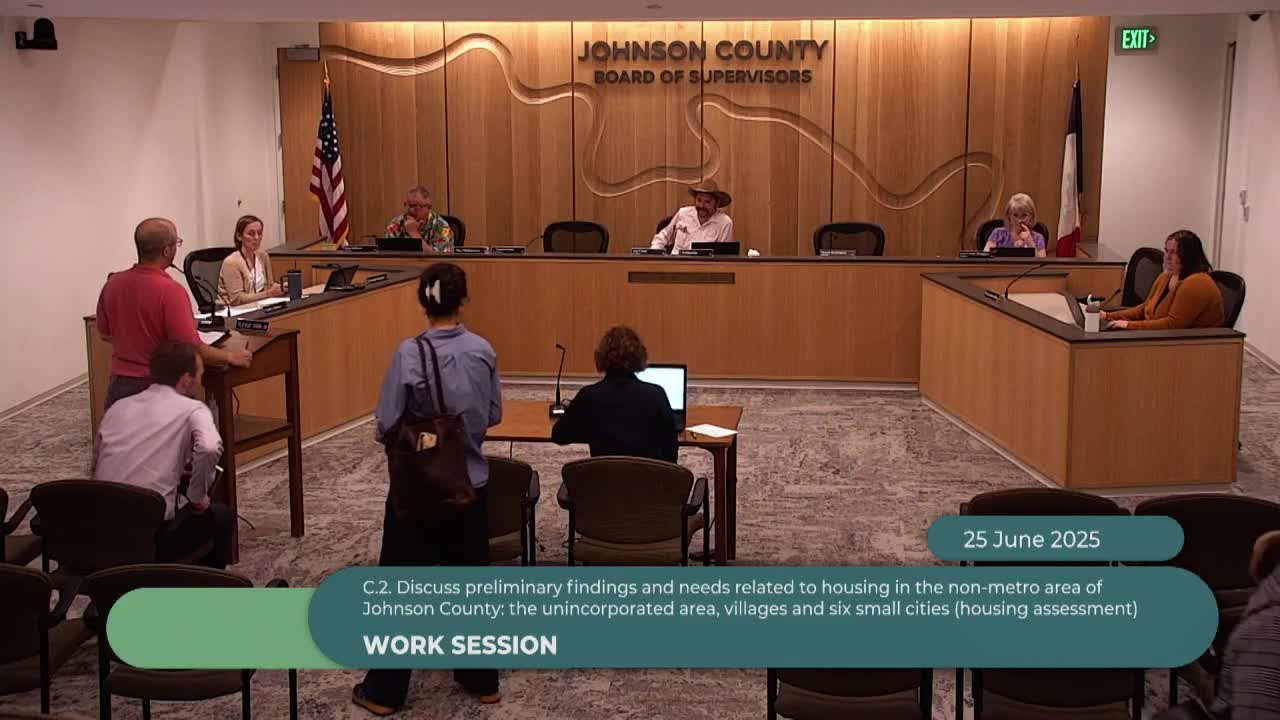
Summary
Consultants from Community Scale presented preliminary findings June 25 on a housing assessment of Johnson County’s non-metro area and asked the board whether and where to encourage growth.
Consultants from Community Scale presented preliminary findings June 25 on a housing assessment of Johnson County’s non-metro area — defined by the county as the six small cities and the unincorporated villages — and asked the board for direction about whether and where to encourage growth.
Why it matters: The consultants said the non-metro area’s population is projected to grow about 6% over the next decade, concentrated at the older end of the age spectrum. "The senior population is growing much faster than other age groups," Jeff Gautzer of Community Scale said, and that trend has implications for housing type, retrofits and services.
Key findings presented: Community Scale’s preliminary indicators included: limited housing diversity in the non-metro area (predominantly owner-occupied, detached single-family homes); fewer rental and multifamily options that lower-income households generally prefer; a shrinking middle-income cohort with growth concentrated at the top and bottom of the income scale; and geographic disparities in income and recent construction, with more building activity in the county’s north.
The consultants estimated that, to keep pace with potential growth, the non-metro area would need roughly 950 new housing units over the next 10 years, but they framed that as a market‑based potential that requires targeted production and choices by the county and towns.
Manufactured-home parks: Community Scale emphasized manufactured-home parks as a critical source of lower-cost housing and recommended recurring outreach to those communities; presenters also reported accounts of predatory tactics in some parks and said the county could explore stabilizing supports.
Board discussion: Supervisors asked whether services (water, sewer, transit, retail) must precede housing development and whether concentrating growth where infrastructure has capacity is prudent. Supervisors also raised concerns about preserving agricultural land and small‑town character, and whether the county should actively pursue growth or focus on targeted locations where infrastructure exists. Several supervisors said they preferred concentrating investments where public utilities and water/sewer capacity exist rather than encouraging dispersed unincorporated development.
Next steps: Community Scale will continue focus groups, host public meetings (scheduled for Swisher and Hills the following day) and return with refined recommendations and a final report later in the year. The consultants said the study will include a spatial dataset local officials can use to drill into neighborhood-level analysis.