
Polk County CJCC coordinator shares data-driven practices: jail dashboard, sobering center and youth diversion
Get AI-powered insights, summaries, and transcripts
Subscribe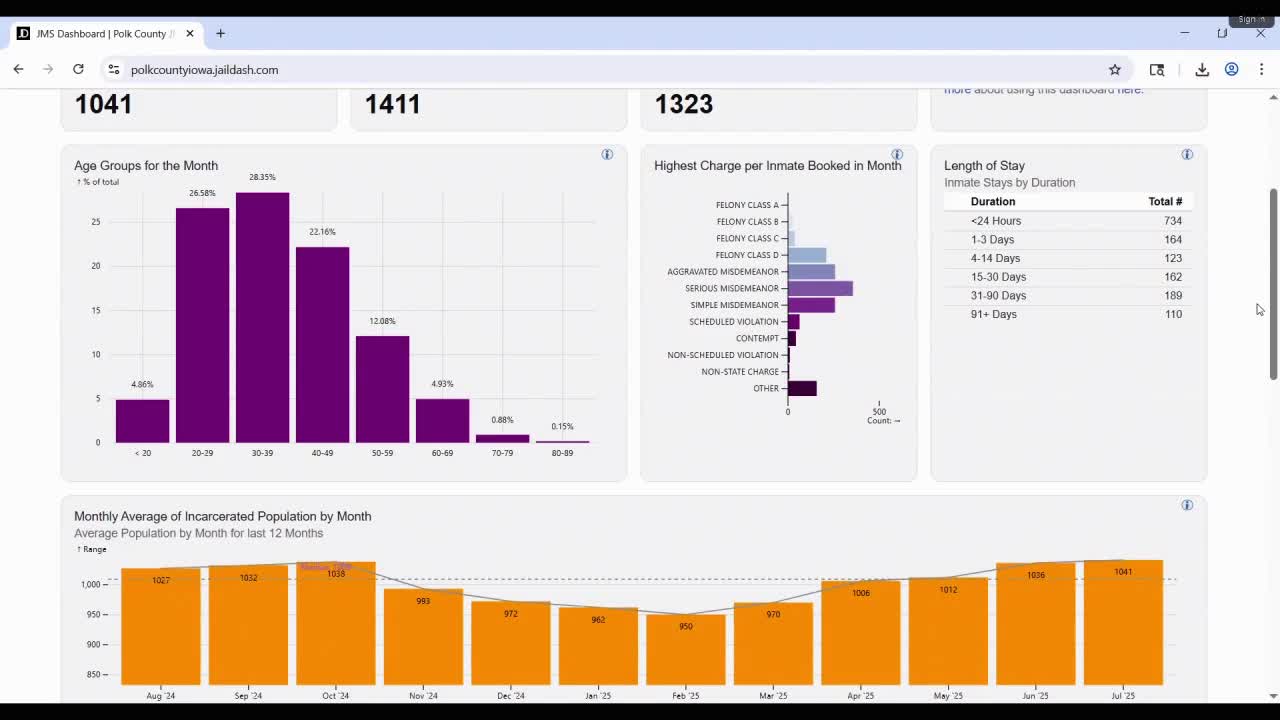
Summary
Polk County CJCC coordinator Jerry Evans described a data-first approach—jail dashboards, a sobering center, a driver-reinstatement program and youth diversion clinics—used to stabilize jail population and reduce unnecessary jail bed days; he cautioned that Polk County’s jail dashboard excludes federal detainees.
Jerry Evans, coordinator of the Polk County Criminal Justice Coordinating Council, presented Polk County’s CJCC experience to the Johnson County CJCC on Aug. 14, 2025, focusing on data tools and diversion programs used to limit unnecessary jail bed days.
Evans said Polk County formed its CJCC in 2007 alongside a new jail construction and later created a coordinator position; the council meets bi-monthly and includes cross-disciplinary stakeholders. He described three categories of work Polk County pursued:
1) Automated jail dashboard and data work: Evans said a Jack Byrne grant funded a jail dashboard that draws from a robust jail-management system. The dashboard auto-populates monthly with metrics such as average inmate population, total bookings/releases, age-group breakdowns, top booking charges, and length-of-stay buckets. He said the dashboard took months of work to join disparate fields but now runs on autopilot and helps the CJCC track trends before problems escalate.
2) Diversion and alternatives to incarceration: Polk County has mobile crisis units, a sobering center (opened the previous November and serving more than 700 people to date), a driver-reinstatement program to reduce bookings for driving while barred, and planned warrant-resolution clinics for low-level outstanding warrants to avoid arrests that result in jail stays.
3) Youth prevention and diversion: Evans described partnerships among schools, police, nonprofits and local government to divert youth from formal juvenile processing into restorative programs and community roundups with mentors and meals.
Evans also noted limitations: the Polk County dashboard excludes federal inmates because of data‑use agreements, and Polk County has a contract to house some federal clients that made gaining federal data for the CJCC difficult. He emphasized the importance of measuring outcomes and cross-agency collaboration to prevent a new facility from simply being “filled up later down the road.”
No formal action was taken; the Polk County model was presented as background and material the Johnson County CJCC might consider as it weighs design and operational choices for its own planning.