
University survey: about 70% support a new sheriff's office and jail in Johnson County; cost is top public concern
Get AI-powered insights, summaries, and transcripts
Subscribe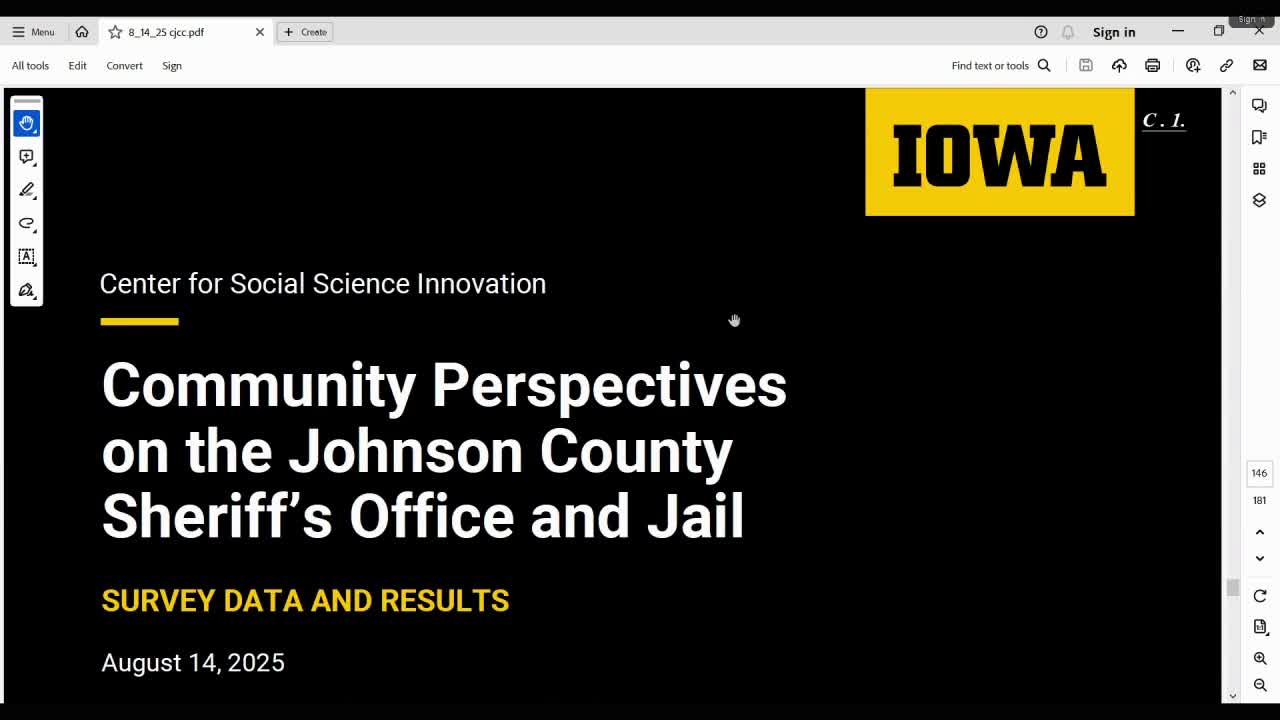
Summary
The University of Iowa’s Center for Social Science Innovation told the Johnson County CJCC on Aug. 14 that 751 mailed-survey responses showed majority support for building a new sheriff’s office and jail; the survey team will follow with focus groups to probe cost concerns and information gaps.
The University of Iowa’s Center for Social Science Innovation (CSSI) reported preliminary results of a countywide mail survey to the Johnson County CJCC on Aug. 14, 2025. CSSI Associate Director Ethan Rogers said the project mailed about 4,000 surveys and received 751 responses (about 19.5% of the mailed sample); the team used weighting to estimate likely views of the broader county population.
Main findings - Initial vote: "about 74% indicated that they would vote yes to support the construction" in the unweighted respondent sample, Rogers reported; weighting to reflect the voting and residential population lowered but did not eliminate a majority in favor (CSSI reported roughly 70% support in weighted results). - Information and awareness: CSSI found definite yes and definite no respondents were generally more informed on factual items about the jail and sheriff’s office; the least-aware groups were more likely to move after receiving factual information in the survey. - Revote results: after being shown six issues about the jail and sheriff’s office, about 18% of respondents shifted closer to a definite yes, and roughly 5% changed from no to yes. CSSI’s analysis flagged the paucity of information among those who moved from no to yes. - Top concerns and information sources: Cost was the most-cited information request and the top concern among stable no voters; stable yes voters prioritized capacity, staffing and space for services. Top information sources reported were local news outlets, social media and word-of-mouth.
Methodology and limitations - CSSI staff said they had planned for a target sample of roughly 400 completed surveys for a 95% confidence level and exceeded that target with 751 returns. CSSI calculated weights to correct for sample differences and reported similar patterns in weighted and unweighted analyses. - Committee member Morgan observed that 751 respondents represent less than 0.5% of Johnson County’s estimated 160,080 residents; CSSI acknowledged representativeness limits and emphasized the role of weighting and follow-up focus groups to deepen understanding.
Qualitative findings and next steps - In open-text comments, stable yes voters most often cited safety of staff and inmates as reasons to support replacement; stable no voters cited cost and concerns about over-criminalization; respondents who switched from no to yes emphasized inmate and staff safety while still expressing cost concerns. - CSSI said it will conduct three 90-minute focus groups (using survey respondents who volunteered; the team reported roughly 89 volunteers) and fold focus-group findings into a final report for the CJCC.
No committee action was taken on the study results; members discussed follow-up focus‑group planning and public outreach messaging. Ethan Rogers closed by inviting CJCC members to propose focus-group priorities to the subcommittee ahead of a planned Monday subcommittee meeting.