
Johnson County CJCC backs invitation to Iowa City to explore joint law-enforcement and jail campus
Get AI-powered insights, summaries, and transcripts
Subscribe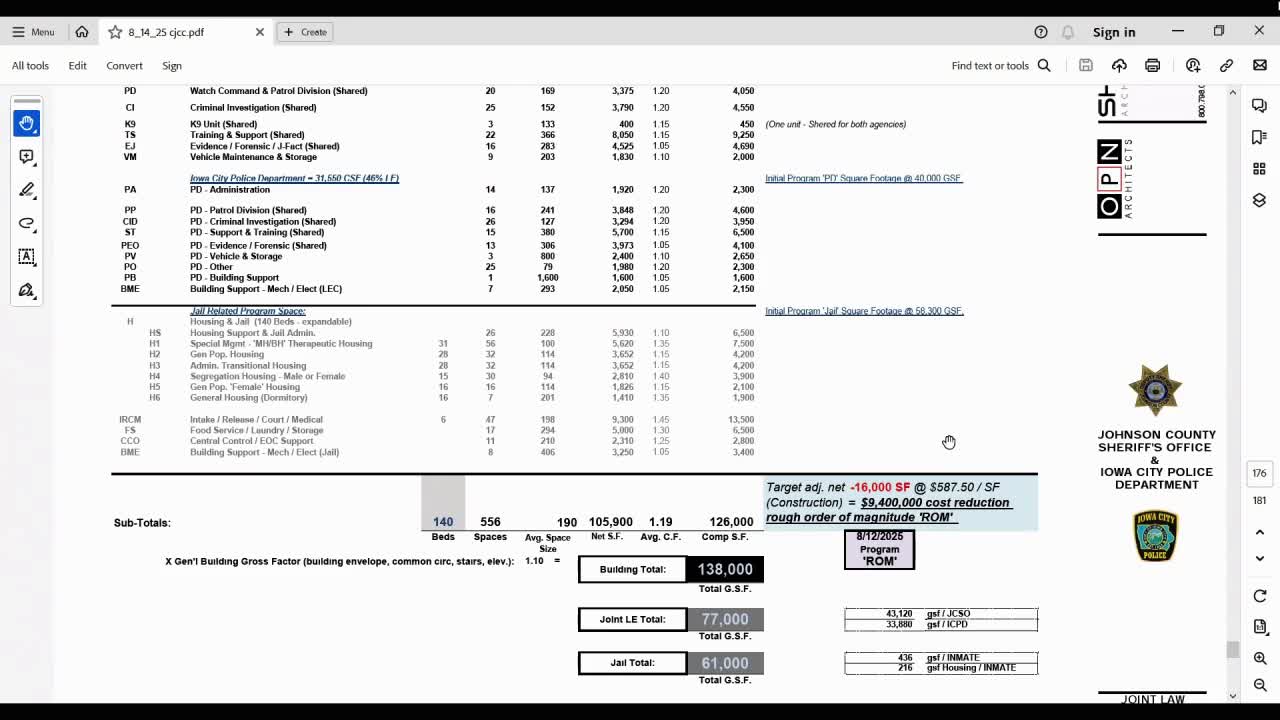
Summary
After a presentation by Shive-Hattery and OPN, the Criminal Justice Coordinating Committee voted consensus to ask the Board of Supervisors to invite Iowa City to explore a joint sheriff/police facility and jail on the Riverside/Highway 6 site; planners presented two design options, cost estimates, site constraints and a 30-year bed projection.
Johnson County’s Criminal Justice Coordinating Committee (CJCC) voted by committee consensus on Aug. 14, 2025, to recommend that the Board of Supervisors extend a formal invitation to the City of Iowa City to explore a joint-law-enforcement and jail campus.
The recommendation follows a presentation by Shive-Hattery and partner OPN that analyzed program needs, two schematic layouts for a joint campus at the Riverside/Highway 6 transportation site, site constraints and cost estimates. Michael Lewis of Shive-Hattery said, “I’m pleased today to announce that we did make a favorable determination in that analysis.”
Why it matters: planners estimated a combined law-enforcement and jail campus totaling roughly 138,000 square feet (the county’s previously modeled jail plus a reduced joint law-enforcement program); Shive-Hattery reported a programmatic saving of roughly 16,000 square feet versus separate facilities. The study found the Riverside/Highway 6 site suitable because the city already owns it (no land-acquisition cost), it has landscape buffers and fits the proposed footprint outside the most constrained height and soil zones.
Key details and estimates presented - Two schematic options: one that places 44 covered parking stalls under the jail (raising the building footprint and lowering surface parking) and a second option using all surface parking. The under-building option was lower-cost in the presentation. The study team carried updated site-development costs (including auger-cast piles for weaker soils) and inflation adjustments targeted to mid-2027 bidding. Shive-Hattery reported an estimated site development cost of about $9,500,000. - Cost figures presented in the meeting: consultants presented a total-project estimate near $106,000,000 and an estimated construction cost near $96,000,000, with soft costs, contingency and furnishings making up the remainder. The alternative (surface-parking) scenario was presented as roughly $1.5 million higher than the preferred scenario. - Bed and program planning: consultants used a 30-year projection that produced a recommended facility program including about 140 jail beds. County officials clarified the 140-bed figure reflects a long-range planning projection, not an immediate day‑one target. Presenters and county staff repeatedly distinguished between beds “on paper” and operational capacity: county staff said the county currently has 92 beds on paper, an operational capacity of about 65 in the existing building, and an average daily custody figure near 86 (many people are housed out of county at any given time). - Site constraints and risk: the riverside site lies adjacent to mapped floodplain areas and airport height-restriction surfaces; consultants said the proposed building footprint fits the less-restricted portion of the site but recommended buffers and raising the finished floor elevation. The team noted a prior city environmental study (fuel-station contamination remediated) and said landfill-depth variability informed foundation choices.
Discussion points and concerns - Timeline and public process: County Auditor Julie Persis emphasized the multi-year nature of the project if a referendum is pursued: design, public hearings, bidding and a typical construction schedule of about 21–24 months. Persis cautioned that, “If I put this on the ballot next year…probably a 2 to 2 and a half years to build and to get everything ready just to set foot in the building.” - Program versus bed count: several committee members questioned building to a larger bed count while county crime rates have trended down; county and consultant presenters said the 30-year projection and desire to avoid repeating past capacity shortfalls drove the planning-size recommendation. Sheriff Conkle and Iowa City Police representatives argued that additional campus space also accommodates evidence storage, in-house training, staff wellness and program space that current facilities lack; as the sheriff put it, some staff “work out of broom closets.” - Flood and soils mitigation: consultants recommended elevating the building footprint and using auger-cast piles in deeper-fill areas; FEMA’s updated maps (received in the week before the meeting) will be used in further planning.
Decision and next steps - The CJCC’s consensus recommendation to invite Iowa City does not bind either jurisdiction to the proposed scope or the site; it authorizes supervisors to consider a formal resolution extending a joint‑study invitation. Committee members noted that if the city agrees, further planning will shift some decision authority to any joint-entity governance structure; county staff reminded the committee that a joint law-enforcement authority, if created, would be a three-member board with appointments by the Board of Supervisors and City Council and a third member by consensus (or state appointment if there is no consensus). - Consultants proposed next steps: refine program adjacencies with chiefs/sheriff, fold in updated FEMA maps and environmental constraints, continue cost refinement and conduct public outreach. The committee asked the Board of Supervisors to consider a resolution to invite the City of Iowa City to formalize next steps.
No referendum or bond sale was approved at the meeting; the committee’s action was a consensus recommendation to the Board of Supervisors to begin joint discussions with the city.