
County staff present draft road-improvement guidance to govern developer cost-shares; supervisors seek limits and safeguards
Get AI-powered insights, summaries, and transcripts
Subscribe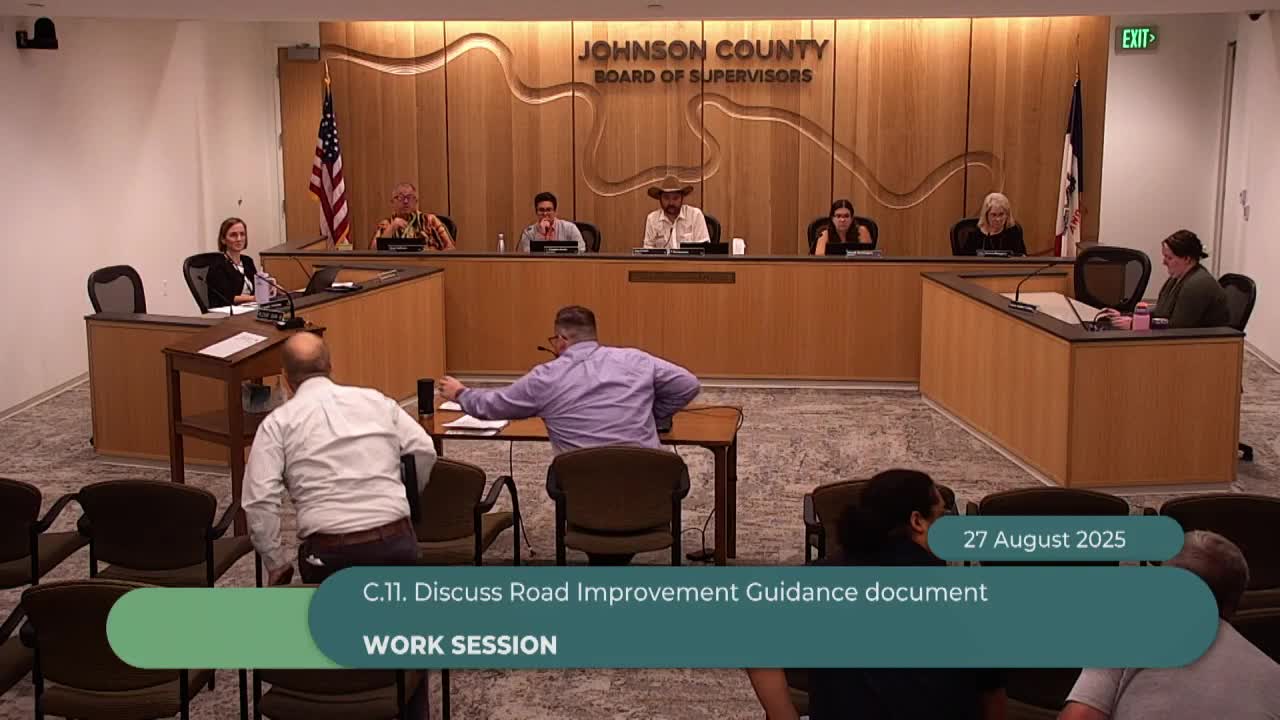
Summary
Planning, roads and county attorney staff presented a draft policy to guide developer-funded road upgrades and potential county cost shares. The Board favored making white/yellow growth-area segments eligible for cost share, discussed a 50% county ceiling in appropriate cases, and asked staff to return with a near-final draft.
Johnson County planning, roads and legal staff presented a draft “road improvement guidance” document on Aug. 27 that lays out how the county would negotiate voluntary and required road upgrades, who would fund them and when the county would accept cost-share agreements.
The draft grew from a multi‑department working group and is intended to provide developers and landowners a predictable framework for requests to upgrade county roads at private expense or by cost-share. Nate Mueller, assistant director, Planning and Development Services (PDS), said the document divides candidate road segments in the county’s growth areas into categories: segments staff considered straightforward candidates, segments with complicating factors and those where upgrades would be technically complex.
Supervisors discussed six policy choices the draft must resolve: which requests qualify for cost-share; maximum county contribution; who performs and pays for maintenance over time; how maintenance funds will be secured; which road segments are eligible; and whether upgrades should be required node-to-node (intersection-to-intersection) or can be partial segments.
Key points from the discussion: supervisors generally supported a policy that would allow cost-share on the “white” and “yellow” segments in the draft exhibit (segments staff labeled as straightforward or borderline) and said the board may, at its discretion, consider projects on “red” segments that staff flagged as complex. Several supervisors said the county should retain the ability to refuse projects that would produce adverse outcomes (for example, paving within a scenic corridor). One supervisor said, “50% should be our ceiling,” arguing developers generally profit from upgrades and the county’s share should be limited.
Staff reported the growth-area exhibit lists about 70 road segments; engineering staff identified roughly 30 as strong candidates for relatively straightforward upgrades and another six to seven that are possible but dead-end or close to existing pavement. Staff described prior agreements for things such as chip-seal projects and said maintaining many bespoke agreements has created administrative burden. County maintenance staff recommended requiring either an upfront escrow or a bank instrument (letter of credit) to secure funds for early maintenance impacts, with staff noting such instruments are commonly structured for one to two years.
Why it matters: a transparent policy would give developers a clearer expectation on design standards, cost shares and maintenance responsibilities and would reduce ad hoc negotiations that have produced inconsistent agreements in the past.
What’s next: staff will produce a 90%-complete draft that fills the policy placeholders (including maintenance terms, a cost-share ceiling and sample contract language) and return for additional board review before bringing a formal policy back to the Board.
Speakers quoted in this article are those directly on the record in the meeting.