
Supreme Court narrows NEPA review in Basin Railway case; Utah AG office outlines implications
Get AI-powered insights, summaries, and transcripts
Subscribe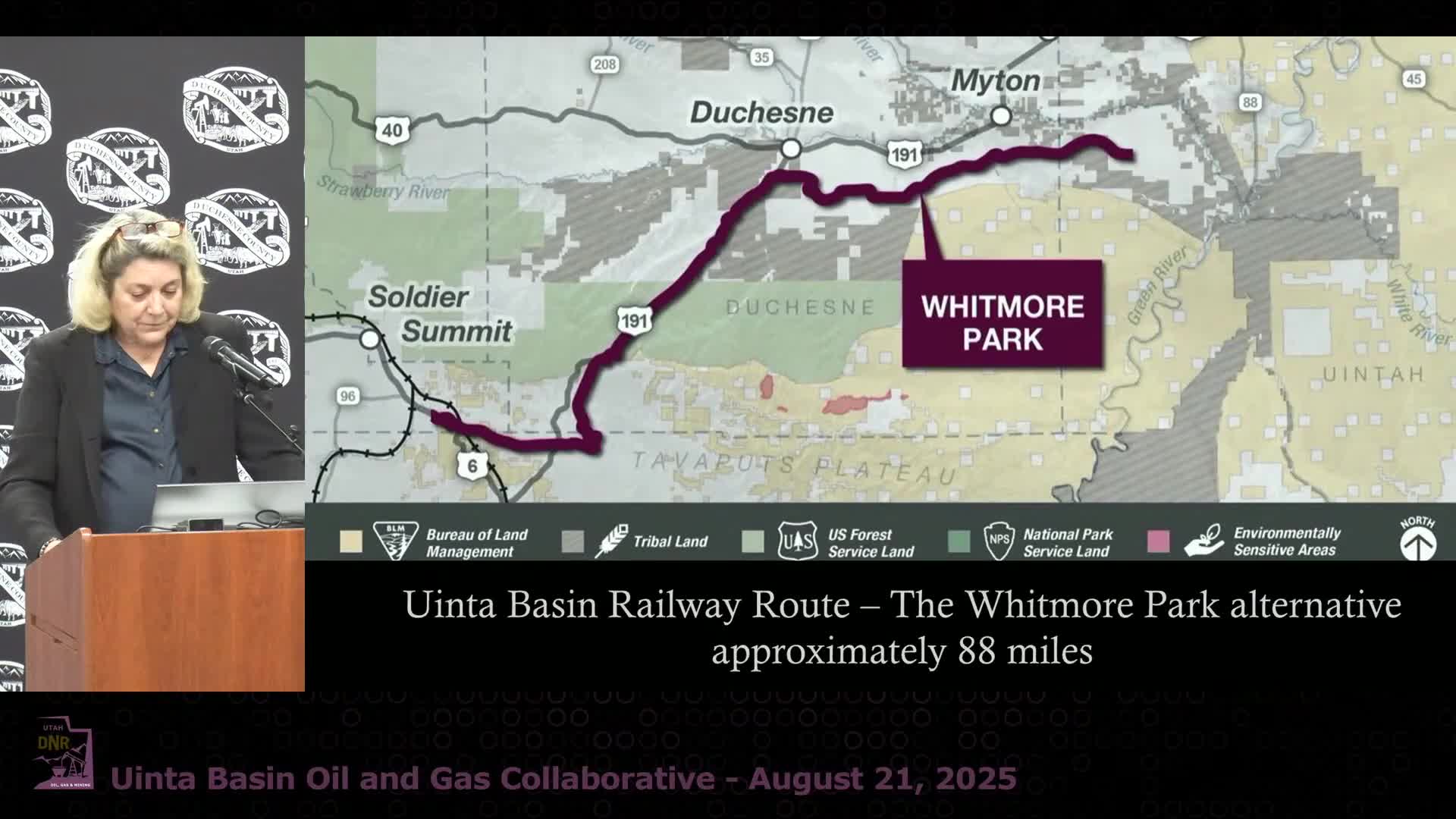
Summary
Assistant Attorney General Kathy Davis summarized the Supreme Courts unanimous decision reversing a D.C. Circuit demand to analyze "upstream or downstream" environmental effects in NEPA reviews and described ongoing procedural steps on remand affecting the Basin Railway project and tiered federal actions.
Kathy Davis, Assistant Attorney General and Section Director of the Public Lands Section of the Utah Attorney General's Office, briefed the Uinta Basin Collaborative on the Supreme Courts unanimous ruling in the Seven County Infrastructure Coalition v. Eagle County / Surface Transportation Board case and its consequences for NEPA review. "The holding of the Supreme Court was that the court didn't give the board the substantial deference that was required in NEPA cases," Davis said, summarizing the Courts reversal of a D.C. Circuit decision that had required broader upstream and downstream analysis.
Davis said the Supreme Court reaffirmed that NEPA is a procedural statute and agencies have discretion over the content and scope of environmental impact statements; she quoted the decision: "NEPA wasn't designed for judges to hamstring infrastructure and construction projects." She added that the concurring opinion agreed the circuit court had gone too far, though it expressed concern about the majority's breadth.
Practical effects: Davis said the circuit court had identified NEPA deficiencies in the project-level EIS, including alleged failures to analyze upstream or downstream effects, wildfire risk and local safety; the Supreme Court narrowed the scope of required NEPA analysis and remanded the case to the D.C. Circuit with instructions to conform to the Supreme Court opinion. She noted the remand leaves unresolved whether some other NEPA findings unrelated to upstream/downstream effects will still require vacatur of the Surface Transportation Board decision; the D.C. Circuit briefing on remand is complete and the court's disposition is pending.
Davis also described consequential administrative changes beyond the case: the CEQ NEPA regulations were found invalid in Marin Audubon Society v. FAA and the CEQ rescinded its own regulations on April 11, 2025; agencies are now drafting separate NEPA rules or guidance. For land-use projects tiered to the Surface Transportation Board decision, Davis said the Forest Service and the Bureau of Indian Affairs cannot issue final, tiered approvals until the D.C. Circuit resolves the remand.
Ending: Davis urged participants that the ruling increases predictability for project development by limiting claims requiring analysis of distant effects, but also said agencies and courts will continue to litigate the boundaries of NEPA scope and that the case remains active on remand.