
Arlington adopts FY2026 budget, sets property tax rate at $1.13 after extended debate
Get AI-powered insights, summaries, and transcripts
Subscribe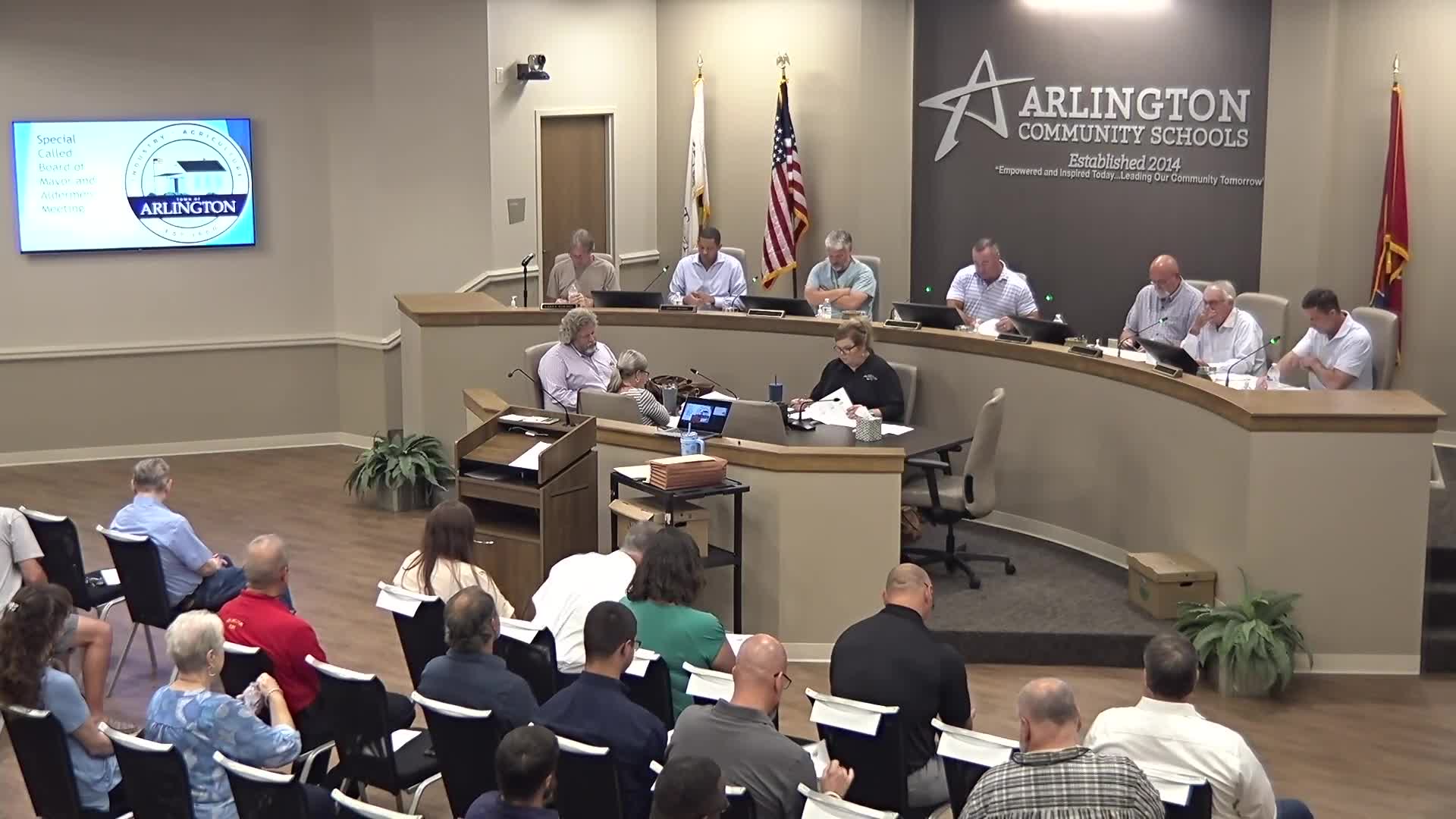
Summary
After public comment and a prolonged board discussion that included a failed first vote and a successful motion to reconsider, the Arlington Board of Mayor and Aldermen adopted the town—s FY2026 budget and set the property tax rate at $1.13. Debate focused on use of reserve funds, employee pay adjustments and capital projects.
The Board of Mayor and Aldermen of Arlington, Tenn., adopted the town—s fiscal 2026 budget and set the property tax rate at $1.13 per $100 of assessed value after a public hearing and multiple votes at a special meeting on June 23, 2025.
The action settled a months-long budget process that staff said was their recommendation after trimming an initial request. The vote followed a failed first attempt on the tax-rate ordinance, a successful motion to reconsider, and a final roll-call vote that passed 4-3.
Why it matters: The board—s decision raises the tax rate above the certified rate for some taxpayers and clears the town—s plan for operating and capital spending for the year that begins July 1, 2025. Board members and department heads repeatedly warned that material, equipment and labor costs have risen sharply, and several said the budget includes market-pay adjustments to retain staff.
At the public hearing, Ray Bryant, a long-time resident, said he opposed drawing heavily on the town—s reserve and urged the board to notify residents more broadly about hearings. "If that's what you're gonna do, I'm opposed to that," Bryant said, referring to tapping the rainy-day fund, and added he would rather see a slightly higher tax rate than large withdrawals from reserves. He also requested a mailed notice rather than relying solely on the town—s publication and website.
Town staff presented the second and final reading of budget amendments for the fiscal year ending June 30, 2025, noting the changes were largely line-item cleanups and one-time development-fee revenues. The board approved those amendments by voice vote.
On the broader FY2026 budget and compensation ordinance, staff said their initial proposal equated to a $1.16 tax-rate scenario; the board reduced that to a $1.13 proposal for final adoption. Vice Mayor Jeff McKee moved the budget ordinance; Alderman Barker seconded. After public hearings and discussion, the board adopted the annual budget and board compensation ordinance by roll call (4 yes, 3 no).
Several aldermen and department directors described the practical effects of constrained budgets. Public Works Director Terry Perkins told the board that increases in materials and equipment have driven many lines into the red this year: "Even at the proposed 13— additional tax, it would be difficult, if not impossible, to continue to provide the same level of service when our tax dollars have a much lower buying down." The town—s fire chief said operating costs and vehicle replacement costs have jumped substantially, noting that a fire engine that cost about $500,000 ten years ago now costs roughly $1.2 million.
Board members debated whether to use reserve funds for capital items or raise the tax rate to cover expenditures. Mayor Wissman sought to correct a public comment and the record, saying staff were not proposing to deplete reserves to balance the budget: "That's not the case. It's a very small portion that we are purchasing some items out of. It's not we're not going into our reserve funds to balance the budget," he said.
Several members favored keeping the increase smaller. Aldermen discussed a $1.10 alternative that had been presented at a prior work session; staff said moving from $1.13 to $1.10 would require identifying about $432,987 in cuts or transfers. A motion from the floor to amend the tax rate to $1.10 failed for lack of a sustained second. Earlier in the meeting an initial vote on the tax ordinance failed (5 no, 2 yes), leading the mayor to move to reconsider; that motion passed and the board ultimately approved the tax ordinance at $1.13 by roll call.
The adopted budget includes market adjustments for town employees. One board member cited roughly $187,000 in market-adjustment and compensation-related spending in the proposal; staff and directors said the adjustments were intended to reduce turnover and make hourly wages competitive with nearby employers.
Council members asked staff for additional information on some line items. One alderman requested a breakdown of sidewalk spending after observing recent multi-day repairs on Hayes Road. Staff reiterated that the town advertises public hearings as required and also posts notices on its website and by email; they said residents can request direct email notification.
What the board decided and next steps: The board approved the budget ordinance and the tax ordinance (ordinance 2025-O6 and ordinance 2025-O5, respectively) and closed the public hearings. Members said they expect to revisit fund-balance policy and budget-process timing ahead of next year—s cycle to involve the board earlier and reduce end-of-process debate.
Public comment at the meeting was limited, and no additional formal appeals or referenda were scheduled. The board adjourned after completing the fiscal votes.