
Supreme Court pause clouds future of EPA "Good Neighbor" emissions trading, Utah official says
Get AI-powered insights, summaries, and transcripts
Subscribe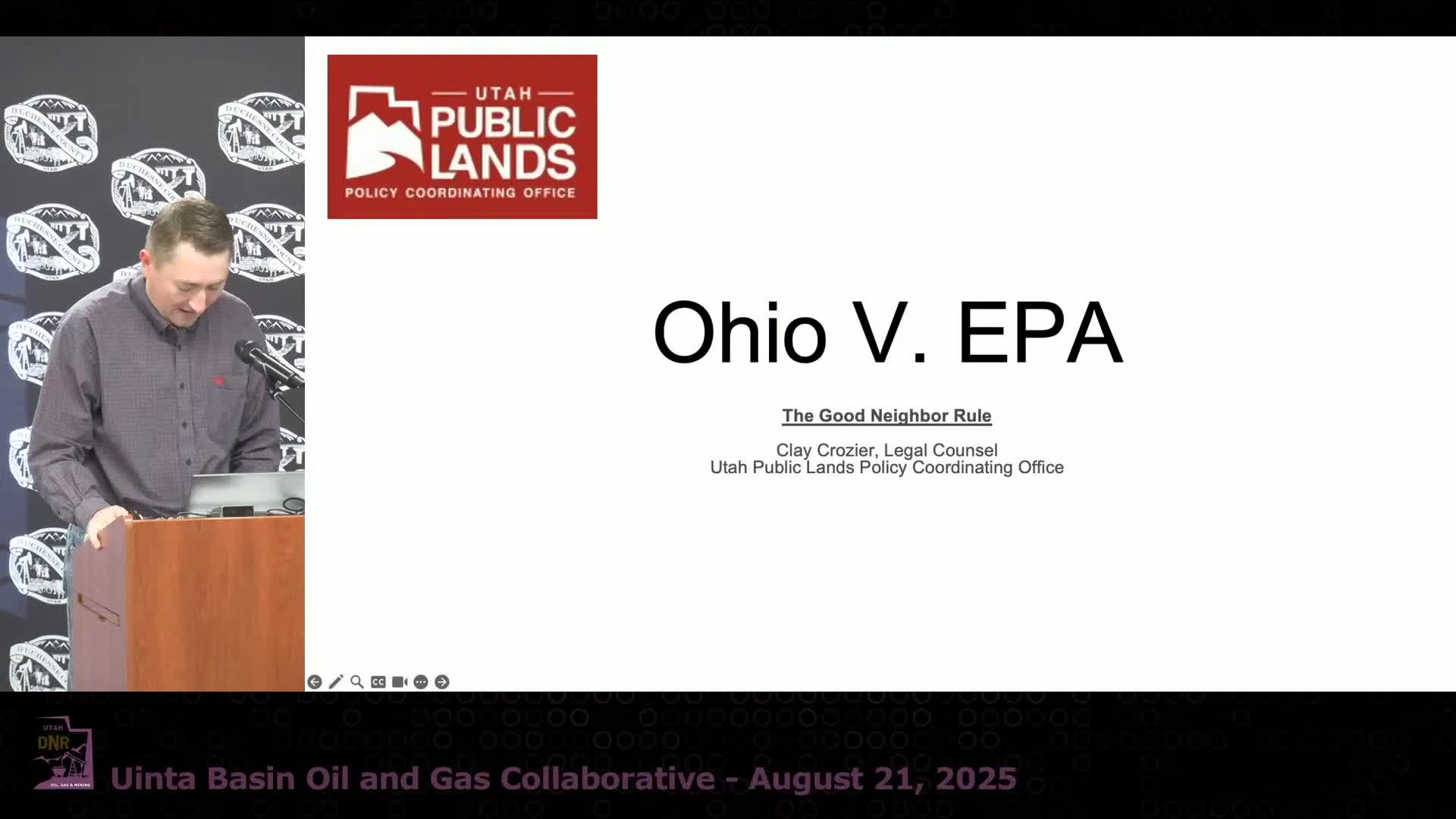
Summary
State official Clay Crozier summarized recent court rulings and federal action affecting the EPAGood Neighbor" obligations under the Clean Air Act and said the decision leaves uncertainty about interstate air-quality trading and state implementation plans.
Clay Crozier, legal counsel for the Utah Public Lands Policy Coordinating Office, told the Uinta Basin Collaborative that changes to the federal Good Neighbor rule and a recent Supreme Court decision have created uncertainty for interstate ozone control measures. "I think the most helpful case to understand it is Ohio versus the Environmental Protection Agency," Crozier said, describing how the Clean Air Act requires states to adopt State Implementation Plans to avoid causing or worsening air-quality violations in neighboring states.
Crozier summarized the sequence of events: the Obama administration tightened the ozone standard and required new SIPs; the Biden administration later imposed a federal implementation plan (FIP) giving states emissions budgets and an interstate trading system; many states sued; the Supreme Court ultimately granted emergency stays and concluded the EPA's methodology was "arbitrary and capricious" in part because the agency relied on assumptions about how many states would participate. "The court found that that was ultimately arbitrary and capricious," Crozier said.
Why it matters: the Good Neighbor provision is the statutory mechanism in the Clean Air Act meant to address upwind-downwind pollution. Crozier said the ruling reduced regulatory certainty for interstate trading and emissions budgeting. He described ongoing limbo within state air-quality agencies and noted that the Trump administration had announced plans in March 2025 to rescind the rule, leaving states and regulated entities uncertain about whether the EPA or the states will set budgets going forward.
Supporting details: Crozier explained the statutory framework that places primary responsibility with states to produce SIPs that meet EPA-set ambient standards, and he described how differing circuit-court rulings and stays created a patchwork of compliance across the country. He said the EPA's cost-effectiveness calculations used a 23-state participation assumption that did not hold when many states obtained stays, and that inconsistency undercut the agency's rationale in the Supreme Court review.
Local context: Crozier noted ozone is a recurring issue in the Uinta Basin, and that some expected future approaches might include either renewed federal action or states adopting stricter plans independently. He cautioned that the only alternative to the interstate framework would be either a nationwide federal plan or higher allowable ozone levels, and he said state regulators remain in a holding pattern pending further federal direction.
Ending: Crozier said he expects the issue to return to the regulatory and litigation arenas and urged local stakeholders to watch for forthcoming federal guidance and any state-level rulemaking tied to the Clean Air Act.