Get Full Government Meeting Transcripts, Videos, & Alerts Forever!
Get email alerts on the Education Accountability topic
No spam. Unsubscribe anytime.
Westminster schools placed in ‘priority improvement’; district outlines literacy, math strategies
Summary
At a Sept. 9 Board of Education meeting, district officials said Westminster Public Schools earned 43.3 points on Colorado’s accountability framework — 0.7 points below the cutoff for an "improvement" rating — and described targeted literacy and math actions in the Unified Improvement Plan.
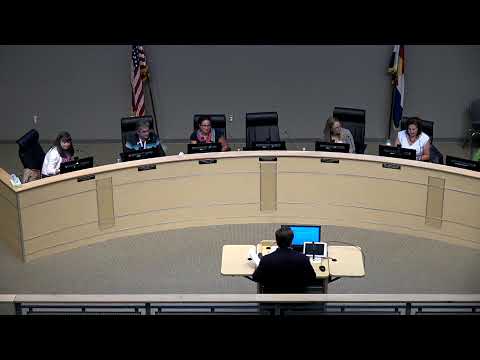
WESTMINSTER, Colo. — Westminster Public Schools officials told the Board of Education on Sept. 9 that the district earned 43.3 points under the Colorado Department of Education accountability framework for 2025, placing it in the state’s "priority improvement" category and 0.7 points short of the 44-point cutoff for an "improvement" rating. Doctor Brian Casina, the district’s director of education, presented the results and described next steps.
Casina said the difference is small but consequential: "44 is the cut score between priority improvement and improvement. That means we are just 0.7 points away from that improvement label. We're right on the bubble." He warned the board the rating starts the state's accountability clock; continued placement in priority improvement or turnaround for five consecutive years can trigger state review and possible intervention.
Why it matters: the accountability label determines whether schools and the district qualify for state review processes and, at later stages, potential intervention and additional funding streams. Casina said the district is treating 2025 as year one under the current clock and outlined the district’s Unified Improvement Plan (UIP) actions intended to regain the improvement rating in 2026.
Most important details: Casina reported the district-level 43.3 total and walked the board through the components that determine the score: academic achievement (CMAS and SAT/PSAT proficiency), academic growth (median growth percentile, MGP), and postsecondary readiness. Elementary ELA growth averaged an MGP of 44 (below the state average), middle school growth was 51 (slightly above average), and high school growth was 40. Casina said elementary scaled ELA scores averaged 719.5 (in the "does not meet" band) and 20% of elementary students met or exceeded expectations, unchanged from the prior year. District-wide, 23% of students met or exceeded standards.
On math, Casina described slower progress: elementary math MGP was 41 and 17% of elementary students met or exceeded standards (a two-point drop). Middle school math MGP was 43 and 13% met expectations. High school math MGP was 36. "Progress is happening but too slowly to shift proficiency rates," Casina said, summarizing the need for system changes.
Planned actions: Casina said the district’s UIP centers two "major improvement strategies": a literacy strategy emphasizing the transition from phonics and decoding to comprehension, vocabulary and extended writing; and a math strategy focused on stronger Tier 1 instruction, daily fluency practice and clearer scaffolds for students below grade level. He said the district will monitor interim measures using Renaissance STAR (computer-adaptive) assessments: beginning-of-year data were complete and the district expects a midyear STAR benchmark window in December with compiled results in January to evaluate early impact.
Other evidence and context presented: Casina described PSAT/SAT patterns with stronger 11th-grade SAT performance (he attributed some of that gain to a Princeton Review SAT-prep program at Westminster High School and Hidden Lake Secondary School). He also reported the district currently enrolls 693 newcomer students — about 10% of total enrollment — and supplied school-level newcomer figures (for example, Fairview ~98 newcomers / 387 total = ~25.3%).
Discussion and next steps: Board members asked for cut scores and cohort explanations; Casina provided state cut ranges used for school and district ratings and explained growth comparisons (state growth starts at grade 4 because CMAS tests begin in grade 3). Casina said the board will move after tonight’s business meeting into a study session to review the UIP in detail. He committed to a January update after the midyear STAR benchmark window: "We won't have results fully ready and compiled until January. So we'll know in January, where we're finding the success with our improvement strategies."
Distinguishing discussion vs action: the presentation was informational; the board did not take a formal vote related to the accountability rating tonight. A study session to review the UIP was announced for later in the meeting.
Ending note: District leaders framed the results as a prompt to accelerate existing work rather than a signal to change course; officials emphasized targeted teacher supports, structured literacy instruction and system-level math interventions as the pathway to regain the improvement rating next year.